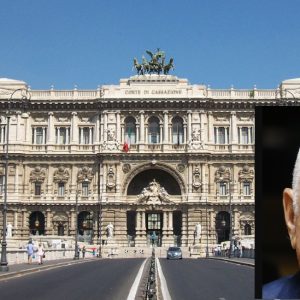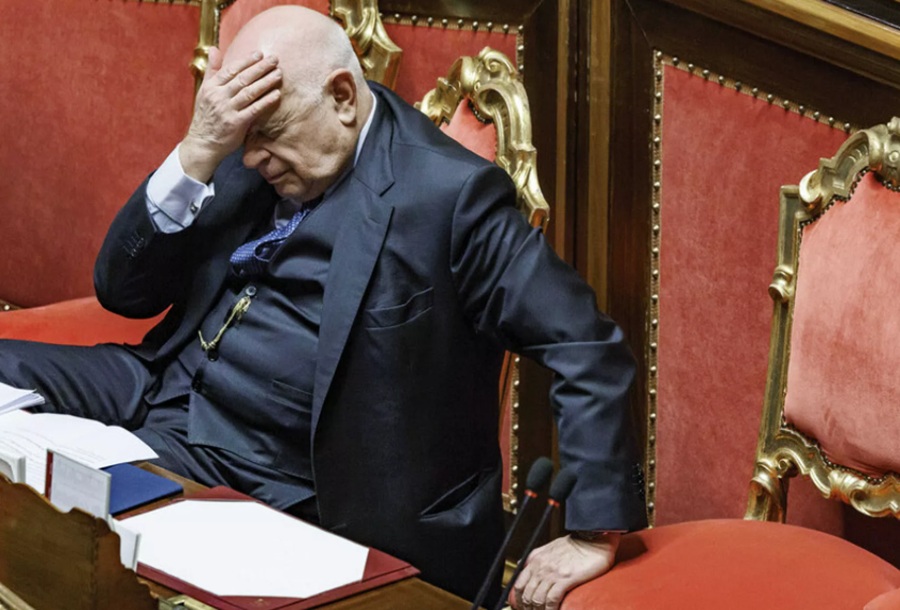
The European Parliament has passed the bloc’s first-ever criminal anti-corruption framework by an overwhelming majority and Italy, which fought hard to keep abuse of office off the statute book, now faces a legal obligation to bring it back. The timing, just days after Meloni’s government suffered its referendum defeat on judicial reform, could hardly be more pointed.
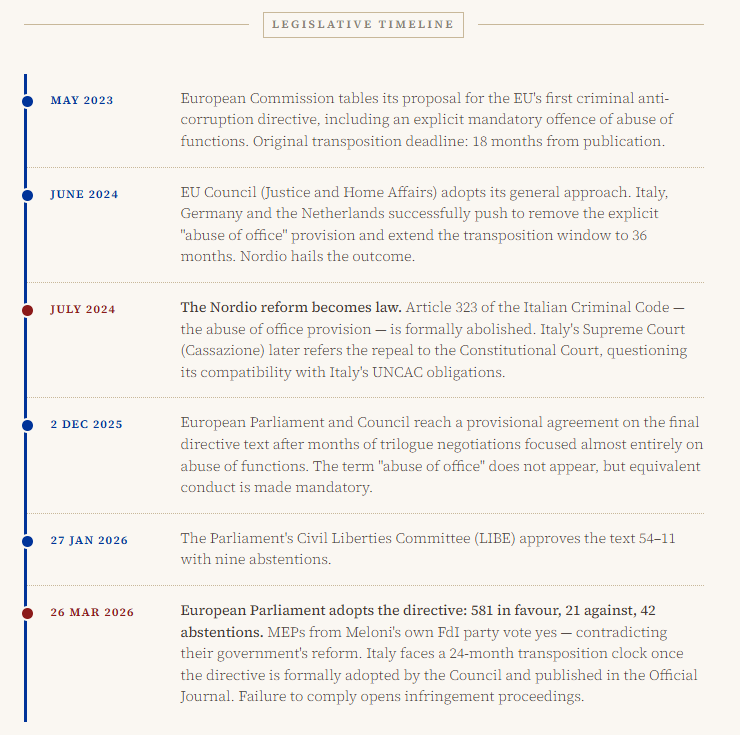
The European Parliament on Thursday voted overwhelmingly to adopt the EU’s first-ever criminal anti-corruption directive — a watershed moment for European law, and a direct challenge to one of the signature reforms of Italy’s Justice Minister Carlo Nordio. The directive, approved by 581 votes to 21 with 42 abstentions, establishes binding minimum definitions for nine corruption-related offences that all 27 member states must enshrine in national law. Among them is a provision on the unlawful exercise of public functions, what Italian law has historically called abuse of office, the same crime Nordio’s government abolished only 20 months ago.
The rapporteur for the directive in the European Parliament, Dutch Liberal MEP Raquel Garcia Hermida-Van der Walle, was unambiguous about the implications. “The mandate is very clear on abuse of office,” she said. “Italy will be required to reintroduce at least two of the most serious offences related to abuse of office.” European Parliament President Roberta Metsola added pointedly: “Looking at the votes within the EU Council, Italy voted in favour of these rules, so I hope the directive will be implemented.”
Unfortunately, in recent years Italian legislation to combat and prevent corruption has taken several steps backward. We hope the swift transposition of the directive will provide an opportunity to immediately fill some of the gaps in protection that have opened up.
Giuseppe Busia, President of Italy’s Anti-Corruption Authority (ANAC)
Legal reforms not going well for Nordio
The irony of Italy’s position is acute. Nordio himself hailed the outcome of the December 2025 trilogue negotiations between Parliament and Council as a victory, declaring himself “pleased with the compromise” after the Council removed the explicit term “abuse of office” from the directive’s text. But the final wording, which obliges member states to criminalise the intentional “culpable breach by a public official of his or her official duties causing substantial damage or harming the rights or legitimate interests of a natural or legal person,” covers precisely the conduct the Italian law had sought to remove from criminal liability.
In a further embarrassment for the government, MEPs from Meloni’s own party, Fratelli d’Italia, voted in favour of the directive. This directly contradicted the position of their Justice Minister and the Italian government’s months-long effort to water down the text. For the opposition, the optics were irresistible.
Lengthy road for EU’s directive
The road to Thursday’s vote was long and fractious. When the European Commission first tabled the directive in May 2023, the proposed text was considerably stronger — explicitly mandating criminalisation of abuse of office and setting an 18-month transposition deadline. Italy, alongside Germany and the Netherlands, fought successfully at the Council of the EU in June 2024 to strip the term from the directive entirely and extend the compliance window to 36 months. Nordio at the time declared victory.
The trilogues between Parliament and Council then ran for months, with the abuse of office provision dominating nearly every session. The final compromise of December 2025 removed the precise label but retained the substance, leaving legal experts broadly agreed that the conduct it mandates overlaps significantly with what Article 323 of the Italian Criminal Code, abolished by the Nordio reform, had covered.
EU decision couldn’t come at a worse time for Meloni and Nordio
The timing of the vote, three days after Meloni’s government lost its referendum on judicial reform and amid the fallout from three ministerial and senior official resignations in 48 hours, deepened the political sting. For the opposition, it amounted to a triple indictment of the government’s entire justice agenda in a single week.
The majority, however, disputed the interpretation. FdI MEPs argued that the directive, read carefully — specifically Article 7, which instructs member states to “adopt the necessary measures” — left significant room for national discretion. Italy, they maintained, already had more than 17 separate criminal provisions covering the illegal behaviour of public officials, rendering a direct reinstatement of the old Article 323 unnecessary.
Legal scholars are sceptical. Professor Gian Luigi Gatta, a criminal law specialist, noted that there are identifiable gaps in Italy’s current framework, notably conduct damaging to individual citizens, and abuse through favouritism in public competitions, that clearly fall within the directive’s mandatory scope and are not covered by any existing Italian offence.
At the Constitutional Court level, the picture had already been complicated before Thursday’s vote. Italy’s Supreme Court (Corte di Cassazione) had in 2025 referred the very legality of the Nordio repeal to the Constitutional Court, arguing it created a “free zone” in anti-corruption law incompatible with Italy’s obligations under the UN Convention Against Corruption (UNCAC). The Constitutional Court’s president, Giovanni Amoroso, noted on Thursday that with the EU directive now changing the regulatory framework, his court may be called upon once again to review the matter.
What now for ‘abuse of power’ legislation in Italy?
The next formal step is adoption by the Council of the EU followed by publication in the Official Journal of the European Union. The directive enters into force 20 days after publication, at which point Italy’s 24-month transposition clock begins. If Italy fails to comply fully by that deadline, the European Commission can open infringement proceedings, potentially culminating in financial penalties.
What Italy’s government will actually do remains unclear. Nordio himself said nothing publicly on Thursday. The Justice Ministry did not issue a statement. The political mathematics are uncomfortable: any move to reinstate something resembling abuse of office would represent a humiliating reversal of the minister’s flagship reform. And this was a reform specifically cited as a rationale for abolishing a crime that, according to its critics, protected the very officials it was supposed to govern. The reform’s defenders, meanwhile, will argue that Italian law can be made to comply without explicitly reviving Article 323, a legal fight that, given the Constitutional Court’s pending review, is likely to run for years.
What is already beyond dispute is the broader context. Within the space of a single week, Meloni’s government has suffered its first major popular defeat at the ballot box, lost three senior figures to resignation and scandal, and now faces a binding European legal obligation to reverse one of its most prominent legislative achievements. The question of whether this amounts to a crisis for the government, or merely an uncomfortable week, will depend largely on whether the prime minister can stabilise the political ground before Italy’s parliamentary term expires next year.