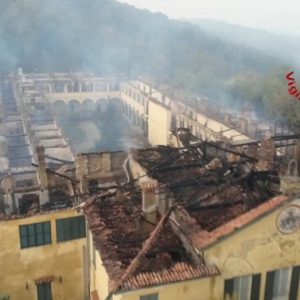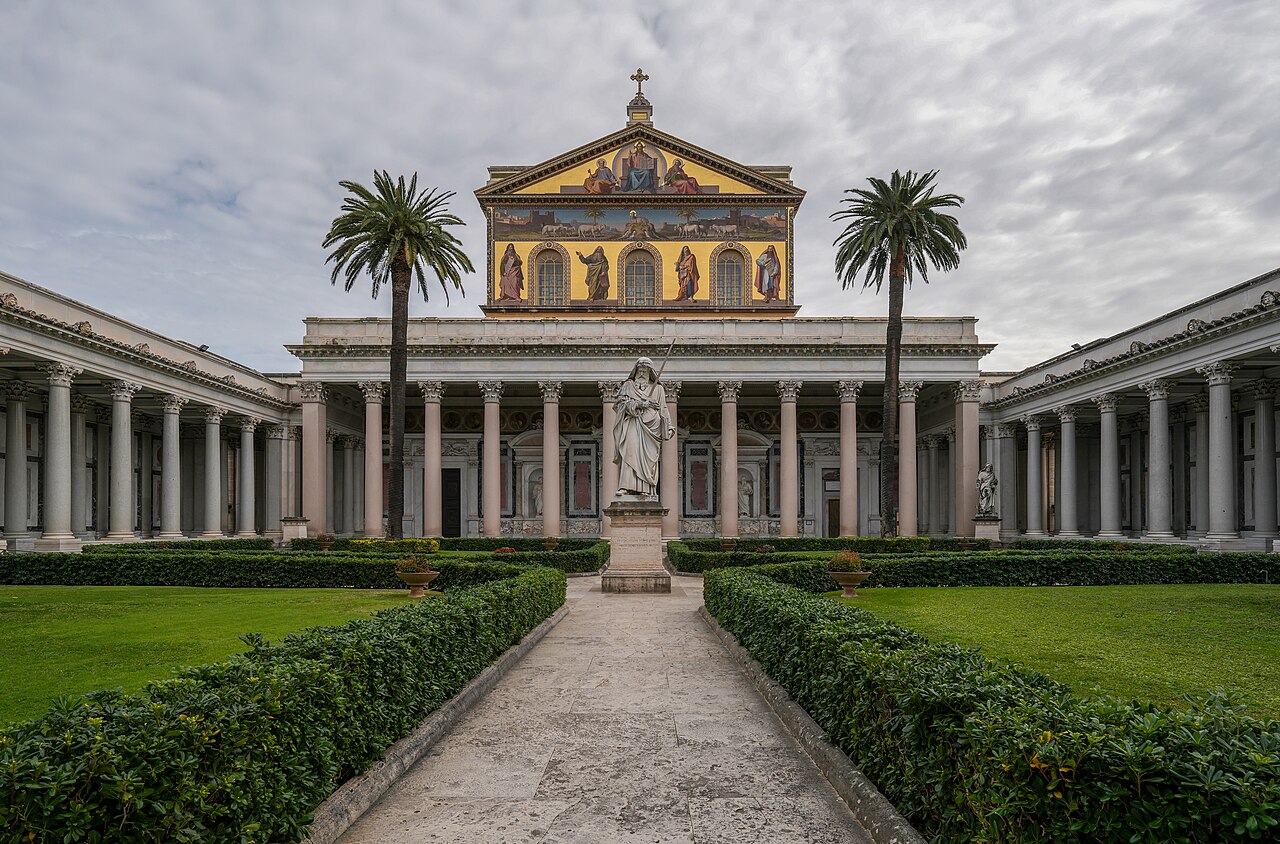
One of Rome’s four great papal basilicas – Saint Paul Outside the Walls – and the last of the city’s ancient churches to have survived largely untouched since antiquity, was gutted by fire on 14/15th July 1823. It was a disaster that shook the Christian world as deeply as the Notre-Dame fire would nearly two centuries later.
On the night of 14th into 15th July 1823, fire tore through the Basilica of St Paul Outside the Walls, one of Rome’s four papal basilicas and, until that night, the only church in the city to have preserved much of its original character across almost 1,500 years.
A repair job that went catastrophically wrong
The basilica’s roof had been leaking for some time, and Pope Pius VII, who had studied and taught at the monastery attached to the church earlier in his life and held it in particular affection, had authorised repairs. On the evening of 14th July, two workmen stayed late into the night extending copper gutters along the eaves. After they left, embers that had not been fully extinguished in the pan they had used to heat and shape the copper escaped and caught, setting the roof alight. The fire burned through the night, unnoticed until herdsmen grazing cattle nearby spotted the flames the following morning and raised the alarm with the resident Benedictine monks.

By the time it had burned itself out, the fire had destroyed the roof entirely, bringing down the whole of the basilica’s north side. The nave, its columns and its ancient timber roof were lost. Remarkably, the triumphal arch with its fifth-century mosaics, the altar area built over the apostle’s tomb, and the transept and apse with their thirteenth-century mosaics were all spared.
The timing was cruel. Pius VII had fractured his hip just days before the fire and was already gravely ill, drifting in and out of consciousness. Those around him could not bring themselves to tell him his beloved basilica had been destroyed, and he died without ever learning what had happened, on 20th August 1823. His successor, Annibale della Genga, took the name Leo XII and inherited the task of deciding how to respond.
Rebuilding “exactly as it had been”
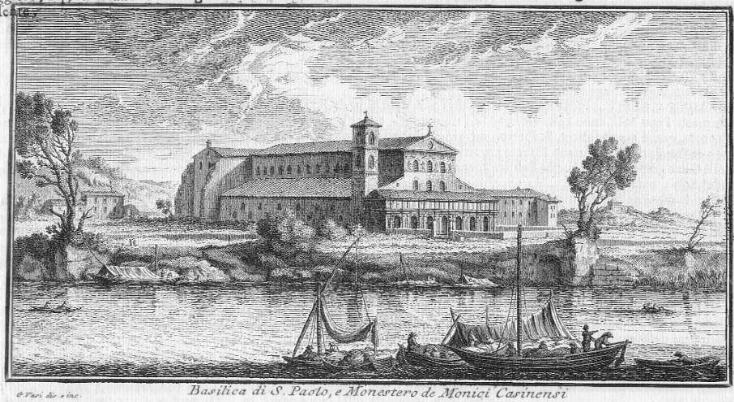
In 1825, Leo XII issued the encyclical Ad plurimas, appealing for donations from Catholics around the world to fund the reconstruction. He initially ordered that the basilica be rebuilt exactly as it had appeared when new in the fourth century, while also insisting that treasures from later centuries — the medieval mosaics and tabernacle among them — be preserved and restored. In practice, those guidelines proved difficult to sustain and were gradually abandoned as work progressed.
The rebuilding effort stretched across three decades. The new basilica, incorporating what could be salvaged of the ancient structure alongside 80 newly carved columns and a wood and stucco ceiling, was finally consecrated by Pope Pius IX on 10th December 1854 — more than 30 years after the fire that had nearly destroyed it.
A church built to survive

Later in the century, concerns over the risk of a second such disaster led to one of the more remarkable footnotes in the basilica’s history. Engineer Luigi Poletti and the astronomer Angelo Secchi devised what is thought to have been the first automatic fire detection and alarm system anywhere in the world, complete with water reservoirs, lightning protection and a telegraph link to a control room elsewhere in Rome.