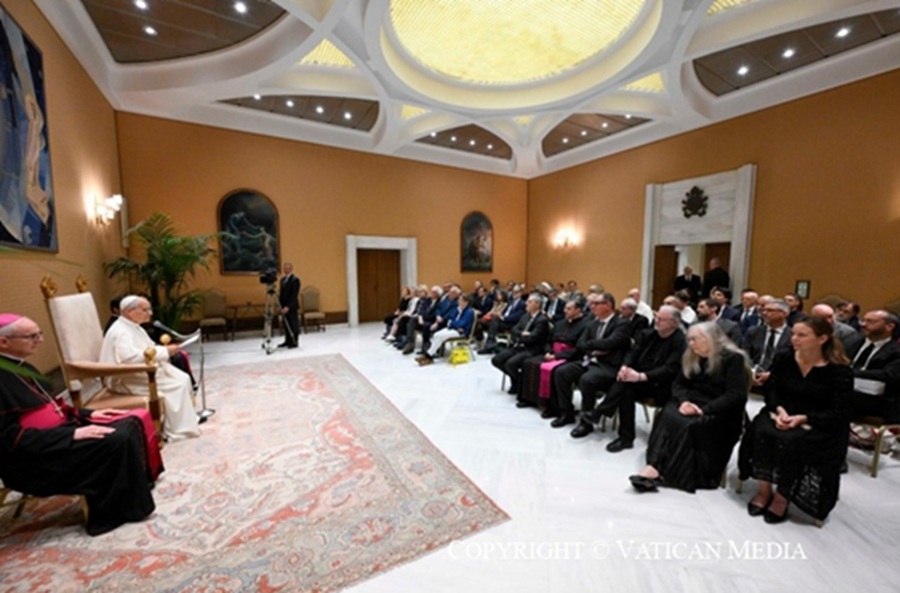
International delegation of writers including Strout, Robinson and Foer meets Pope Leo XIV as Vatican publisher LEV marks its centenary.
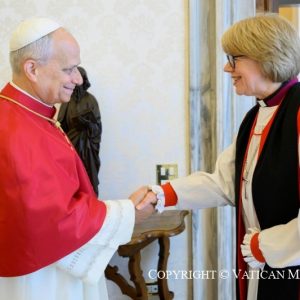
Pope Leo XIV left an international gathering of writers feeling that literature sits at the heart of human life, according to Italo-Somali novelist Igiaba Scego. She was among a delegation received by the pontiff on Wednesday to mark the 100th anniversary of Vatican publisher Libreria Editrice Vaticana (LEV).
“Pope Leo made us feel that writers are very useful,” Scego told ANSA after the audience. “Fiction is often marginalised, and yet, precisely because we live in a world of artificial intelligence and unbridled capitalism, understanding that storytelling is the centre of life was important.”
The audience with the Pope
The delegation, received in the sacristy of St Peter’s Basilica, included American novelists Elizabeth Strout and Marilynne Robinson, Jonathan Safran Foer, Irish-American writer Colum McCann, Italian authors Susanna Tamaro, Enrico Brizzi, Maria Grazia Calandrone, Daniele Mencarelli and Eraldo Affinati, French journalist and writer Sorj Chalandon, and Romanian novelist Mircea Cărtărescu.
The Pope spoke about writing as the foundation of humanity at a moment when artificial intelligence and war are reshaping the world. “Starting from the human being, at a time when we are experiencing terrible wars and passively accepting AI, without truly managing it, is crucial,” he said, according to Scego’s account. “If we don’t do something, everything will be very dehumanising.”
“Reading a literary text places us in the position of ‘seeing through the eyes of others’ [C.S. Lewis] thus gaining a breadth of perspective that broadens our humanity. We develop an imaginative empathy that enables us to identify with how others see, experience and respond to reality. Without such empathy, there can be no solidarity, sharing, compassion, or mercy”. (Letter on the Role of Literature in Formation, 34).
Scego: a compass for peace
Scego, born in Rome to a Somali family and the author of works including Cassandra in Mogadishu — shortlisted for the 2023 Strega Prize — and her recent debut graphic novel Figli della foresta, described Leo as one of the few world leaders still speaking consistently about peace.
“His voice is heard; it is a compass,” she said. “I think all men of religion — Christianity, Islam, Judaism, Hinduism — should speak of peace because they are the only ones left to do so in a world that is rearming.”
A Muslim woman who described herself as deeply Roman, Scego drew a connection between the current pontificate and that of Pope Francis, whom she has also met. “On some topics, yes, certainly on the theme of peace. What strikes me about this Pontiff is that he has a vision of the world of peace and understanding of our mutual humanity.”
She also addressed migration, warning that European asylum policy was heading in a dangerous direction. “The right to asylum is absolutely in danger. We are creating something truly problematic and in violation of human rights at a time when Africa and Asia are becoming the continents of the future.”
Strout: writing breaks isolation
Pulitzer Prize-winning author Elizabeth Strout, whose novel Olive Kitteridge brought her international recognition, said the meeting had moved her deeply.
“He spoke about how important it is for readers to be able to read the works of writers because in this way they can identify with so many different lives, they can understand what it means to be so many different people, and I completely agree,” she told ANSA. “It’s one of the reasons I write, to help break this isolation that naturally exists between all of us.”
Strout announced that her novel The Things We Never Say — already a bestseller in Ireland — will be published in Italy in October.