
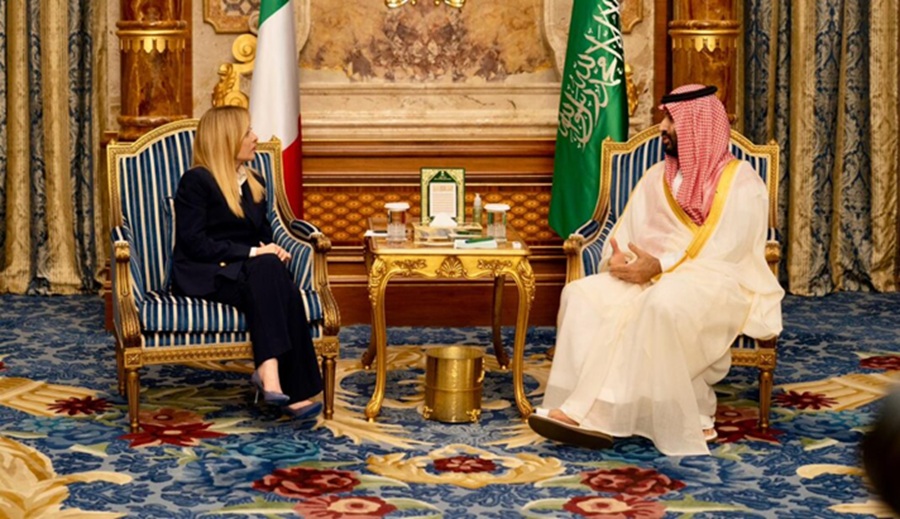
Italian Prime Minister Giorgia Meloni has embarked on an unannounced diplomatic tour of the Gulf, meeting Saudi Crown Prince Mohammed bin Salman in Jeddah on Friday before heading to Qatar and the United Arab Emirates. This makes her the first leader from an EU or NATO country to visit the region since the current Middle East conflict began on 28 February.
The Gulf tour, which had not been publicised in advance, is being framed by Italian government sources around two clear priorities. Firstly, reaffirming Italy’s solidarity with Gulf states targeted by Iranian strikes, and secondly, protecting Italy’s energy security as war continues to destabilise one of the world’s most critical oil and gas corridors.
Jeddah: Solidarity, Strategy and a Strategic Partnership
In Jeddah, Meloni’s discussions with Crown Prince Mohammed bin Salman went beyond diplomatic pleasantries. According to a readout from Palazzo Chigi, the two leaders discussed the defensive military assistance Italy is providing to Saudi Arabia, exchanged views on the conflict’s prospects, and reviewed ongoing efforts to reach a diplomatic solution. They also discussed how to build a broader regional framework capable of breaking the current cycle of conflict.
Energy featured prominently. The two leaders agreed on the urgency of securing energy supplies and mitigating the crisis’s impact on businesses and ordinary citizens, and both underlined the importance of restoring freedom of navigation in the Strait of Hormuz as swiftly as possible. Before the war, the strait handled around a quarter of global seaborne oil trade and 20% of liquefied natural gas supplies.
The meeting also gave Meloni the opportunity to build on the strategic partnership she and the Crown Prince launched during her previous visit to Al-Ula in January 2025. Both leaders agreed on the importance of deepening cooperation across a wide range of areas — economy, investment, strategic infrastructure, security and defence — describing it as all the more pressing given the current regional and international situation.
Energy at the heart of the mission
Italy is heavily dependent on energy imports, and the Gulf remains, in the words of one government source, “a crucial source of oil and gas” for the country. With energy prices rising amid the conflict, Rome has already cut fuel excise taxes until 1 May in an attempt to cushion the blow for Italian consumers.
The Jeddah visit follows a trip Meloni made to Algeria on 25 March, where she sought to increase imports of natural gas from a country that already supplies around 30% of Italy’s needs. Taken together, the two visits paint a picture of a government in active pursuit of energy diversification and supply security, with an urgency sharpened by the ongoing crisis.
Saudi Arabia, Qatar and the UAE have all been struck by Iranian drone and missile attacks, Tehran’s response to the US-Israeli bombardment of Iran. Rome wants to make its position clear. “The aim is to strengthen relations with these countries and repeat Italy’s support against Iranian attacks,” a government source said.
Between Washington and Brussels
Meloni’s Gulf tour also reflects her particular position within the Western alliance: closer to US President Donald Trump than most European leaders, yet unwilling to follow Washington all the way.
Trump has urged nations affected by Iran’s selective blockade of the Strait of Hormuz to intervene militarily to reopen the waterway. The strait is a chokepoint that, before the war, handled around a quarter of global seaborne oil trade and 20% of liquefied natural gas supplies. Meloni declined. “Italy does not want to join in the war effort,” she has said repeatedly, in line with European allies.
But she has been equally candid about not wanting Europe to drift too far from the US. “I continue to believe that, geopolitically, Europe does not have much to gain from a widening gap with the United States,” she said on Friday. “But our job is above all to defend our national interests, and when we disagree we have to say so. And this time we do not agree.”


