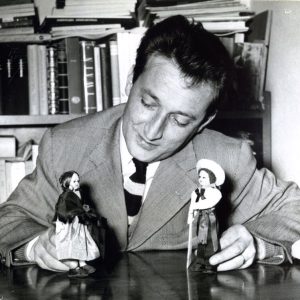
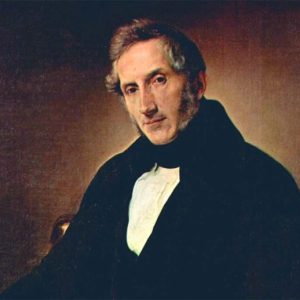
On 24 March 1926, one of the most provocative and prolific figures in twentieth-century theatre was born in the small Lombardy town of Leggiuno Sangiano, in the Province of Varese. Dario Fo would go on to write more than 80 plays, win the Nobel Prize in Literature, be banned from Italian television, and spend a lifetime putting the powerful in the dock.
Fo grew up on the shores of Lago Maggiore, the son of a socialist railway stationmaster and a resourceful, imaginative mother whose own writing would later be published. His early storytelling instincts were sharpened by his maternal grandfather, who toured the countryside selling produce from a horse-drawn wagon and held crowds with sharp, satirical tales of local life. From his grandfather, sitting beside him on the big wagon, young Dario began to learn the rudiments of narrative rhythm.
He moved to Milan to study at the Brera Fine Arts Academy, and later enrolled in architecture at the Polytechnic, though he never completed his degree. During the war he was conscripted into the army of the Salò Republic before managing to desert, spending the final months of the conflict hidden in an attic. He returned to Milan after the war, abandoning architecture for painting and small theatre work, presenting improvised monologues that would become the foundation of his distinctive style.
Marriage, censorship, and national fame
In the 1950s Fo worked in radio and on stage, performing his own material. It was during this period that he met actress Franca Rame, whom he later married. Rame’s family had deep roots in travelling theatre, and she took on the administrative and organisational responsibilities of the Fo-Rame Company. The pair would collaborate for the next five decades, becoming one of the most celebrated partnerships in European theatre.
The couple moved to Rome, where Fo worked as a screenwriter, before returning to Milan, where they formed a theatre company and began performing at the Teatro Odeon. His play Archangels Don’t Play Pinball brought them their first wave of national and international recognition.
In the early 1960s, Fo and Rame were given the chance to write and direct a popular television variety show, Canzonissima, for the national broadcaster RAI. The collaboration ended abruptly after an episode drew attention to the dangerous working conditions on Italian building sites. The episode was censored, Fo and Rame walked out in protest, and the pair were subsequently banned from Italian television, for 14 years.
Mistero Buffo and political theatre
In 1969 Fo premiered what would become his most celebrated solo work, Mistero Buffo. Performed not only in theatres but also in parks, prisons and schools, the work drew on medieval farce and the buffoonery of commedia dell’arte. Fo presented it as though he were a medieval travelling player, using a blend of improvisation and invented language known as grammelot to retell stories of the life of Christ and the struggles of ordinary people against authority. The Vatican condemned it as blasphemous effectively confirming its impact.
Accidental Death of an Anarchist
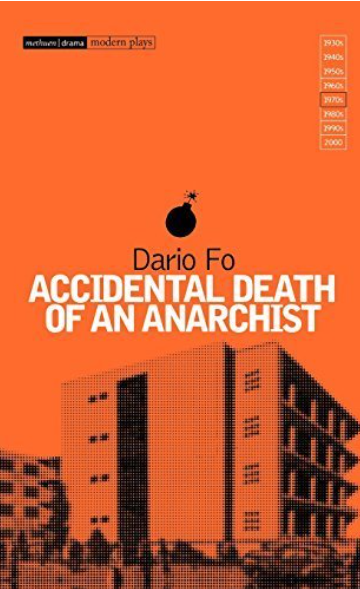
In 1970, Fo completed what would become his most internationally recognised work. Accidental Death of an Anarchist was described by Fo himself as “a grotesque farce about a tragic farce,” and was written in the wake of the 1969 bombing at the Banca Nazionale dell’Agricoltura in Milan. The play was based on the real case of an anarchist railway worker who died after falling from a fourth-floor window of a Milan police station during interrogation; his death ruled accidental by authorities. The play ran across Italy and then the world, and its Broadway production in 1984, starring Patti LuPone, attracted considerable attention in the United States.
The same year the play was written, Franca Rame was subjected to a savage physical attack by fascists, widely believed to have been acting on the orders of senior Carabinieri officials. She returned to the stage two months later with new anti-fascist monologues.
Can’t Pay, Won’t Pay and later work
In 1974 Fo premiered Can’t Pay, Won’t Pay, a sharp comedy about a consumer revolt against rising prices that resonated far beyond Italy. Through the 1980s and 1990s, his work broadened in scope, tackling themes including AIDS, the Gulf War, and the vast corruption scandal known as Tangentopoli that brought down much of Italy’s political class in the early 1990s. Later targets included Silvio Berlusconi and Forza Italia, and eventually the banks and big business. He also ran, unsuccessfully, for Mayor of Milan.
The Nobel Prize — and controversy
The Nobel Prize in Literature 1997 was awarded to Dario Fo as someone “who emulates the jesters of the Middle Ages in scourging authority and upholding the dignity of the downtrodden.” He was the first Italian dramatist to win the prize since Luigi Pirandello was honoured in 1934. The award was not without controversy: the Vatican’s newspaper described it as beyond imagination, and critics in Italy questioned whether his work had sufficient literary merit. Fo, characteristically, was delighted by the uproar and turned his Nobel lecture into a performance.
His plays have been translated into 30 languages and performed across the world, from Argentina to South Africa, India to Sweden.
Later life and death
Fo continued to write, paint and campaign on political and social issues into his final years. His wife and lifelong collaborator Franca Rame died in Milan in 2013 at the age of 83. Dario Fo himself died in Milan on 13 October 2016, aged 90. He had contracted a respiratory illness, and passed away on the same day that that year’s Nobel Prize in Literature was announced.
Author of more than 80 plays and an enormously influential theatre-maker, Dario Fo was an innovative craftsman of storytelling with strong anti-institutional convictions that led him into frequent clashes with Italy’s rich and powerful. A century after his birth, his work remains in production around the world, proof that the jester’s art, when practised with enough intelligence and courage, endures.