On 17 March 1861, the Kingdom of Italy was proclaimed, formally bringing into existence the unification of a single Italian state for the first time since antiquity. The event marked the culmination of a long and complex process known as the Risorgimento, through which a fragmented peninsula of states, foreign territories and competing political visions was consolidated into a single nation.
This transformation was neither inevitable nor straightforward. It was shaped by revolutionaries, monarchs, diplomats and soldiers, whose ambitions often conflicted as much as they converged. The resulting state reflected compromise as much as ideology, and its creation left unresolved tensions that would continue to shape Italian history for decades.
Italy before unification: a fragmented peninsula
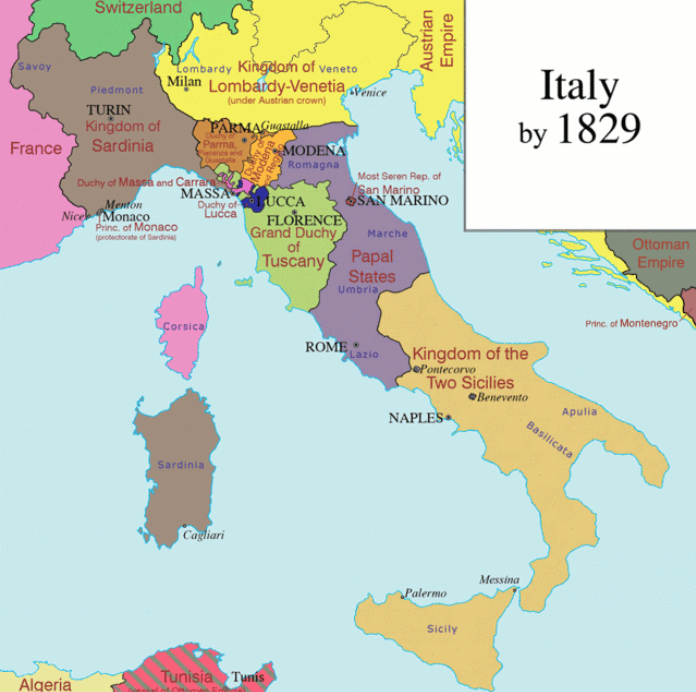
At the beginning of the 19th century, “Italy” existed only as a cultural and geographical concept rather than a political reality.
The peninsula was divided among several states:
- the Kingdom of Sardinia-Piedmont in the northwest
- the Austrian-controlled regions of Lombardy and Venetia
- the Papal States in central Italy
- the Kingdom of the Two Sicilies in the south
- smaller duchies such as Parma, Modena and Tuscany
Austrian influence was particularly strong. Following the Congress of Vienna (1815), the Austrian Empire emerged as the dominant power in northern Italy, directly ruling some territories and exerting influence over others.
The Austrian statesman Klemens von Metternich famously dismissed Italy as “a geographical expression”, a phrase that captured the absence of political unity. Yet beneath this fragmentation lay shared linguistic, cultural and historical traditions. Intellectuals and writers increasingly began to articulate the idea of Italy as a nation.
The intellectual and revolutionary roots of the Risorgimento
The Risorgimento was not only a political process but also an intellectual movement. Writers such as Alessandro Manzoni, whose novel I Promessi Sposi helped standardise the Italian language, contributed to the development of a shared national culture.
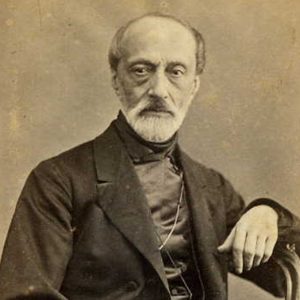
More explicitly political was the work of Giuseppe Mazzini, who became one of the most influential ideologues of Italian nationalism. In his writings and letters, Mazzini argued that nations were natural and moral communities, destined to achieve unity and independence. His organisation Young Italy, founded in 1831, sought to mobilise popular support for a unified republican state.
Mazzini’s vision was rooted in revolutionary activism. He believed that unification should be achieved through popular uprising rather than diplomatic negotiation.
However, repeated insurrections inspired by Mazzini — in places such as Genoa and Savoy — were suppressed, revealing the limits of revolutionary nationalism in the face of entrenched political and military power.
The revolutions of 1848 and their failure
The revolutions of 1848, which spread across Europe, marked the first major attempt to unify Italy. In various Italian states, uprisings demanded constitutional government, national independence and political reform.
The Kingdom of Sardinia-Piedmont, under King Charles Albert of Sardinia, declared war on Austria in what became the First War of Independence. Initially, nationalist forces achieved some success. However, Austrian military strength ultimately prevailed. By 1849, the revolutions had been suppressed, and Austrian control was reasserted.
The historian Denis Mack Smith later argued that the failure of 1848 demonstrated the weakness of revolutionary movements without strong political and military backing.
The collapse of these uprisings marked a turning point. It became increasingly clear that unification would require not only popular support but also diplomatic strategy and military organisation.
Cavour and the politics of Italian unification
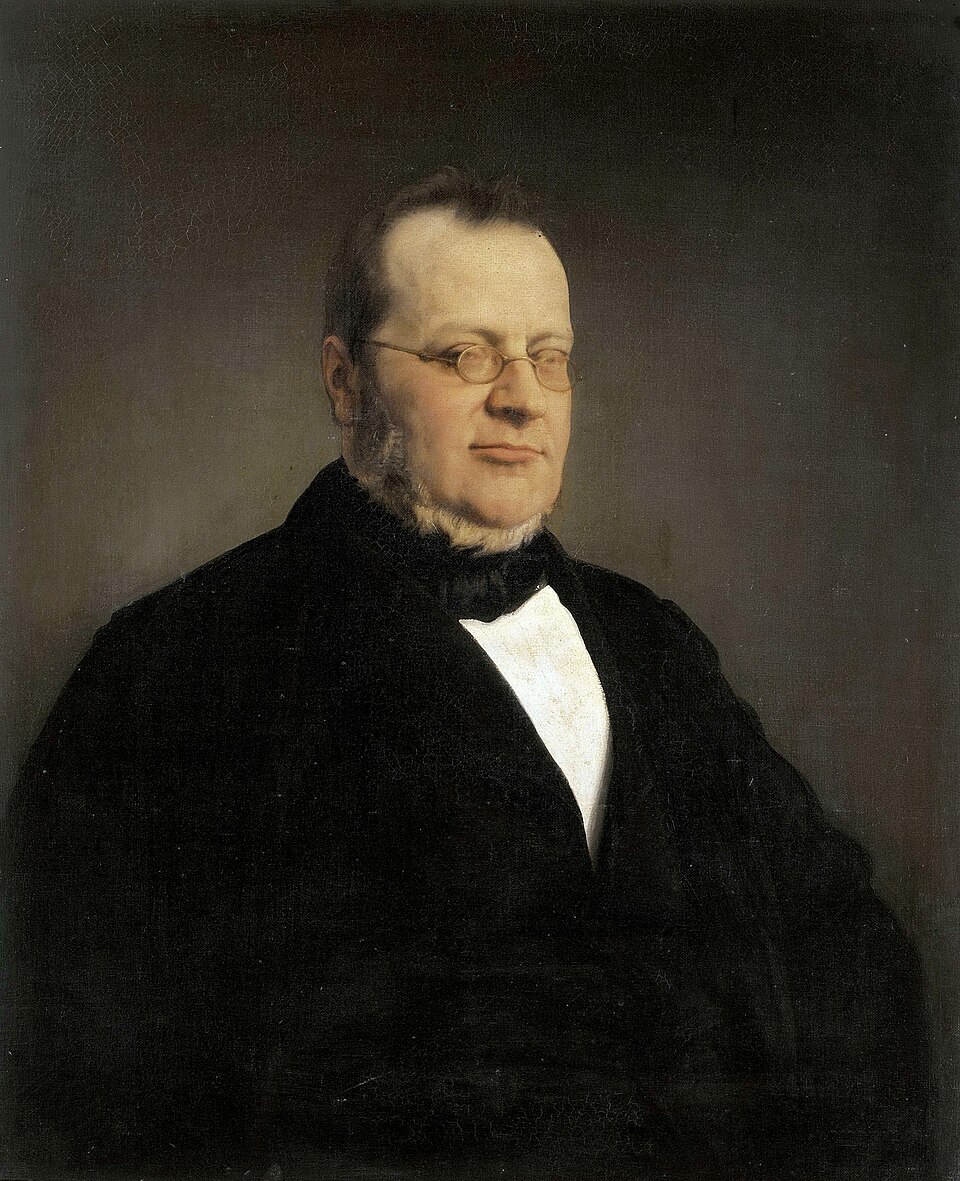
The leadership of the unification movement gradually shifted to the Kingdom of Sardinia-Piedmont, particularly under its prime minister Camillo Benso, Count of Cavour. Cavour rejected Mazzini’s revolutionary approach in favour of pragmatic statecraft.
Through a combination of economic reform, political modernisation and diplomatic manoeuvring, he sought to position Piedmont as the nucleus of a future Italian state. Cavour’s correspondence reveals his strategic thinking. He understood that Austria could not be defeated without international support.
To this end, he secured an alliance with Napoleon III, whose intervention proved decisive in the next phase of unification.
The Second War of Independence and northern unification
In 1859, Piedmont and France went to war against Austria in the Second War of Independence.
The conflict resulted in significant territorial gains. Lombardy was annexed to Piedmont, while central Italian states such as Tuscany and Modena voted, through plebiscites, to join the expanding kingdom.
These plebiscites, although presented as expressions of popular will, were often tightly controlled. Historians continue to debate the extent to which they reflected genuine public opinion. Nevertheless, by 1860 much of northern and central Italy had been unified under Piedmontese leadership.
Garibaldi and the conquest of the south
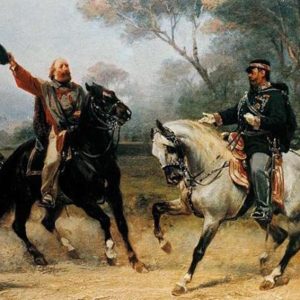
While Cavour pursued diplomatic and military strategy in the north, events in southern Italy unfolded in a dramatically different manner. In 1860, Giuseppe Garibaldi launched the Expedition of the Thousand, a volunteer force that landed in Sicily.
Drawing on both military skill and popular support, Garibaldi’s forces rapidly defeated the Bourbon monarchy that ruled the Kingdom of the Two Sicilies.
Contemporary accounts and later historical studies emphasise the complexity of this situation. While Garibaldi was welcomed as a liberator in some areas, resistance and social unrest persisted in others. Garibaldi himself was a committed republican, yet he chose to hand over control of the conquered territories to Victor Emmanuel II.
This decision reflected a broader recognition that unity could only be achieved through compromise between republican and monarchist visions.
The proclamation of the Kingdom of Italy
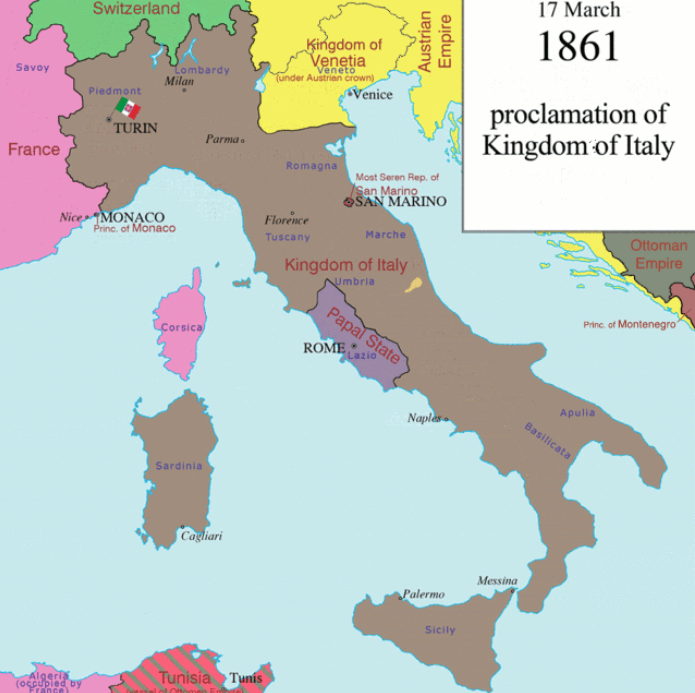
On 17 March 1861, the Italian parliament proclaimed the Kingdom of Italy, with Victor Emmanuel II as its ruler.
The choice of title — retaining his existing regnal number — symbolised continuity with the House of Savoy rather than the creation of an entirely new political order. Despite the significance of this moment, unification remained incomplete.
Venetia was still under Austrian control, and Rome remained part of the Papal States, protected by French troops.
Completing unification: Venetia and Rome
The final stages of unification occurred over the next decade. In 1866, following the Austro-Prussian War, Italy acquired Venetia.
Rome remained a more complex issue. The presence of French forces prevented Italian annexation until 1870, when the outbreak of the Franco-Prussian War forced their withdrawal.
Italian troops entered Rome later that year, effectively ending papal temporal power. In 1871, Rome was declared the capital of Italy. This annexation created a prolonged conflict between the Italian state and the Papacy, known as the “Roman Question”, which remained unresolved until the Lateran Treaty of 1929.
Historiography: competing interpretations of unification
The Risorgimento has been interpreted in different ways over time. Early nationalist historians portrayed it as a heroic and inevitable process driven by the will of the Italian people. However, modern scholarship offers a more critical perspective.
Historians such as Denis Mack Smith have argued that unification was largely an elite project, shaped by political calculation rather than mass participation. Other scholars have emphasised regional divisions and the limited impact of nationalist sentiment among rural populations.
Primary sources — including Mazzini’s writings, Cavour’s letters and diplomatic archives — reveal the competing visions that shaped the process.
The consequences of Italian unification
The creation of the Italian state did not immediately resolve the divisions of the peninsula. Significant challenges remained:
- economic disparities between industrialising northern regions and the agrarian south
- linguistic fragmentation, with many Italians speaking regional dialects rather than standard Italian
- political instability and limited electoral participation
These issues contributed to tensions that persisted well into the 20th century.
At the same time, unification created the institutional framework of the modern Italian state and established Italy as a significant European power.
Understanding the significance of 17 March 1861
The proclamation of the Kingdom of Italy on 17 March 1861 represented a decisive political transformation: the replacement of a fragmented system of states with a single national government. Yet the significance of this moment lies as much in its limitations as in its achievements.
The new state was the product of compromise between competing ideologies — republicanism and monarchy, revolution and diplomacy — and it incorporated territories with very different historical experiences.
As a result, unification did not immediately produce a cohesive national identity. Instead, it marked the beginning of a longer process of state-building, during which political institutions, infrastructure and education systems were gradually extended across the peninsula.
For historians, 17 March 1861 is therefore best understood not as the completion of Italian unification, but as a critical stage within an ongoing process of political and social integration.