The Risorgimento was the political and social movement that led to the unification of Italy in the 19th century. Lasting roughly from the early 1800s until 1871, it transformed the Italian peninsula from a patchwork of independent states into a single nation: the Kingdom of Italy.
The word Risorgimento means “resurgence” or “rising again” in Italian. It reflected the belief that Italy — once the centre of the powerful Roman Empire — could rise again as a united and independent nation.
Italy before unification
Before the Risorgimento, Italy was not a single country but a collection of kingdoms, duchies and territories controlled by both local rulers and foreign powers.
After the defeat of Napoleon Bonaparte in 1815, the Congress of Vienna reorganised Europe and restored conservative monarchies. The Italian peninsula was divided into several states, including:
- The Kingdom of Sardinia in the northwest
- The Kingdom of the Two Sicilies in southern Italy
- The Papal States ruled by the pope in central Italy
- Austrian-controlled territories such as the Kingdom of Lombardy–Venetia
The Austrian Empire exercised strong influence over much of northern Italy, and many Italians resented foreign domination.
At the same time, the spread of nationalist ideas across Europe led intellectuals and political activists to call for a unified Italian nation.
Early revolutionary movements
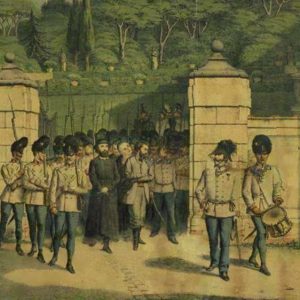
The earliest Risorgimento movements were driven by secret societies such as the Carbonari, whose members organised uprisings against conservative regimes in the 1820s and 1830s.
Although these revolts largely failed, they spread nationalist ideas and inspired future leaders.
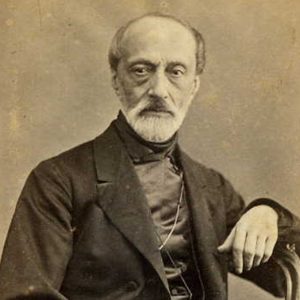
One of the most influential figures of this period was Giuseppe Mazzini, a passionate nationalist and republican who founded the political movement Young Italy in 1831. Mazzini believed Italy should become a democratic republic created through popular revolution.
His ideas helped inspire generations of Italian patriots, even though many of his early uprisings were unsuccessful.
The revolutions of 1848
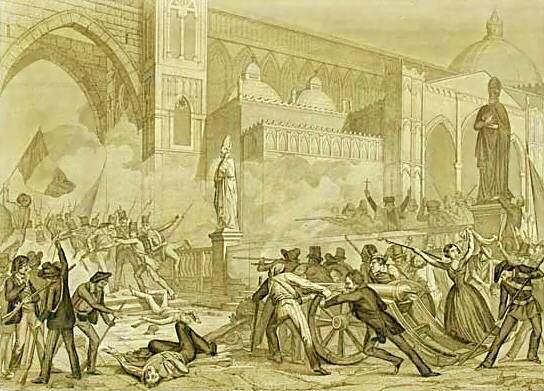
The year 1848 brought a wave of revolutions across Europe, and Italy was no exception.
Several Italian states rebelled against Austrian control, including uprisings in Milan and Venice. The king of the Kingdom of Sardinia, Charles Albert of Sardinia, declared war on Austria in what became known as the First Italian War of Independence.
Despite initial enthusiasm, the war ended in defeat for the Italian forces. However, the revolutions helped establish the Kingdom of Sardinia as the leading force behind the unification movement.
Also read articles related to 1848: Padua uprising Murder of Pellegrino Rossi Sicilian uprising of 1848
Cavour and diplomatic strategy
In the 1850s, the Risorgimento gained new momentum under the leadership of Camillo Benso, Count of Cavour, the prime minister of the Kingdom of Sardinia. Cavour believed Italian unity could be achieved through diplomacy, alliances and limited war rather than widespread revolution.
He secured support from Napoleon III of France and launched a campaign against Austria in 1859 known as the Second Italian War of Independence. The war led to the annexation of Lombardy by Sardinia, while nationalist movements in central Italy voted to join the Sardinian kingdom.
Garibaldi and the unification of the south

While Cavour worked through diplomacy, a more radical and charismatic figure advanced the cause through military action: Giuseppe Garibaldi.
In 1860, Garibaldi led a volunteer force known as the Expedition of the Thousand. With just over 1,000 fighters, he landed in Marsala in Sicily and began a campaign that quickly defeated the rulers of the Kingdom of the Two Sicilies.
Garibaldi’s forces captured Palermo and later marched north to Naples, overthrowing the Bourbon monarchy.
Although Garibaldi was a republican, he handed his conquered territories to the Sardinian king, Victor Emmanuel II, in the interest of national unity.
The birth of the Kingdom of Italy
In 1861, the Italian parliament proclaimed Victor Emmanuel II king of the new Kingdom of Italy.
However, the unification process was not yet complete. Two important territories remained outside the new state:
- Venice, still under Austrian control
- Rome, governed by the pope and protected by French troops
Venice joined Italy in 1866 after the Third Italian War of Independence, which coincided with the Austro-Prussian War.
Rome finally became part of Italy in 1870 when Italian troops entered the city after French forces withdrew during the Franco‑Prussian War. The following year, Rome was declared the capital of the Kingdom of Italy.
Cultural and intellectual influence
The Risorgimento was not only a political and military movement but also a cultural awakening.
Writers, artists and composers helped promote the idea of a unified Italy. The novelist Alessandro Manzoni, for example, contributed to the development of a national Italian language through his famous novel I promessi sposi.
Opera also played a role in stirring patriotic feeling. Works by composer Giuseppe Verdi often became associated with nationalist sentiment, and his surname even served as an acronym for the slogan “Vittorio Emanuele Re D’Italia” (Victor Emmanuel King of Italy).
Legacy of the Risorgimento
The Risorgimento created modern Italy, but the new nation faced many challenges. The north was more industrialised and economically developed than the largely agricultural south, creating inequalities that persisted for decades. There was also tension between the Italian state and the Catholic Church after the loss of the Papal States.
Nevertheless, the Risorgimento remains one of the most important periods in Italian history. It forged a national identity, unified diverse regions and laid the foundations for the Italy that exists today.