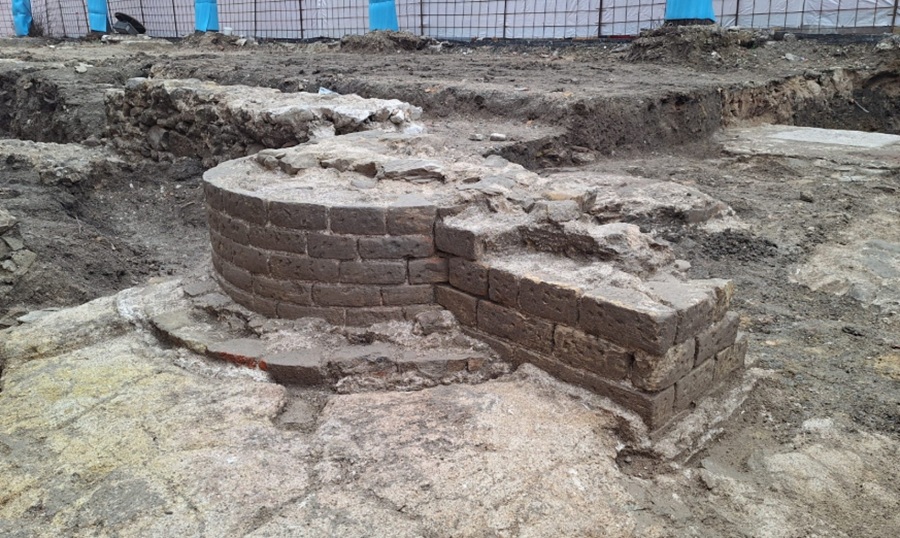
Archaeologists have uncovered the remains of the long-lost basilica designed by the Roman architect Vitruvius in the Marche city of Fano, a discovery hailed by Italy’s culture minister as “the Tutankhamun of the 21st century”.
The structure, built in the ancient Roman city of Fanum Fortunae and completed in 19 BC, is the only building scholars can directly attribute to Vitruvius, the first-century BC architect whose work later inspired Leonardo da Vinci’s Vitruvian Man. Although Vitruvius referred explicitly to the basilica in De architectura, the building itself had disappeared over time and its precise location had remained a mystery for more than two millennia.
“For more than 2,000 years we have been waiting for this discovery,” Fano mayor Luca Serfilippi said as he presented the findings. “We have found the Basilica of Vitruvius. I am proud of the work done.”
Speaking via video link, culture minister Alessandro Giuli described the discovery as a watershed moment for archaeology, architecture and urban history. “This remarkable discovery truly represents something exceptional in the history of archaeology, architecture, and the morphology of the city of Fano,” he said, adding that the site’s importance had long been recognised through written sources alone.
Italian equivalent of Tutankhamun
Giuli drew parallels with some of the most significant archaeological finds of the modern era, including the discovery of Tutankhamun’s tomb in the 20th century and the Lapis Niger in the Roman Forum. “The exact same thing has happened in Fano in archaeology and research,” he said. “At this precise moment in our lives, history is divided between before the discovery of the Basilica of Vitruvius and after.”
Until now, Giuli noted, Vitruvius had been known only through texts and later interpretations by figures such as Palladio. “We only had written knowledge of the sources,” he said. “Now we have the contextual data.” He compared the find to the archaeological identification of Pythagoras’s school in Crotone, arguing that the discovery confirms the spatial principles Vitruvius described, rooted in Pythagorean ideas of proportion and harmony.
“Today we have discovered the spatial configuration theorized by Pythagoras, realized and canonized by Vitruvius,” Giuli said. He added that the site would become a reference point for historians and researchers, allowing them to reassess the development of urban planning from antiquity to the modern age. “It is something our grandchildren will talk about,” he said.
The minister also underlined the symbolic dimension of the discovery, linking it to Italy’s cultural identity. He said that just as Leonardo had been able to conceive the Vitruvian Man through Vitruvius’s writings, the people of Fano were now “living, breathing Vitruvian Men”, having uncovered a physical reflection of their historical and cultural roots.
Expansion of excavation site
Mayor Serfilippi said the discovery projected Fano onto a global stage. “Vitruvius was truly the founder of architecture; he cites Fano in De architectura,” he said, noting that scholars had searched for physical traces of his work for more than 500 years. He confirmed that the excavation area would expand and that a technical committee would be established to oversee further research and conservation.
Excavation work is ongoing, with local and national authorities now focused on securing resources to deepen the investigations and properly valorise the site. Officials said the discovery would also reinforce public awareness of the importance of archaeological protection in areas whose historical significance has long been attested by sources, but only now confirmed by material evidence.