Italy’s position as a global cultural destination remains firmly established. However, new cultural tourism data suggests that how visitors engage with its heritage is beginning to shift.
With 61 UNESCO World Heritage Sites, the highest number in the world, and the recent addition of Italian cuisine to the list of intangible heritage in 2025, Italy continues to attract millions of cultural travellers each year. However, research by Data Appeal and Mabrian based on travel data from 2025 indicates a gradual redistribution of demand, alongside changing expectations around visitor experience.
Changing profile of cultural travellers
Cultural tourism in Italy remains strongly social. Couples account for the largest share of visitors to art cities at 43%, followed by families at 28%. Solo travellers make up 16% of the total and are the fastest-growing segment, increasing by 3% year on year.
The rise in solo travel reflects a broader trend towards more personalised and flexible cultural experiences. Italy continues to be seen as a relatively accessible and safe destination for independent travellers.
Domestic tourism remains a key driver, with Italians themselves generating the highest volume of reviews. Among international markets, France remains stable, while Germany has shown a slight decline, suggesting subtle shifts in European travel behaviour.
Experience matters as much as heritage
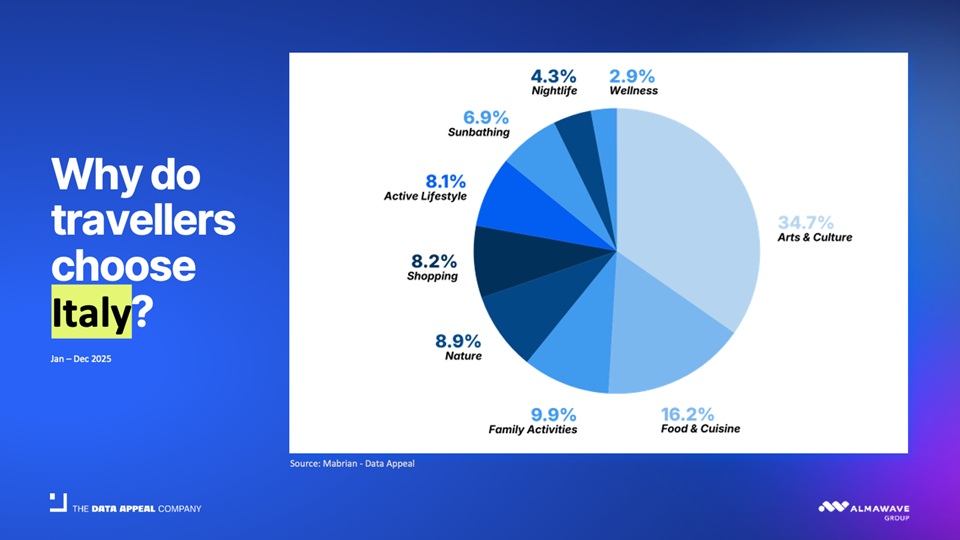
While historic landmarks remain the main attraction, visitor satisfaction is increasingly shaped by the overall travel experience.
“Arts and culture” continues to be the primary motivation for travel, accounting for 34.7% of trips. However, other factors are gaining importance. Culinary experiences, closely linked to Italy’s global reputation for food, achieve high satisfaction levels, while accommodation and hospitality indicators have also improved.
This suggests that Italy’s appeal is no longer based solely on its cultural assets, but on the combination of heritage, gastronomy and atmosphere.
Major landmarks remain dominant
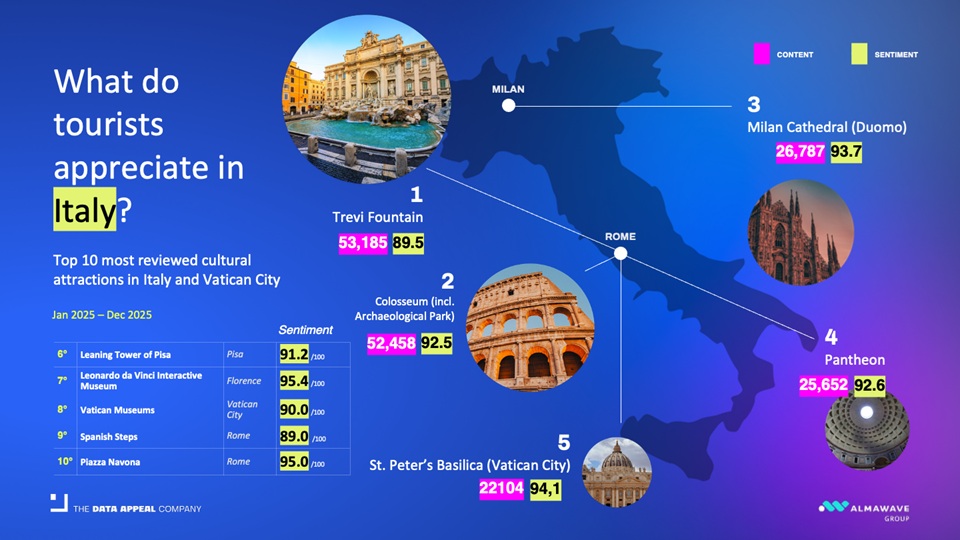
Italy’s most iconic sites continue to attract the highest levels of engagement. In Rome, the Trevi Fountain ranks first by visitor engagement and recorded the strongest growth in 2025, followed closely by the Colosseum. Landmarks such as the Pantheon and St Peter’s Basilica continue to combine high visitor numbers with strong approval ratings.
In Milan, the Duomo di Milano stands out for particularly high visitor satisfaction.
Museums in Florence and Rome remain among the most visited, including the Vatican Museums and the Archaeological Park of Pompeii.
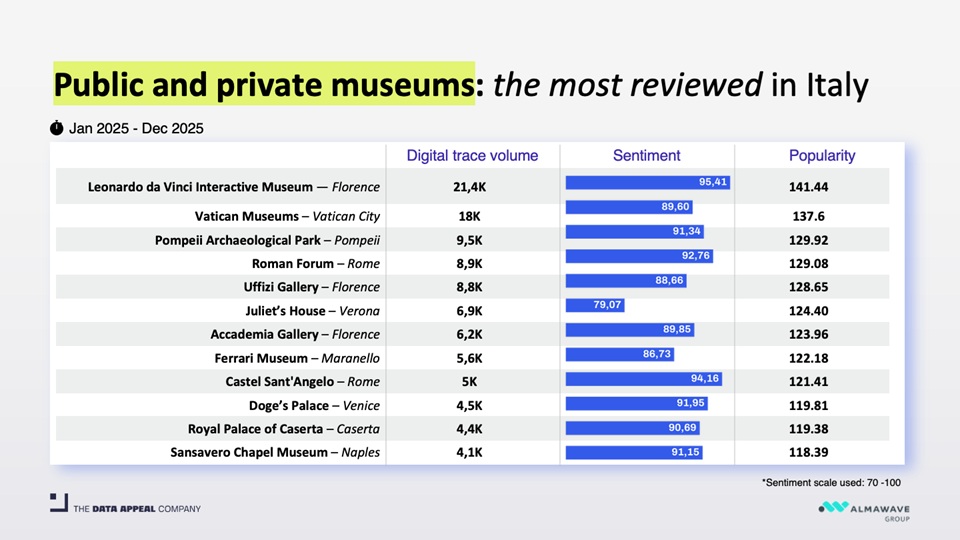
At the same time, sites with strong narrative appeal are gaining traction. Juliet’s House in Verona recorded one of the highest growth rates in visitor engagement, reflecting continued interest in symbolic and story-driven destinations.
A broader cultural map emerges
Despite the dominance of major cities, the data points to a more geographically balanced pattern of cultural tourism.
In central Italy, cities such as Siena and Assisi achieve particularly high levels of visitor satisfaction. In the south, Caserta and Bari stand out, with the Royal Palace of Caserta ranking among the most visited cultural sites nationwide. Meanwhile, Naples continues to gain ground, with the Museo Cappella Sansevero showing strong growth in visitor interest.
This reflects a broader trend towards exploring destinations beyond Italy’s traditional cultural centres, particularly among long-haul travellers.
Interactivity and management challenges
Visitor expectations are also evolving. Data analysis shows growing demand for interactive and immersive experiences, particularly in museums that integrate technology and participatory elements. At the same time, recurring challenges remain. Costs, cleanliness and waiting times are the most frequently cited issues in visitor feedback.
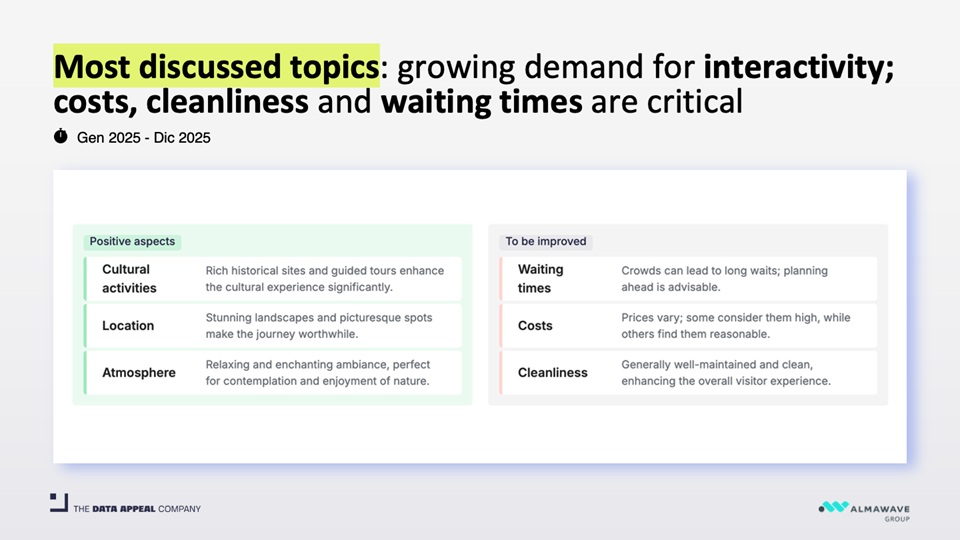
Experts suggest that targeted investments — including improved visitor flow management and timed entry systems — could help address these concerns while maintaining high visitor numbers.
The overall picture is one of continuity and gradual change. Italy’s cultural heritage remains the primary draw, but the way visitors experience it is becoming more diverse.