
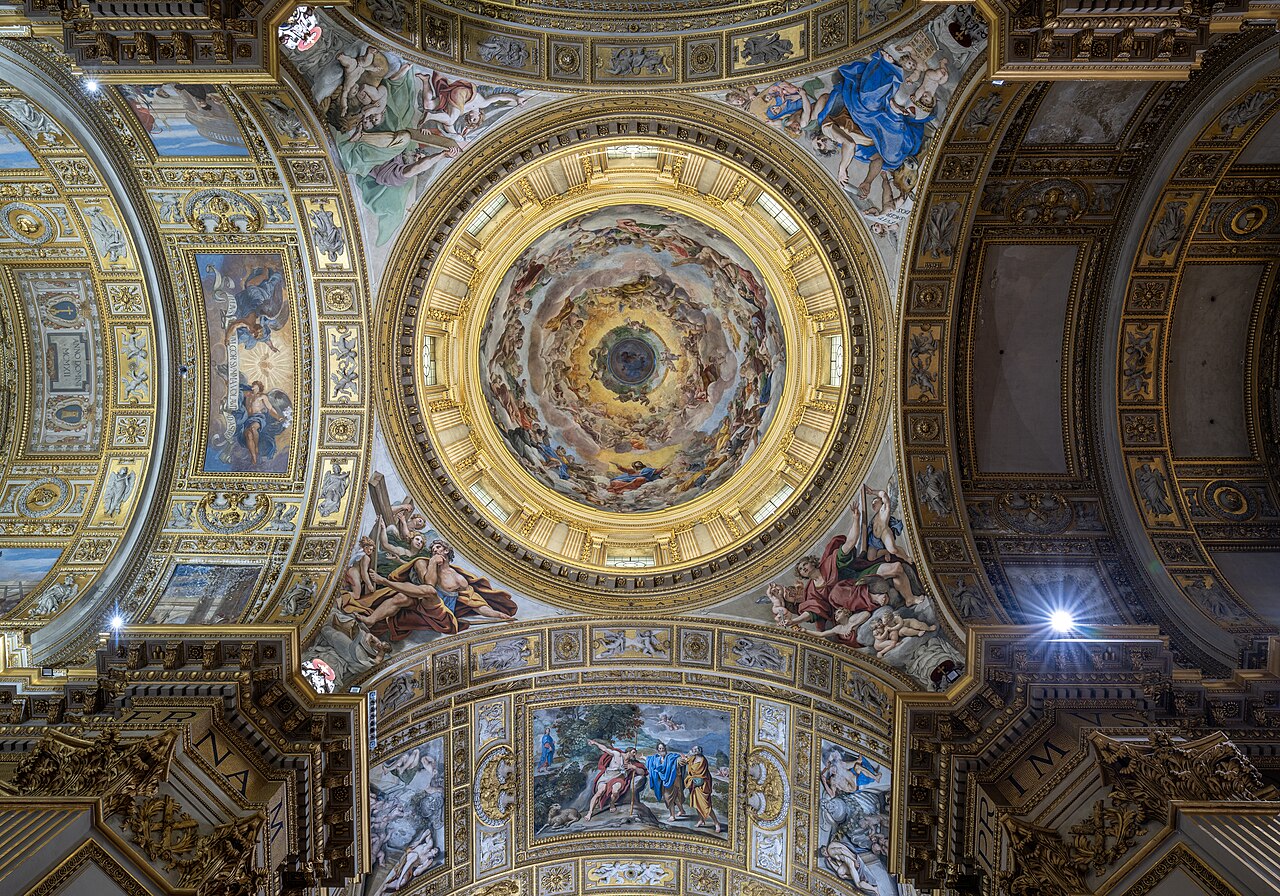
The Italian painter Giovanni Lanfranco, regarded as one of the leading masters of High Baroque painting in Rome, was born on 26th January, 1582 in Parma. Lanfranco’s work, particularly his dome frescoes, set new standards for illusionistic perspective and dramatic foreshortening.
Born Giovanni Gaspare Lanfranco, he was the third son of a poor Parmese family. As a boy, he drew on walls with pieces of coal. His talent caught the attention of Count Orazio Scotti, who arranged for him to apprentice with the Bolognese artist Agostino Carracci. Lanfranco soon worked alongside fellow Parmese painter Sisto Badalocchio in local Farnese palaces.

After Agostino Carracci’s death in 1602, Lanfranco moved to Annibale Carracci’s workshop in Rome, contributing to the ceiling of the Galleria Farnese in the Palazzo Farnese. He went on to work on the Herrera Chapel in San Giacomo degli Spagnoli, and frescoes in San Gregorio Magno and the Cappella Paolina in Santa Maria Maggiore.
Renowned for dome frescoes

Lanfranco became renowned for his dome frescoes, most famously the Assumption of the Virgin (1625–27) in the duomo of Sant’Andrea della Valle in Rome. He also painted the altar fresco of the Navicella (1627–28) in St Peter’s Basilica, the cupola of the Gesù Nuovo church in Naples (1634–36), and the Cappella del Tesoro in Naples Cathedral (1643). His work inspired later Neapolitan painters including Mattia Preti, Luca Giordano and Francesco Solimena.
He was influenced by Antonio da Correggio, whose dome frescoes in Parma introduced innovative uses of light, perspective and foreshortening. Lanfranco combined Carracci’s figure style with Correggio’s illusionistic methods, producing a High Baroque style that emphasised dynamic space and dramatic movement.
Rivalry with Domenichino
Lanfranco’s career included rivalries as well as commissions. Domenichino, a fellow painter, reportedly attempted to sabotage Lanfranco’s scaffolding during the Sant’Andrea della Valle project. The rivalry continued over accusations of plagiarism and competition for commissions throughout the 1620s.
From 1634 to 1646, Lanfranco worked extensively in Naples, decorating the Gesù Nuovo, the Certosa of San Martino, Santi Apostoli, and the Cappella del Tesoro di San Gennaro. He returned to Rome in 1646 and died the following year, his last work being the apse of San Carlo ai Catinari.
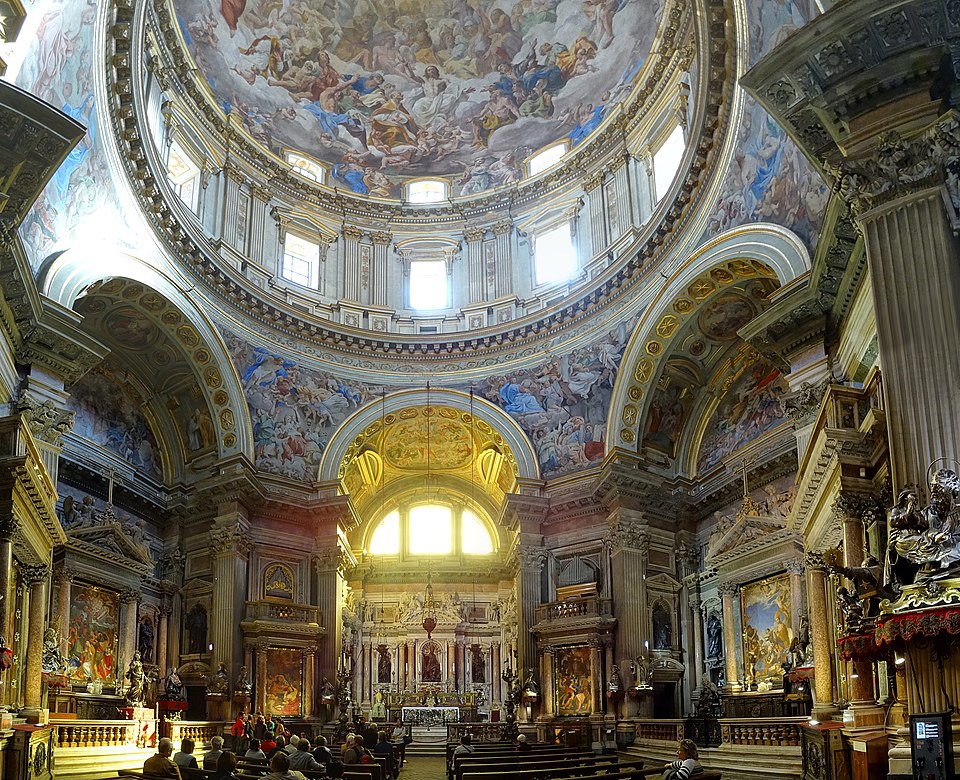
Lanfranco’s legacy lies in his mastery of illusionistic fresco techniques and his influence on the evolution of Baroque painting in Italy.
![Annibale Carracci (cropped) By Annibale Carracci - [2], Public Domain, https://commons.wikimedia.org/w/index.php?curid=35333992](https://italynews.online/wp-content/uploads/2025/11/Annibale_Carracci_Autoritratto_-300x300.jpg "On this day in history: Baroque artist Annibale Carracci born")


