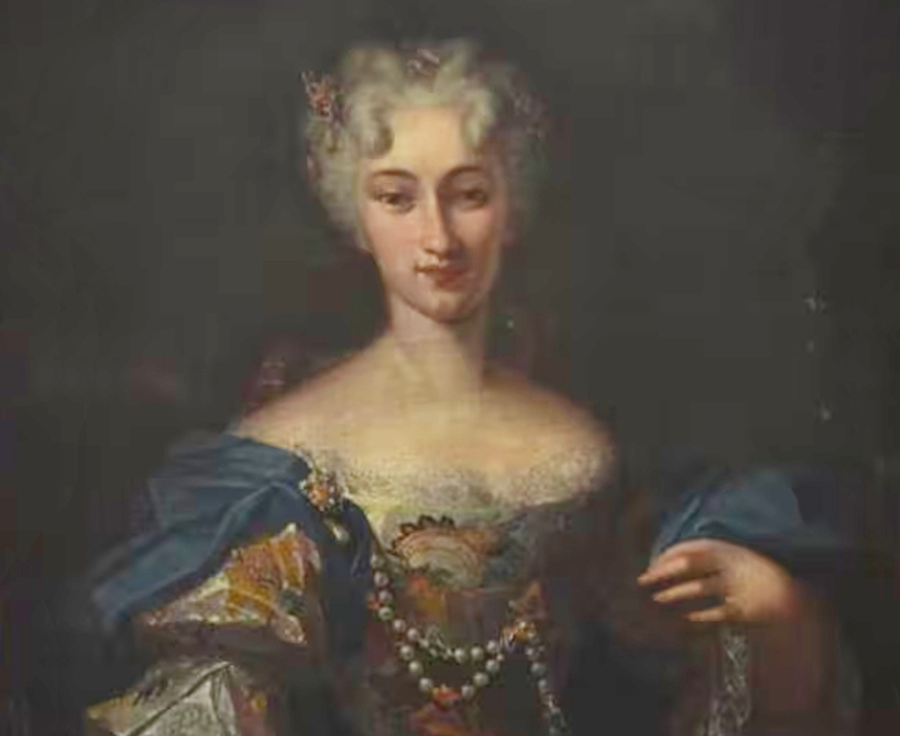
An aristocratic woman recognised as one of the brilliant mathematicians and scientists of her era, Clelia Grillo Borromeo Arese, died on 23rd August 1777 in Milan.
Borromeo Arese was known for her outstanding ability to solve difficult mathematical problems. She was also considered a natural philosopher in her own right, having devoted much of her life to studying how the world worked.
She was born in Genoa in 1684, the daughter of Duke Marcantonio Mondragone and his wife, Antonia. As a young girl, Clelia received a thorough education, first from her mother and later at a convent. There she became proficient in eight languages and developed a strong interest in geometry and mechanics.
In 1707, she married Count Giovanni Benedetto Borromeo Arese, and the couple went on to have eight children together. Her husband was the son of Carlo Borromeo Arese, one of the richest and most powerful men in Italy at the time. The union gave Borromeo Arese both the resources and the social standing to pursue her scientific interests seriously.
A salon that became a scientific hub
Borromeo Arese frequently invited scientists to her home in Milan, drawing visitors from Italy and further afield. Among her regular guests was Antonio Vallisneri, a physician, naturalist and professor of medicine at the University of Padua. An avid reader herself, she built an extensive personal library that visitors often remarked upon for its breadth and depth.
In 1717, she founded her own academy at her home, the Accademia dei Vigilanti, where she became known for her ability to solve virtually any mathematical problem put to her. The academy went on to play a significant role in the scientific debates of the day, counting among its members the mathematicians Giovanni Saccheri and Tommaso Ceva, and physicists including Giovanni Crivelli and, notably, a young Alessandro Volta. Through these members, the academy played a prominent part in spreading the physics of Newton and the philosophy of Leibniz across Italy.
A curve that carries her name
In 1726, Borromeo Arese made a mathematical discovery of her own, identifying a distinctive type of curve on the surface of a sphere that has since become known as the Clelia curve. A satellite’s orbital path traced onto the surface of the planet it circles, for instance, follows precisely this kind of curve.
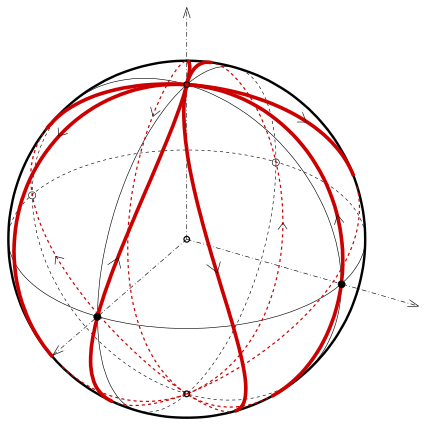
The Italian monk and mathematician Luigi Guido Grandi, himself a member of her academy, later wrote about the curve in a book he dedicated to her. He described Clelia curves as curves on the Earth’s sphere for whose points there is a linear relationship between longitude and colatitude — colatitude being the complement of a given latitude, calculated by subtracting the latitude angle from 90 degrees, effectively measuring angle down from the North Pole rather than distance from the equator.
A woman who formed her own opinions
Borromeo Arese was fiercely independent-minded, and in 1746 chose to support Spain against Austria during the ongoing war of succession, a stance that forced her to leave Milan for a time. When she was eventually permitted to return, she was welcomed home as something of a heroine by the Milanese people.
Genoa, the city of her birth, later honoured her contribution to geometry with a medal inscribed “Genuensium Gloria” — “The Honour of Genoa.”
After her death in 1777, Clelia Grillo Borromeo Arese was buried in the Church of Santa Maria Podone, a Greek Orthodox church in the centre of Milan.