Liberation Day, known as Anniversario della Liberazione or Festa della Liberazione, is celebrated on 25th April in Italy. It commemorates the end of fascist rule and the occupation of the country by Nazi Germany.
Every year on 25 April, Italy pauses to mark one of the most important and emotionally charged dates in its modern history. Shops close, flags fly, squares fill with people, and the opening bars of Bella Ciao drift across piazzas from Milan to Palermo. For Italians, the Festa della Liberazione — Liberation Day — is far more than a public holiday. It is a reminder of who they are, and of what it cost to become it.
What is Liberation Day commemorating?
Liberation Day, known in Italian as the Festa della Liberazione or Anniversario della Liberazione, commemorates the end of fascist rule and the Nazi occupation of Italy at the close of the Second World War. It marks the moment Italy freed itself from more than two decades of dictatorship and began the journey toward the democratic republic it would formally become in 1946.
It has been a national public holiday since 22 April 1946, when Prime Minister Alcide De Gasperi declared it by decree, with the words: “In celebration of the total liberation of Italian territory, 25 April 1946 is declared a national holiday.”
Why 25 April?
The date is rooted in a specific moment of collective action. On 25 April 1945, the National Liberation Committee for Northern Italy, known by its Italian acronym CLNAI, based in Milan, proclaimed a general insurrection against all Nazi-fascist forces still occupying the north of the country. It ordered all partisan units active in Northern Italy to attack German and fascist garrisons and impose surrender, days before the arrival of Allied troops.
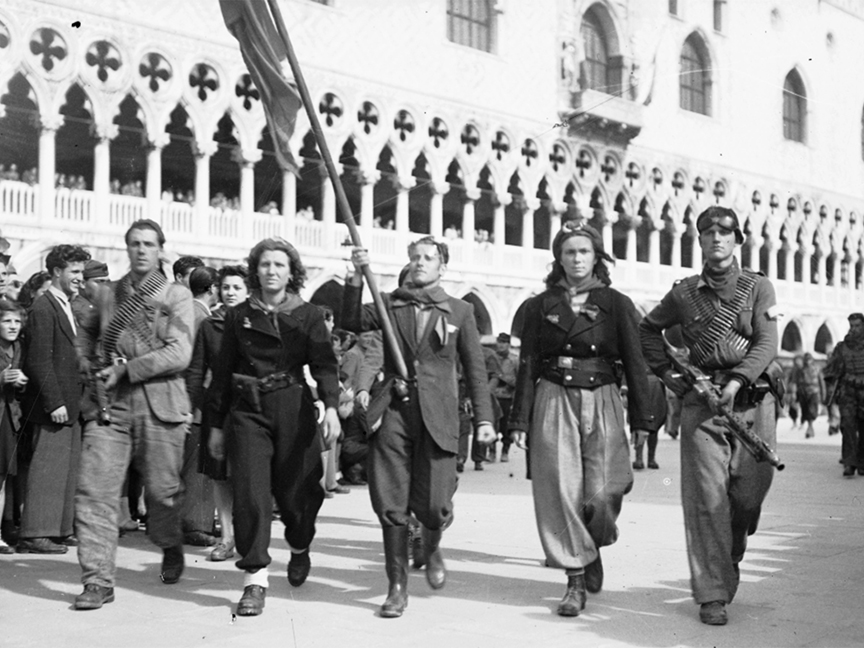
In the days that followed, key cities fell in rapid succession: Bologna on 21 April, Genoa on 23 April, Milan on 25 April, Turin and Venice on 28 April. Mussolini was captured and executed by partisans on the same day Venice was recaptured. German forces in Italy surrendered formally on 2 May 1945. By 1 May, all of northern Italy was free.
The liberation brought to an end not only two and a half years of German occupation, but five years of war and twenty-three years of fascist dictatorship. It was, in the truest sense, Italy’s liberation.
The Italian Resistance
To understand Liberation Day fully, it helps to understand the movement it honours. The Italian Resistance (Resistenza) was the armed partisan struggle against Nazi-fascist forces that lasted from 1943 to 1945. Around 300,000 partisans from varied political backgrounds fought guerrilla warfare across the mountains and cities of occupied Italy. Approximately 45,000 lost their lives.
The Resistance was not just a military force but a moral and political statement: a rejection of fascism from within Italian society, and the foundation on which the Italian Republic would be built. Liberation Day honours not only the Allied troops who advanced from the south, but the Italian men and women who chose to fight.
How Italy celebrates
The day is observed across the country with a blend of solemn ceremony and popular festivity, shaped by Italy’s strong regional identities but sharing common traditions nationwide.
In Rome, the centrepiece of the official commemorations is the ceremony at the Altare della Patria in Piazza Venezia, where the President of the Republic lays a laurel wreath at the Tomb of the Unknown Soldier. The President also traditionally visits the Mausoleum of the Ardeatine Caves on the outskirts of the city, where 335 civilians and prisoners were massacred by the Nazis in March 1944 in one of the worst atrocities committed on Italian soil.
On the day, the Italian flag and the European flag are displayed on all buildings housing public offices and institutions across the country.
In Milan, the city that fell on 25 April itself, the focal point is Piazza Duomo, the final destination of the city’s traditional Liberation Day parade.
In Turin, another city with deep partisan history, the day begins with commemorations at the Monumental Cemetery and continues with the Liberation Day parade through the city centre, ending in Piazza Castello. Turin played a particularly significant role in the liberation: as the heart of Italy’s industrial north, its factories and workers had been central to the wartime economy, and its partisans were among the most active in the country.
Across Italy, marches and parades are organised by the National Association of Italian Partisans which brings together veterans’ families, trade unions, students and civic groups. Libraries, museums and cultural venues host talks, exhibitions and educational events, while smaller communities hold their own local ceremonies, often the most intimate and moving of all.
Bella Ciao
No account of Liberation Day would be complete without Bella Ciao. The song, whose origins lie in northern Italian folk music, later adopted by the partisan movement, tells the story of a young fighter who dies for freedom and asks to be buried in the mountains beneath a beautiful flower. It has become an international anti-fascist anthem, but in Italy it retains a particularly deep historical meaning, and singing it on 25 April is one of the most widely observed popular traditions of the day.
Its resonance has, if anything, grown in recent years. When opposition politicians sang it in the Italian parliament on 24 April 2026, during the heated vote on the government’s security decree, the symbolism was lost on no one.
What happens on the day
As a national public holiday, Liberation Day means that state schools, public offices, banks and post offices are all closed. Many private businesses and shops close too, though those in tourist areas often remain open. Public transport runs on a reduced, Sunday-style timetable.
Museums and cultural institutions in many cities offer free or reduced entry in honour of the holiday.
Many Italians mark the day with a scampagnata, a spring picnic in the countryside, enjoying the season as much as the occasion. The holiday often forms the anchor of a long spring weekend, with families and friends gathering for the traditional outdoor lunch that signals, in Italy, the true arrival of spring.
Updated for 2026. First published April 2022.