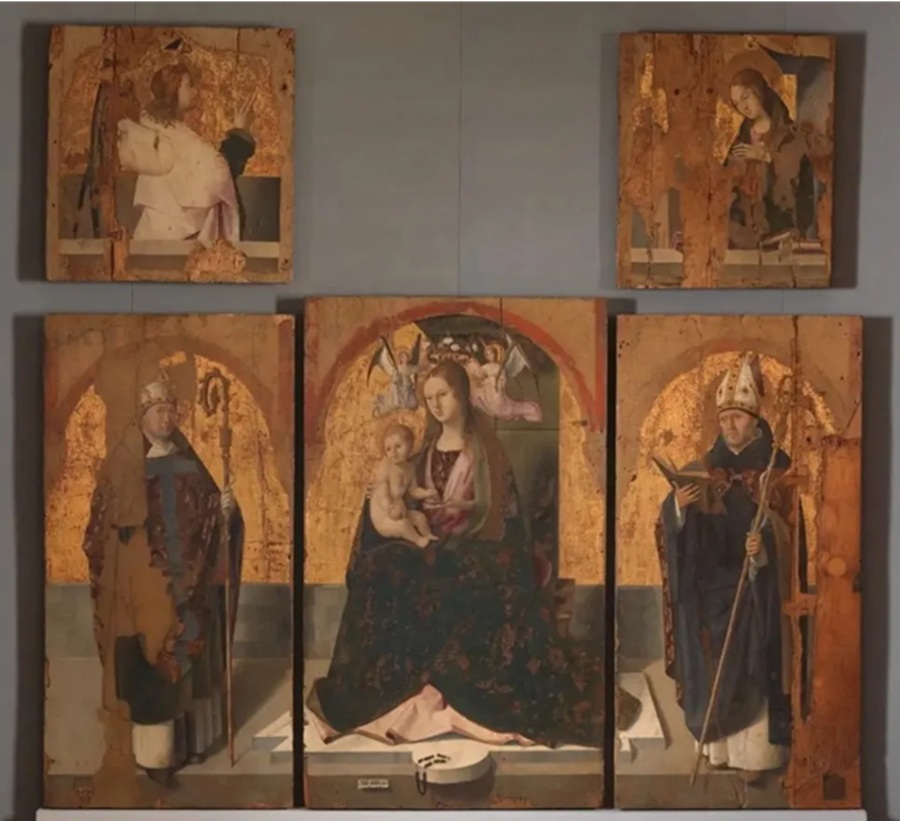
Four works by Renaissance master Antonello da Messina have been stolen from a museum in his native Messina, Sicily, in a daring raid that police believe may have involved someone with inside knowledge.
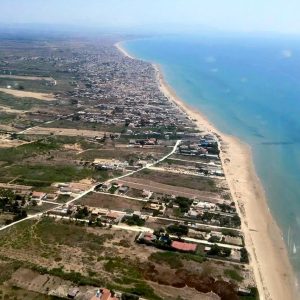
The theft took place on Saturday evening, during the Feast of the Assumption, one of the biggest celebrations in the Sicilian city. While hundreds of people gathered in Piazza Duomo for the traditional Vara procession, thieves entered the Regional Museum of Messina, around 4km away, and removed paintings by one of Sicily’s most important 15th-century artists.
The stolen works form part of an altarpiece and are among the very few works by Antonello da Messina held in the city.
According to investigators, three or four people wearing balaclavas entered the museum shortly before 10pm. The entire operation reportedly took only two or three minutes.
The thieves allegedly gained access through the museum garden from the side facing Viale Annunziata before forcing their way through a door into the rooms where the paintings were kept. They then smashed the glass of the display cases and removed the works.
Two other Antonello paintings were found abandoned on a low wall outside the museum. Investigators believe the thieves may have left them behind when they encountered passersby during their escape.
The four remaining works, however, have disappeared.
Police suspect an inside job
The circumstances of the robbery have raised questions about how such valuable works could be removed so quickly despite the museum’s security systems.
Museum officials have confirmed that both the alarm and video surveillance systems were working properly. Investigators have obtained footage which reportedly records the entire theft. There were also four custodians inside the building at the time.
Police are therefore examining what happened when the alarm was triggered. According to investigators, the alarm went off when the thieves broke into the display cases. It was apparently deactivated shortly afterwards by one of the custodians.
Investigators are asking why nobody monitoring the security system responded to the alarm and why museum staff apparently did not realise that paintings had been stolen. The custodians reportedly became aware of the incident only when police arrived at the museum after the two works were discovered outside.
Staff members have been questioned as witnesses while investigators establish exactly what happened.
Sicilian Regional President Renato Schifani has ordered an internal investigation into the museum’s security procedures and any possible responsibility among the staff.
“An internal inspection has been launched to reconstruct every step and determine any liability attributable to the custodial staff,” Schifani said. “The alarm and video surveillance system worked. No grey area will be tolerated.”
Police have not said that any member of staff is a suspect, and the investigation is currently being conducted against unknown persons.
Who could buy stolen Renaissance masterpieces?
Investigators are considering several possible motives, including the possibility that the theft was commissioned by an art dealer intending to sell the works privately.
Selling major Renaissance paintings on the legitimate art market would be extremely difficult because of their provenance and importance. Their disappearance would attract international attention, while museums, auction houses and legitimate dealers would be expected to identify them.
A specialist buyer operating illegally could, however, have commissioned the theft with the intention of keeping the paintings hidden.
The value of the stolen works is estimated at tens of millions of euros.
The case has inevitably brought comparisons with last year’s spectacular robbery at the Louvre in Paris, when a gang stole jewellery worth millions of euros in a carefully planned operation lasting only minutes.
Search extends beyond Sicily
Immediately after the Messina theft was discovered, police established checks at ferry terminals in an attempt to prevent the stolen works from being taken across the Strait of Messina to mainland Italy. So far, those checks have produced no results.
It remains unclear whether the thieves succeeded in leaving Sicily or whether the paintings are still somewhere on the island.
The investigation is being led by the Messina Public Prosecutor’s Office, with the Carabinieri’s Cultural Heritage Protection Unit also involved. Investigators are examining the museum’s security footage, interviewing staff and reconstructing the movements of the thieves before and after the robbery.
Culture Minister Alessandro Giuli expressed his “dismay and regret” over the theft and offered his full cooperation with the Sicilian authorities, whose museums operate under the island’s special autonomous status. Schifani called the robbery an “exceptional criminal act” and an “intolerable affront to universal cultural heritage.”
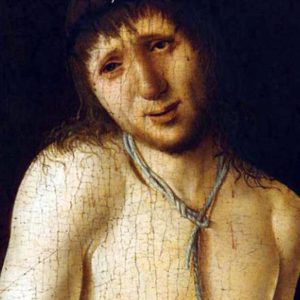
For Messina, the loss is particularly significant. Antonello da Messina was born in the city around 1430 and became one of the most influential Italian painters of the 15th century. Recently, the Italian government purchased a work by da Messina. His work combined the traditions of Italian Renaissance painting with techniques and influences from northern Europe, particularly in his use of oil paint and highly detailed portraits.