A first-of-its-kind survey has found that forests now cover more of Italy than agriculture does, a shift not seen since medieval times. But the story behind the numbers is less a triumph for nature than a portrait of rural Italy slowly emptying.
Forests have covered more of the country than farmland does since 2020, which hasn’t been the case since the Middle Ages. Wooded land has crept past 100,000 square kilometres — more than a third of the entire country — quietly overtaking the fields, vineyards and pastures that have defined the Italian landscape for centuries.
The figures come from a new report, Foreste in Comune, the first study to look at Italy’s forests not just as an environmental statistic but as a municipality-by-municipality economic and demographic story. Backed by PEFC Italia together with UNCEM, Legambiente and Consorzio Caire, the researchers combined national forest mapping data with population and land-use records for close to 7,900 Italian comuni. They matched, for the first time, where the trees are growing against where the people are leaving.
Where Italy is at its wildest
Some places have gone almost entirely back to nature. Marcetelli, a tiny town in the province of Rieti, is now 98.4% forest — the most wooded municipality anywhere in the country. Bormida in Savona, Percile near Rome, and Drenchia and Grimacco up near Udine all sit close behind, each with well over 95% of their land under tree cover.
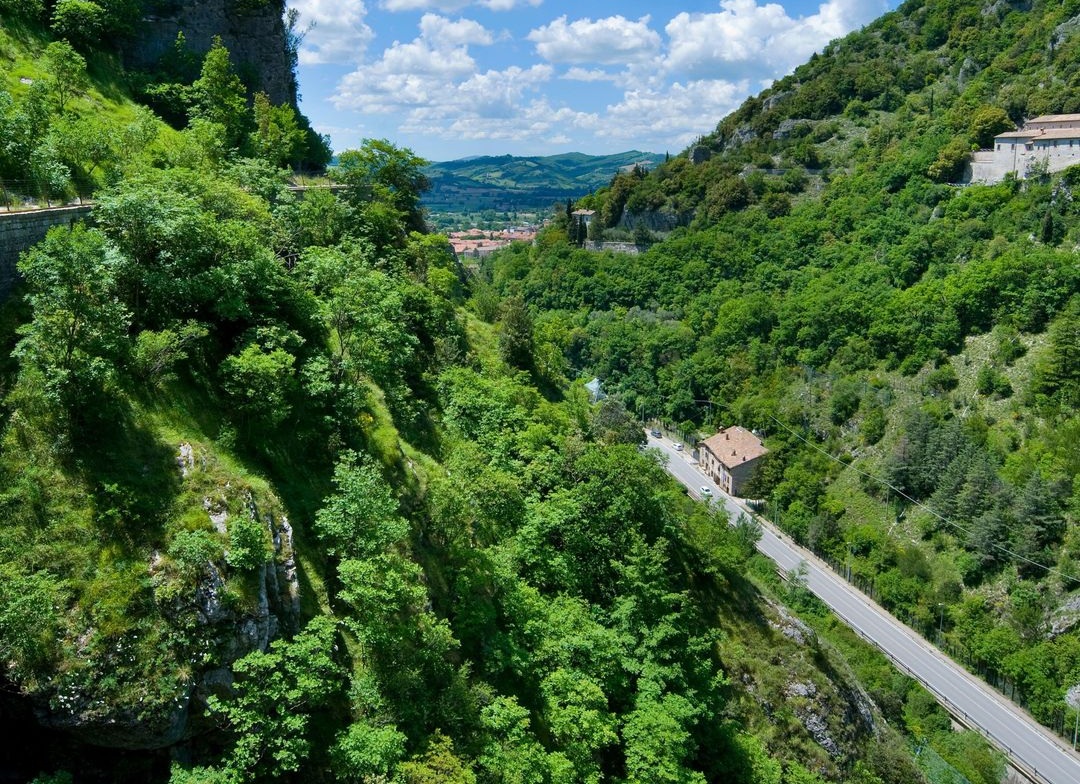
There’s real money in that, too, not just scenery. Marcetelli’s forests alone are estimated to be worth close to €8 million a year if you take inot account that they freely clean the air, regulate water, hold the soil together, and store carbon. And if you’re measuring by sheer size rather than percentage, Gubbio in Umbria wins outright, with almost 27,000 hectares of forest, more than any other town in Italy.
A country split in two
What the report makes clear is that this isn’t a story about Italy generally becoming greener. It’s more skewed than that. Roughly three-quarters of all the country’s forest sits within just 3,596 mountain municipalities — territories that cover nearly half of Italy but hold only 13.5% of its people. Push that further, and you find 495 towns where forest covers more than 80% of the land. Barely 1% of the population lives in them. And yet, between them, they hold nearly 14% of all the forest in Italy.
Flip to the other half of Italy and the picture reverses completely. In roughly half of the country’s municipalities, forest covers less than a fifth of the land, and this is where two-thirds of Italians live — holding, between them, less than 10% of the nation’s total forest. You can see it starkly in the province of Verona: Isola della Scala has just 3.8 hectares of forest out of nearly 7,000 hectares of land, while towns like Bovolone, Cerea and Oppeano report having no forest at all.
Growth born from absence not abundance
It would be easy to read all this as good environmental news, but the report is careful not to frame it that way. Much of this new forest hasn’t been planted or protected, it’s simply moved in on land that farmers walked away from. Over the past twenty years, around 1.3 million farms have closed across Italy, three-quarters of them in exactly the kind of steep, marginal, hard-to-work terrain that’s now returning to woodland. Between them, those closures have taken roughly 850,000 hectares of cultivated land out of use.
That comes at its own cost. The old patchwork of Italian farming — permanent meadows, terraced hillsides, mixed crops, trees grown alongside pasture — created habitats that plenty of species have depended on for generations, shaped as much by people as by nature. When the farming stops and the forest closes back over, those habitats tend to go with it. Meanwhile, on Italy’s flatter plains, the opposite pressure is building: farming there is consolidating into larger and larger industrial operations, precisely because flat land is cheap and easy to mechanise, squeezing out the same kind of landscape variety from the other direction.
Human transcience
Behind the ecology is a much more human story. Farms in Italy’s mountainous interior were already fighting an uphill battle — steep ground, scattered plots, higher costs than anything on the plains could match. On top of that, younger residents have kept leaving. Plus, Italy’s modern food supply chains increasingly favour the kind of standardised, high-volume produce that has no real place for the small local varieties these regions used to grow.
There is, at least, a small sign the trend might not run only one way forever. Between 2021 and 2025, 932 Italian municipalities gained population faster than they lost it, and a fair number of them were sitting in some of the most heavily forested parts of the country. This movement hints at a human transience to these wilder, greener regions, even as traditional farming keeps retreating from them.
The report’s authors are wary of framing this as a choice between two extremes — letting the countryside quietly return to forest on one side, or pushing agriculture toward ever more intensive, homogenised farming on the other. Italy’s forests are a genuine asset, both ecologically and economically, but the researchers argue that managing them well won’t be enough on its own.
What happens to Italy’s interior, they suggest, will come down to whether the country can find a way to support smaller-scale, genuinely diverse farming and give real value to what makes each region distinct — so that the forest’s return doesn’t end up simply erasing the communities, and the biodiversity, that shaped these landscapes in the first place.