
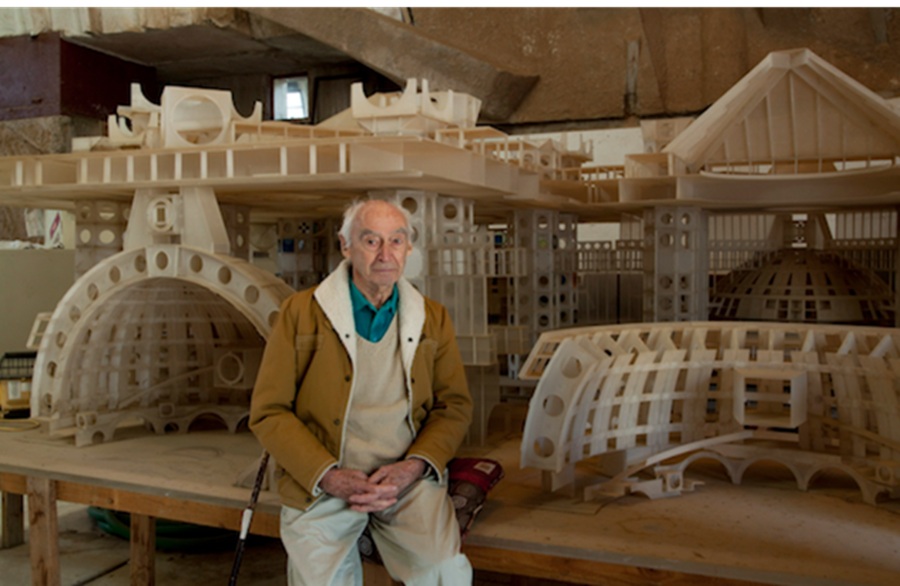
On 21 June 1919, the pioneering architect, urban planner, and ecologist Paolo Soleri was born in Turin, Italy. Renowned for his radical philosophy of “arcology”, a fusion of architecture and ecology, Soleri dedicated his life to reimagining how human habitations could coexist harmoniously with the natural world.
Soleri grew up in Italy and completed his formal architectural education at the Politecnico di Torino, where he earned his master’s degree. However, a pivotal move to the United States in 1946 fundamentally altered the trajectory of his career.
In America, Soleri met and studied under the legendary architect Frank Lloyd Wright at Taliesin West in Arizona. Wright’s principles of organic architecture, which emphasised designing structures in harmony with their environment, deeply influenced Soleri.
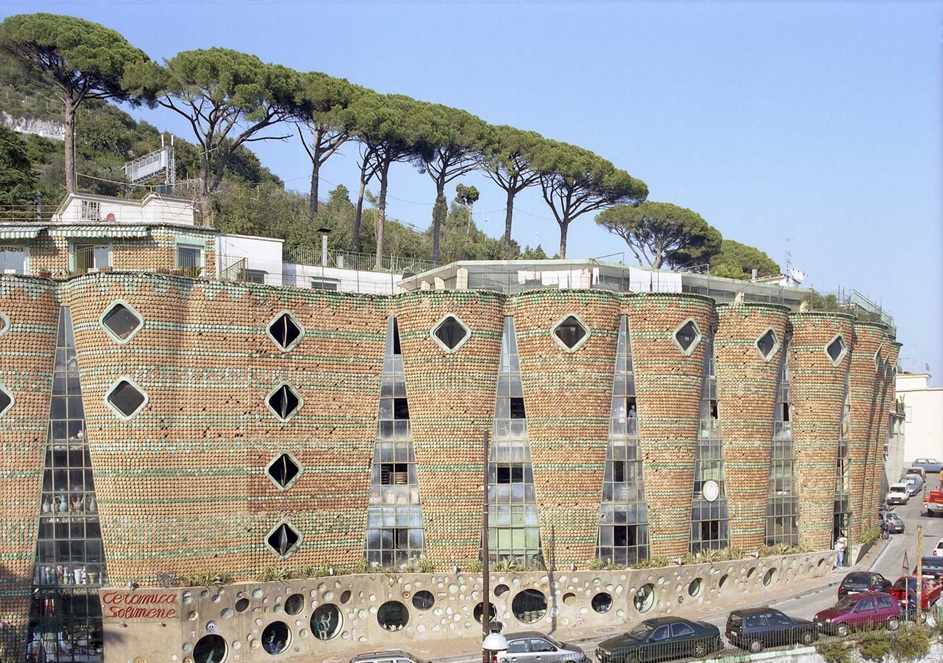
Following a temporary return to Italy, Soleri demonstrated his evolving style in 1954 by designing the Ceramica Artistica Solimene factory in Vietri sul Mare. Located on the Amalfi coast, the building remains a distinct architectural landmark, featuring a unique exterior of multi-coloured ceramic tiles, conical shapes, and inverted glass triangles.
The Birth of cosanti and earthcasting
Soleri soon returned to Scottsdale, Arizona, settling with his American wife, Colly. In 1956, they established the Cosanti Foundation to support innovative research into urban planning.
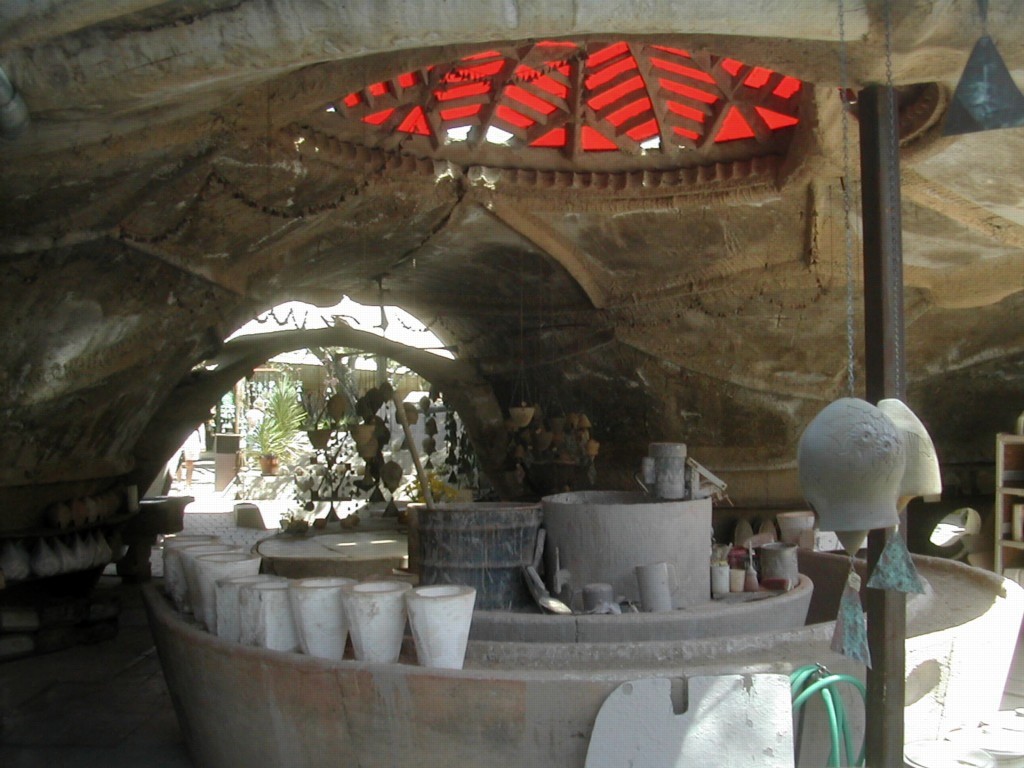
During this period, Soleri experimented with a unique construction technique known as “earthcasting”. This process involved shaping large mounds of earth, pouring concrete over them to form a solid shell, and then excavating the soil from underneath to reveal the hollow structure within.
His admiration for Wright eventually diverged over urban density. While Wright proposed low-rise, expansive suburban developments, Soleri viewed the sprawling American suburbs as a wasteful and inefficient use of land, arguing instead that future urban centres needed to build upwards rather than outwards.
Arcosanti: The Desert Experiment
In 1970, Soleri began his most ambitious project: Arcosanti, an experimental town located in the central Arizona desert. Conceived as a self-sufficient urban laboratory for 5,000 residents, the project sought to eliminate the need for cars by combining living, working, and social spaces into a single, highly integrated structure.
To build Arcosanti, Soleri utilised semi-submerged designs dug directly into the desert troughs. Every structure was strategically oriented to capture and maximise solar energy for heating and power. To fund the town’s construction and maintain an income, Soleri established a small foundry on-site to produce ceramic and bronze wind bells, applying techniques he had mastered on the Amalfi coast.
Although Arcosanti’s population peaked at just over 200 residents and only 5% of the original master plan was ever constructed, the site remains an architectural wonder. Its concrete blocks, vaults, and domes rising from the desert have drawn comparisons to both ancient ruins and futuristic film sets.
Soleri later expressed regret over the project’s limited physical growth, acknowledging that he perhaps spent insufficient time promoting the concept to the wider public. Nevertheless, Arcosanti was never abandoned. Following Soleri’s death in Paradise Valley, Arizona, in 2013 at the age of 93, the settlement has remained active. Today, it serves as an educational center and a home to a dedicated community continuing to live by his principles, with more than 6,000 volunteers having contributed to its construction over the decades.


