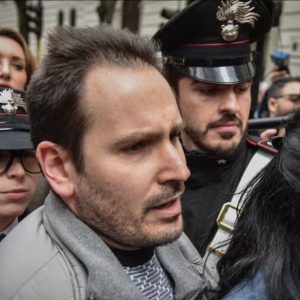
Andrea Sempio invoked his right to remain silent when summoned for questioning over the 2007 killing of Chiara Poggi. The case may now see the man convicted of the murder, Alberto Stasi, have his sentence overturned.
The murder of Chiara Poggi in the small town of Garlasco, near Pavia, on a summer morning in August 2007 is one of the most debated criminal cases in modern Italian history. The 26-year-old economics graduate was found stabbed to death at her family home. Her then boyfriend, Alberto Stasi — also an economics graduate, from Bocconi University — was convicted of the killing in 2015. He is nearing the end of the 16-year sentence he received.
For years the case was considered closed. That changed last year, when DNA found under two of the victim’s fingernails was identified as compatible with that of Andrea Sempio, a 38-year-old former phone shop clerk and friend of Chiara’s brother Marco. Sempio was placed under investigation, and Pavia prosecutors reopened an inquiry that has since returned the Garlasco case to the front pages.
Four hours of silence
On Wednesday, Sempio appeared before prosecutors who had summoned him for formal questioning. He spent four hours at the prosecutor’s office. He answered none of their questions, exercising his right to remain silent.
The summons is widely understood to be one of the final procedural steps before prosecutors close their investigation and formally request an indictment. Pavia prosecutors have indicated their intention to seek to have Stasi’s sentence overturned in light of the new evidence.
Also summoned on Wednesday was Marco Poggi, Chiara’s brother and Sempio’s friend. He appeared before prosecutors as a person with knowledge of the case.
According to the Pavia prosecutor’s office, Sempio acted alone in killing Chiara Poggi. This differs from earlier theories that he may have been involved alongside others, or in concert with Stasi. The alleged motive is sexual: prosecutors contend that Sempio stabbed the young woman after she rejected a sexual advance.
Evidence cited includes a wiretapped phone call in which, according to reporting by Rai television, Sempio made an approach toward Chiara and she told him she did not wish to speak to him. He also reportedly viewed an intimate video featuring Chiara and Stasi.
Sempio’s lawyer, Liborio Cataliotti, has pushed back firmly on the sexual motive, arguing it is inconsistent with the evidence of the relationship — or lack of one — between his client and the victim. Sempio, speaking through his lawyer last week, said he had no meaningful connection to the young woman. “I didn’t have any relationship with this girl, any relationship in the social sense,” he said via Cataliotti. The defence has also noted that Chiara was reportedly at work on the occasions when Sempio visited her family home, undermining the suggestion of repeated contact or escalating fixation.
Stasi’s conviction could be overturned
The implications for Alberto Stasi, now 42, are profound. If prosecutors proceed to indictment and ultimately secure a conviction against Sempio, Stasi — who has always maintained his innocence — would likely see his own conviction struck down. He has spent almost 16 years in prison for a crime the Italian justice system may now formally attribute to another man.
The Garlasco case has provoked intense public debate in Italy about the reliability of forensic evidence, the workings of the criminal justice system, and the way in which media coverage shapes public perception of guilt.
ItalyNews.Online covers Italian politics, society, and culture for an international readership.