

Premier Giorgia Meloni has taken on the tourism portfolio herself after forcing the resignation of Daniela Santanchè, who faced a mounting pile of criminal probes. The decision to fold the ministry into the prime ministerial office rather than appoint a successor raises pointed questions about trust and priorities.
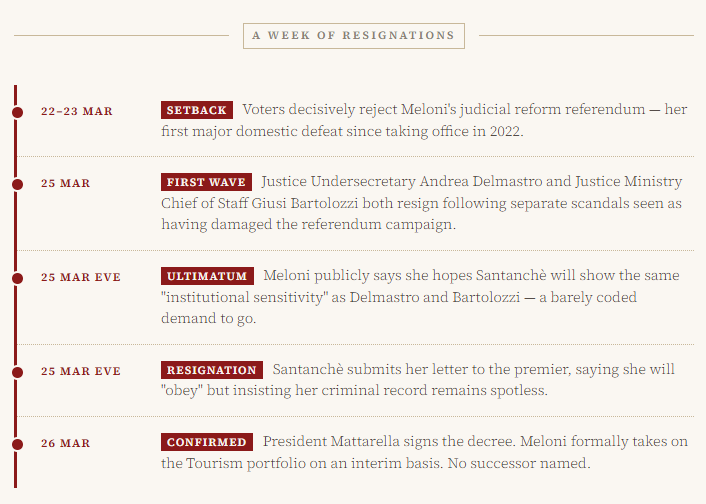
Giorgia Meloni is now, in addition to being Italy’s Prime Minister, its acting Tourism Minister. President Sergio Mattarella signed the relevant decree on Thursday, formally accepting the resignation of Daniela Santanchè and entrusting the tourism portfolio to the premier on an interim basis. It is a tidy solution to an uncomfortable problem. Whether it is a sensible one is another matter entirely.
Santanchè, 64, had been a fixture of the Meloni government since its formation in October 2022, one of the most prominent and colourful figures in Fratelli d’Italia. For over three years she survived hostile opposition, a formal no-confidence motion in 2023, and a growing avalanche of criminal investigations, all while clinging to a cabinet post Meloni had declined to strip from her. That patience finally ran out on Tuesday evening, when the premier — still reeling from a bruising referendum defeat on her flagship judicial reform — publicly called on Santanchè to step aside.
I won’t hide a little bitterness about the outcome of my ministerial journey,
Daniela Santanchè, letter of resignation to Premier Meloni
but in my life I’m used to paying my own bills — and often those of others as well.
Santanchè obeyed but, pointedly, on her own terms. Writing to Meloni, she said she was resigning “only in response to a request from the leader of my party”. She took pains to stress that her criminal record remained “unblemished” and that she was not “making myself a scapegoat for the referendum defeat.” There was an element of warmth too. “I care more about our friendship and the future of our movement,” she wrote — a line that read, to some, less like a farewell and more like a reminder of what Meloni owes her.
Resignation trumps no-confidence motion
The resignation came less than 24 hours after Meloni’s public appeal, and roughly a week before a parliamentary no-confidence debate that would have provided the opposition with a damaging national platform. The timing, few observers doubted, was not coincidental.
Santanchè’s list of legal cases and her time as Tourism Minister
Santanchè denies all wrongdoing. But the sheer breadth of her legal exposure — four separate proceedings, all active simultaneously — had long since made her a liability. She had herself publicly stated that she would step aside if committed to trial over the INPS fraud case.
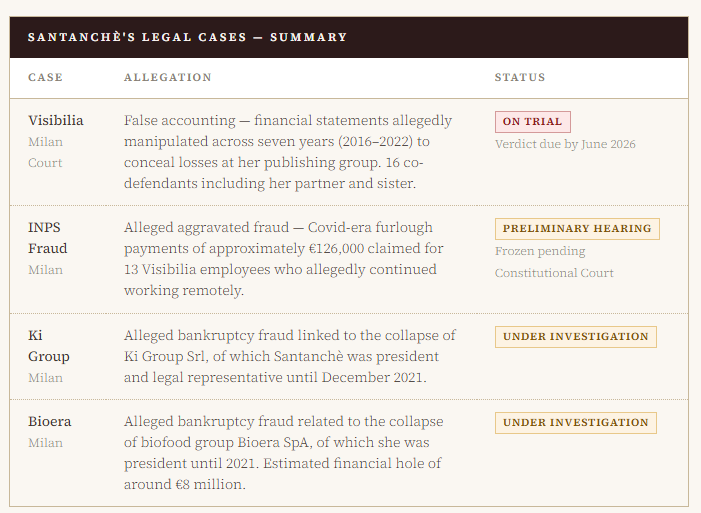
That threshold was never formally reached; her exit came on political rather than legal grounds. Applause broke out in the lower house of parliament when news of her resignation spread, with the main opposition Democratic Party welcoming it, whilst noting that it had come years too late.
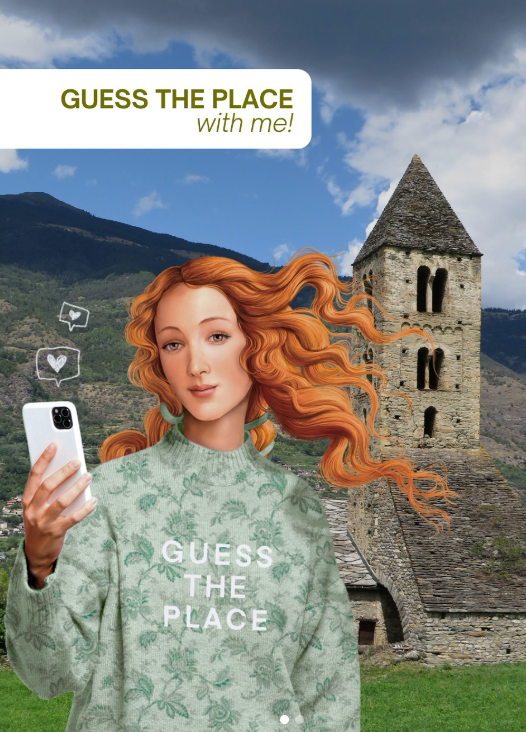
The case will also be remembered for a less solemn reason. Santanchè oversaw, in 2023, Italy’s ill-fated “Open to Meraviglia” tourism campaign, which reimagined Sandro Botticelli’s Venus as a pizza-eating social media influencer. The campaign was widely ridiculed domestically and internationally, and became a byword for governmental tone-deafness on cultural matters.
INO Commentary
Who does Meloni trust or is she not taking the tourism role seriously?
There is an obvious reading of Meloni’s decision to absorb the Tourism portfolio into the prime ministerial office rather than immediately appoint a replacement: this is temporary housekeeping, a brief interregnum before a successor is named. Italian prime ministers taking on interim portfolios is not unusual.
But the arrangement is worth examining more closely. Italy is one of the world’s most visited countries — a destination that generated over €84 billion in tourism revenues in 2024, accounting for roughly 12% of national GDP. The sector directly employs around 1.5 million people and is a strategic pillar of the economy in dozens of regions. It is not, in other words, a minor administrative brief to be tucked under a pile of other folders.
Is there no-one worthy of the role?
Which raises the first uncomfortable question: does Meloni not have anyone in Fratelli d’Italia, or among her coalition partners, she trusts enough to install in the role? In a party that has been in government for nearly three and a half years, the inability, or unwillingness, to name an immediate successor suggests either a thin bench of capable and untarnished figures, or a political calculation that the appointment is too sensitive to rush in the current climate. The government is already under pressure following the referendum loss and three resignations in two days. A botched or controversial ministerial appointment would be the last thing Meloni needs.
The second question is more fundamental: should a serving Prime Minister be taking on an additional ministerial portfolio at all, even temporarily? The office of Prime Minister in Italy, as in most parliamentary democracies, is already among the most demanding in public life. Meloni is managing a three-party coalition, navigating a fractious relationship with Brussels, handling an active foreign policy agenda including Ukraine and relations with Washington, and now absorbing the political fallout of her first significant domestic defeat. Adding a ministerial red box to that load, however briefly, is not a sign of strength. It is a sign of a cabinet that, at a critical moment, has been left short-handed.
Accountability of senior figures
There is also the view of this week’s events. Meloni has positioned herself as a leader of discipline and accountability. It cannot be said she is always willing to act decisively against misconduct in her own ranks. It has taken a major referendum defeat to oust Delmastro and Santanchè — members of her party who have legal ases against them. However, forcing three resignations in 48 hours is decisive. But the decision to pocket the resulting portfolio herself, rather than demonstrate confidence in a party colleague, somewhat undercuts that narrative. It looks less like a premier in command and more like a premier who cannot quite let go of the wheel, or cannot find anyone else reliable enough to hand it to.
For now, the tourism brief sits in Palazzo Chigi, waiting. The question of who will eventually run it, and whether Meloni can name that person quickly and without further controversy, will be an early test of whether the purge she has begun has actually strengthened her government, or merely exposed how stretched it has become.


