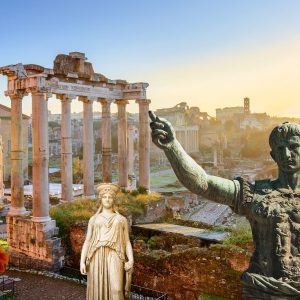
The fall of the Roman Empire remains one of the most studied events in world history. For centuries Rome had dominated the Mediterranean basin, ruling an empire that stretched from Britain to the Middle East. Yet by the late 5th century AD the Western Roman Empire had collapsed, marking a major turning point in European history.
The traditional date for the fall of the western empire is AD 476, when the Germanic leader Odoacer deposed the last Roman emperor, Romulus Augustulus. However, most historians now see the collapse not as a sudden event but as a gradual process that unfolded over several centuries.
Ancient historians such as Ammianus Marcellinus, writing in the 4th century, already described an empire facing mounting internal and external pressures. Later writers including Procopius and Jordanes also recorded the conflicts that reshaped the Roman world in late antiquity.
Early signs of decline
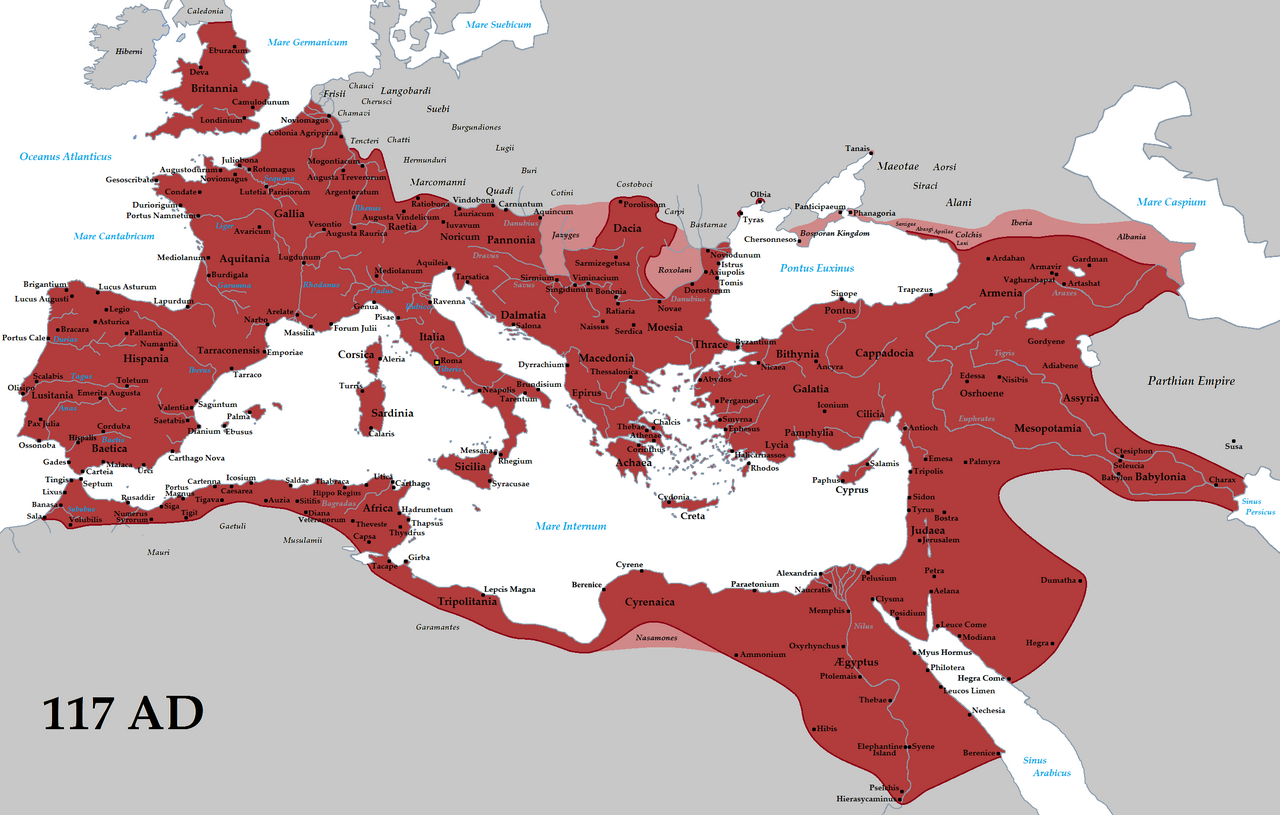
Although the Roman Empire reached its greatest territorial extent under Emperor Trajan in AD 117, maintaining such a vast territory created enormous administrative and military challenges.
By the 3rd century AD, the empire faced what modern historians call the Crisis of the Third Century (AD 235–284). During this period dozens of emperors rose and fell in rapid succession.
Herodian of Antioch, who lived during this turbulent era, wrote a not entirely reliable but very colourful history in Greek of the Empire titled History of the Empire from Marcus onwards (τῆς μετὰ Μάρκον βασιλείας ἱστορία) in eight books covering the years 180 to 238. He described the empire as being in a state of “constant disturbance”, with rival generals competing for imperial power.
The instability weakened central authority and diverted military resources away from defending the empire’s borders.
Political instability and civil war
Roman government was heavily dependent on strong leadership. However, the empire lacked a stable system of succession. Emperors were often chosen by the army or overthrown by rivals, leading to frequent civil wars.
Ancient sources frequently emphasise the damaging effects of these conflicts. The historian Cassius Dio, writing in the early 3rd century, described how competition for the throne repeatedly plunged the empire into turmoil.
Civil wars not only drained the treasury but also weakened frontier defences, making the empire more vulnerable to invasion.
Economic pressures
The Roman economy also faced increasing strain during the later centuries of the empire. Archaeological evidence and surviving documents indicate that inflation and taxation became serious problems.
Coins from the 3rd century show a steady decline in silver content, suggesting that the imperial government debased the currency to cover rising expenses.
These developments are also reflected in the writings of Diocletian, whose famous Edict on Maximum Prices (AD 301) attempted to control inflation across the empire. Although the policy ultimately failed, it provides valuable evidence of the economic pressures facing the Roman state.
Pressure on the empire’s frontiers
At the same time, the empire faced growing threats along its borders. Germanic groups such as the Goths, Vandals, and Franks increasingly crossed Roman frontiers, sometimes as invaders and sometimes as migrants seeking refuge.
The historian Ammianus Marcellinus described the arrival of large numbers of Gothic refugees along the Danube frontier in AD 376.
Roman authorities allowed them to settle within the empire, but poor treatment and corruption by local officials soon led to rebellion.
This conflict culminated in the Battle of Adrianople (AD 378), where Roman forces were defeated and Emperor Valens was killed.
Modern historians often regard this battle as one of the most significant military disasters in Roman history.
The sack of Rome
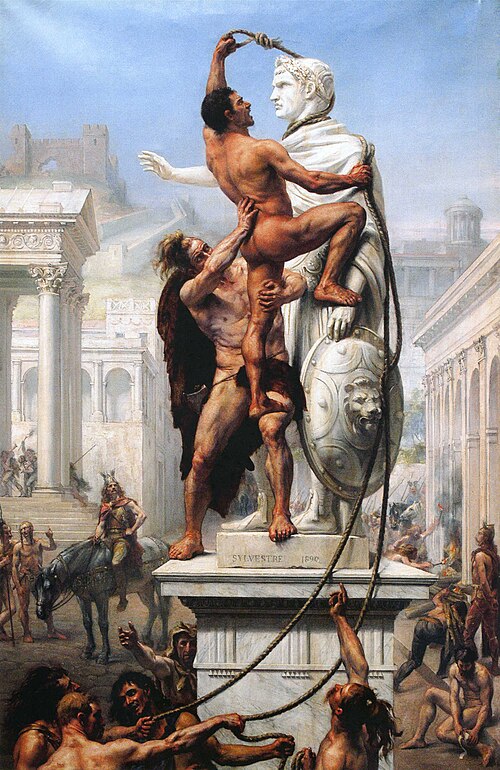
Rome suffered repeated sackings from 390BC. However, the symbolic power of Rome itself was truly shaken in AD 410, when the Visigothic king Alaric captured and looted the city.
In North Africa, the Christian theologian Augustine of Hippo responded to the crisis by writing The City of God, a major philosophical work that reflected on the decline of Roman power.
Although Rome was no longer the administrative capital of the empire, the sack demonstrated that the empire could no longer protect its historic centre.
The end of imperial rule in the west
By the mid-5th century, Roman authority in western Europe had largely collapsed. Germanic kingdoms had replaced Roman administration in many regions, while the remaining emperors relied heavily on military commanders of non-Roman origin.
According to later sources, including the historian Jordanes, the final act came in AD 476, when the Germanic leader Odoacer forced the young emperor Romulus Augustulus to abdicate.
Rather than appoint a new western emperor, Odoacer ruled Italy in the name of the eastern emperor in Constantinople. For many historians, this marked the end of the Western Roman Empire.
How historians interpret the fall of the Roman Empire
The question of why Rome fell has fascinated scholars for centuries. In the 18th century the historian Edward Gibbon famously argued that the empire declined because of internal decay and the rise of Christianity.
Modern historians tend to see the collapse as the result of multiple interacting factors, including political instability, economic pressures, military challenges and environmental change.
Archaeology, climate research and new interpretations of ancient sources continue to reshape our understanding of the late Roman world.
The legacy of Rome after the empire
Although the Western Roman Empire disappeared, Roman civilisation did not vanish.
The Eastern Roman Empire, centred on Constantinople, continued for nearly another thousand years and preserved many Roman institutions.
Meanwhile, Roman law, Latin language and Christian institutions shaped the development of medieval Europe. Even today, the legacy of Rome remains visible in European legal systems, architecture and political ideas.