Italy has one of Europe’s most complex political systems, combining a parliamentary democracy with strong regional government and a powerful constitutional court. We provide an overview of how the Italian government works.
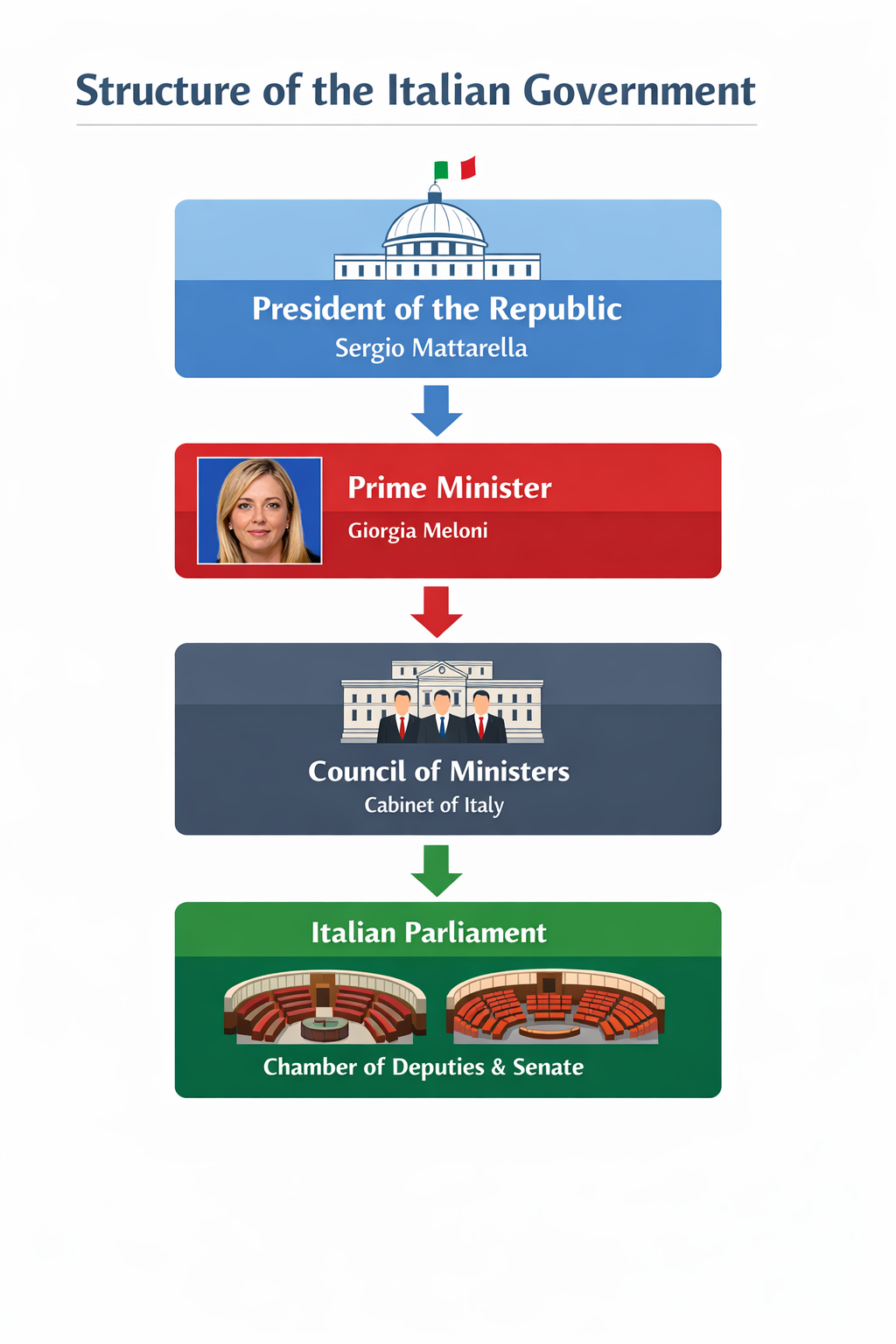
Summary of how the Italian government works: The Italian government operates within a parliamentary republic in which the prime minister leads the executive but must maintain the confidence of parliament. Legislative authority is held by a bicameral parliament made up of the Chamber of Deputies and the Senate. Meanwhile the president of the republic acts as head of state and guarantor of the constitution.
The modern Italian state was created in 1946 after the fall of the monarchy and the adoption of a republican constitution. Today, the country is governed through a system in which power is shared between the parliament, the government led by the prime minister, and the president of the republic.
Understanding how these institutions interact is essential to following political developments in Italy.
Italy as a Parliamentary Republic
Italy is officially the Italian Republic and operates under a parliamentary system established by the 1948 constitution. Unlike presidential systems, executive power in Italy depends on the support of parliament. The government must maintain the confidence of both legislative chambers in order to remain in office.
The key institutions in the system are:
- the parliament
- the government (Council of Ministers)
- the president of the republic
- the constitutional court.
These bodies together form the framework of Italian national governance.
The Italian Parliament
The legislative branch of the state is the Italian Parliament, which passes laws and holds the government accountable. Italy has a bicameral parliament, meaning it consists of two chambers with equal powers:
Chamber of Deputies
The lower house, the Chamber of Deputies, represents the national electorate. Deputies are elected directly by voters.
Senate of the Republic
The upper house is the Senate of the Republic. Senators are also elected by the public, although historically the Senate has included a small number of life senators appointed for distinguished service.
Both chambers must approve legislation in identical form before it becomes law. This process is often referred to as “perfect bicameralism”, a defining feature of the Italian political system.
Because both houses have the power to withdraw confidence from the government, coalition stability can be fragile.
The role of the Prime Minister and Government
Executive authority is exercised by the government, formally known as the Council of Ministers. The head of government is the prime minister, officially titled the President of the Council of Ministers.
The current government is led by Giorgia Meloni, who became prime minister in October 2022.

The government is responsible for:
- proposing legislation
- implementing laws
- managing national policy
- overseeing public administration
- representing Italy internationally.
The Council of Ministers
Cabinet ministers oversee specific departments such as finance, foreign affairs, defence and interior. Currently, there are 25 ministers in the Cabinet, including two deputy prime ministers: Antonio Tajani and Matteo Salvini. The deputies also hold other portfolios.
Ministers with Portfolios
These ministers run the main government departments.
- Foreign Affairs and International Cooperation — Antonio Tajani
- Interior — Matteo Piantedosi
- Justice — Carlo Nordio
- Defence — Guido Crosetto
- Economy and Finance — Giancarlo Giorgetti
- Business and Made in Italy — Adolfo Urso
- Agriculture, Food Sovereignty and Forests — Francesco Lollobrigida
- Environment and Energy Security — Gilberto Pichetto Fratin
- Infrastructure and Transport — Matteo Salvini
- Labour and Social Policies — Marina Elvira Calderone
- Education and Merit — Giuseppe Valditara
- University and Research — Anna Maria Bernini
- Culture — Alessandro Giuli
- Health — Orazio Schillaci
- Tourism — Daniela Santanchè
Ministers Without Portfolio
These ministers sit in the cabinet but oversee cross-government policy areas rather than traditional ministries.
- Relations with Parliament — Luca Ciriani
- Public Administration — Paolo Zangrillo
- Regional Affairs and Autonomies — Roberto Calderoli
- Civil Protection and Maritime Policies — Nello Musumeci
- European Affairs, Southern Italy, Cohesion Policy and the NRRP — Tommaso Foti
- Sport and Youth — Andrea Abodi
- Family, Birth Rate and Equal Opportunities — Eugenia Roccella
- Disabilities — Alessandra Locatelli
- Institutional Reforms and Regulatory Simplification — Elisabetta Casellati
Key Administrative Role
- Secretary of the Council of Ministers — Alfredo Mantovano
This role coordinates the work of the cabinet and the prime minister’s office.
The President of the Republic
The head of state is the President of Italy, currently Sergio Mattarella.

Although the role is largely ceremonial, the president has several important constitutional powers.
These include:
- appointing the prime minister
- dissolving parliament
- calling elections
- signing legislation into law
- acting as a guarantor of the constitution.
Parliament and regional representatives elect Presidents for a seven-year term. In times of political crisis, the president often plays a crucial role in forming new governments.
How governments are formed
After national elections, the president consults with political parties to determine who can command a parliamentary majority.
If a leader appears capable of forming a coalition, the president invites them to form a government. The new government must then win a confidence vote in both chambers of parliament.
If it fails, the president may invite another leader to try to form a government or call new elections. This process explains why Italian governments often rely on coalition agreements between multiple parties.
The Constitutional Court
The Italian Constitutional Court ensures that laws comply with the constitution.
The court has the authority to:
- strike down unconstitutional legislation
- resolve disputes between branches of government
- judge cases involving the president.
Its rulings are binding and can have major political consequences.
Regional Government in Italy
Italy is also a highly decentralised state. The country is divided into 20 regions, each with its own government and elected president.
Five regions have special autonomous status:
- Sicily
- Sardinia
- Trentino-Alto Adige/Südtirol
- Valle d’Aosta
- Friuli-Venezia Giulia.
Regional governments oversee areas such as healthcare, transport and economic development.
Italy’s Electoral System
Italian voters elect parliament using a mixed electoral system combining proportional representation and single-member constituencies.
This structure aims to balance political representation with stable governance. However, fragmented party politics often leads to coalition governments.
Why Italian governments change frequently
Italy has frequent changes of government. Several factors contribute to this:
- coalition politics
- proportional representation
- strong parliamentary powers
- divisions within political parties.
Despite this, the Italian state itself remains stable because institutions such as the presidency and the constitutional court provide continuity.
Why understanding Italy’s political system matters
Italy is the third-largest economy in the eurozone and a founding member of the European Union.
Political developments in Rome influence:
- European economic policy
- migration management
- energy security
- relations within the EU.
Understanding how the Italian government works helps explain the country’s political debates and policy decisions.
Frequently Asked Questions
Italy is a parliamentary republic where the government depends on the support of parliament.
The prime minister leads the government and chairs the Council of Ministers.
The president of the republic is the head of state and plays a constitutional oversight role.
Italy has two legislative chambers: the Chamber of Deputies and the Senate of the Republic.