Raffaello Sanzio da Urbino, known to history simply as Raphael, died on 6 April 1520, aged just 37. The date marked the end of one of the most influential careers in Western art. Raphael died in Rome at the height of his fame, mourned so deeply that, according to accounts of the time, a crack appeared in the Vatican following the news. His funeral was a grand affair.
Raffaello Sanzio da Urbino was an Italian painter and architect of the High Renaissance. His work is admired for its clarity of form, ease of composition, and visual achievement of the Neoplatonic ideal of human grandeur. Together with Leonardo da Vinci and Michelangelo, he forms the traditional trinity of great masters of that period. Of the three, he alone died young. The other two lived into their eighties. What those extra decades might have yielded is one of art history’s great unanswerable questions.
Early Life
Raphael was born on 6 April 1483 in Urbino, a small city in the Marche region of central Italy that punched far above its weight in cultural terms. Urbino had become a centre of culture during the rule of Duke Federico da Montefeltro, who encouraged the arts and attracted the visits of men of outstanding talent, including Donato Bramante, Piero della Francesca and Leon Battista Alberti, to his court. To be born into this environment was to receive an education in aesthetic ambition simply by breathing the air.
Raphael’s father, Giovanni Santi di Pietro, worked as a painter for Federigo da Montefeltro, where he was the head of a well-known studio. Raphael was the only child of three to survive infancy. His father taught him the basics of painting from earliest childhood. He also exposed him to the humanist philosophy that permeated the Urbino court, ideas about the dignity of the individual, the harmony of knowledge and beauty, the marriage of classical learning and Christian faith that would eventually find their supreme expression in the Vatican frescoes.
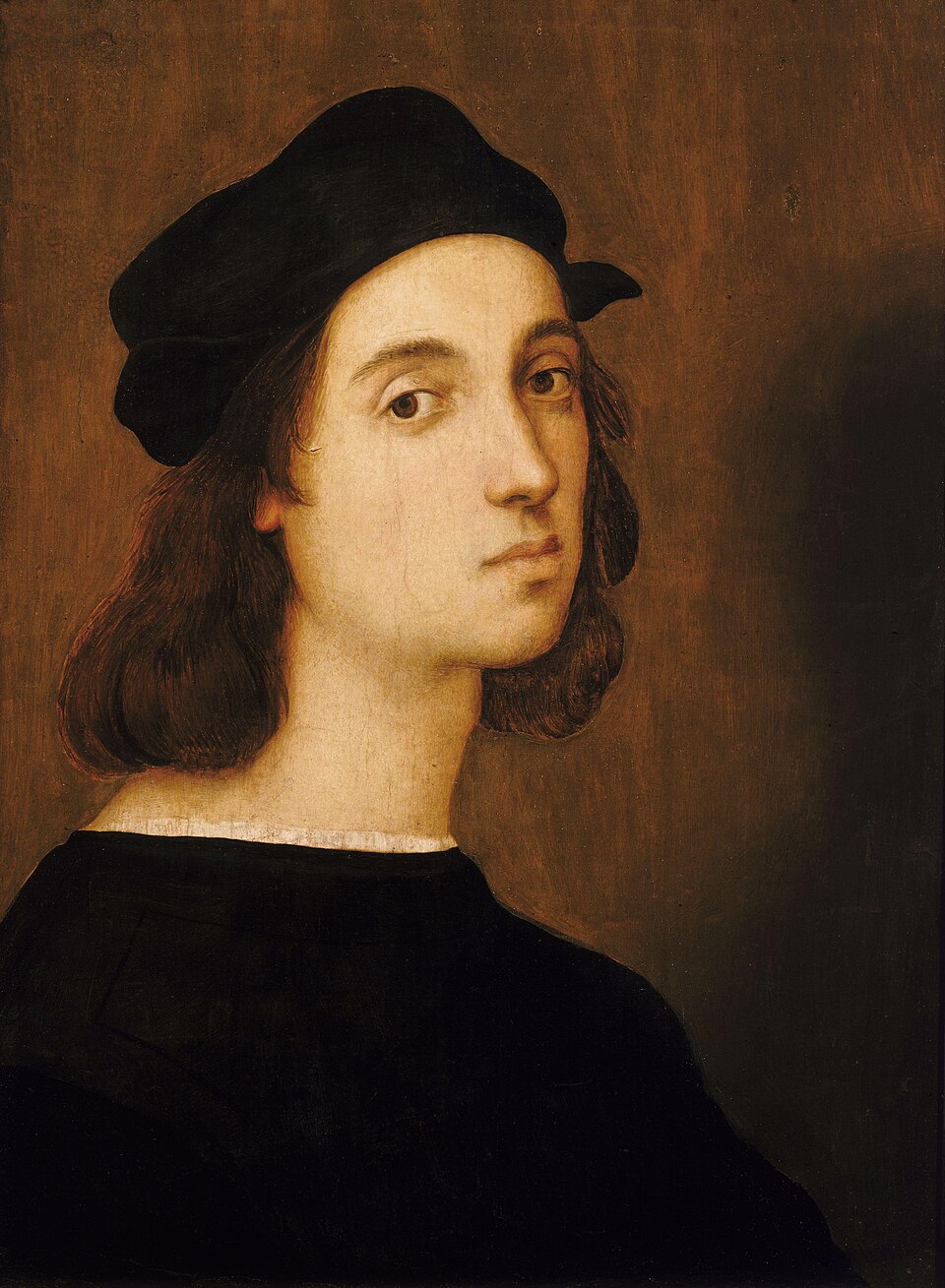
Tragedy arrived early. His mother died in 1491 when Raphael was nine years old, and his father remarried to Bernardina, the daughter of a goldsmith, the following year. Then, in 1494, Giovanni Santi died too, leaving an eleven-year-old boy to manage his father’s workshop. According to Giorgio Vasari , Raphael had already been “a great help to his father,” and a self-portrait drawing from his teenage years confirms the almost unsettling precocity of his talent.
Surpassing his master
According to Vasari, Raphael’s father placed him in the workshop of the Umbrian master Pietro Perugino as an apprentice “despite the tears of his mother.” Perugino was one of the finest painters of his generation, his style characterised by serene compositions, gentle figures and luminous Umbrian landscapes. He was working on frescoes for the Collegio del Cambio in Perugia when Raphael joined his studio, and the young apprentice absorbed everything his master could offer.
The absorption was so complete that it became almost problematic. As the art historian Heinrich Wölfflin observed, “probably no other pupil of genius has ever absorbed so much of his master’s teaching as Raphael did.” Vasari wrote that it was impossible to distinguish between their hands at this period. Yet Raphael was already beginning to surpass his teacher. By age 17 Raphael was a “master,” yet he continued to study the work of his contemporaries, notably Leonardo da Vinci and Michelangelo.
His first documented commission came in 1500: an altarpiece for the church of Saint Nicholas of Tolentino in Città di Castello, a town halfway between Perugia and Urbino. Unfortunately, an earthquake in 1789 damaged the altarpiece and only fragments survive. But other early works survive in better condition: among them the Mond Crucifixion (c.1503), and most significantly The Marriage of the Virgin (1504), now in the Brera in Milan, which already shows Raphael beginning to transcend Perugino’s careful orderliness with something altogether more animated and emotionally alive.
Florence: The Crucible
In 1504, Raphael left Umbria and moved to Florence, and the experience transformed him. The city was in the grip of a creative ferment unlike anything Europe had seen. Leonardo da Vinci and Michelangelo were both working there. Masaccio’s revolutionary frescoes in the Brancacci Chapel had redefined how paint could describe space and human weight. Raphael was heavily influenced by the works of Fra Bartolommeo, as well as those of Leonardo da Vinci, Michelangelo and Masaccio. To Raphael, these innovative artists had achieved a whole new level of depth in their composition.
He responded with characteristic intelligence: not by imitating what he saw, but by studying it, digesting it and making it his own. Leonardo had developed a new way of arranging figures in a pyramidal composition, stable, harmonious, deeply human. Raphael took the idea and ran with it, producing in his Florentine years a series of Madonna paintings that remain among the most beloved in Western art. He became a noted portraitist and painter of Madonnas, and his output during this period, from around 1504 to 1508, is staggering in its quantity and quality.
Works in the Uffizi
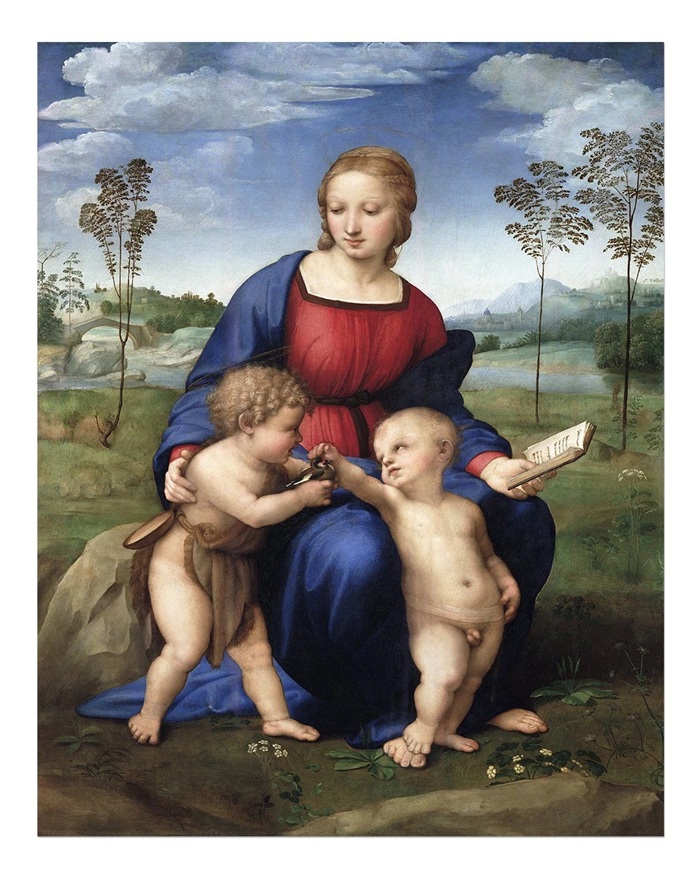
The Madonna of the Goldfinch, now in the Uffizi in Florence, is a prime example. The Virgin seated in an open landscape, the Christ child and the young St John the Baptist studying a goldfinch, a bird traditionally associated with the Passion of Christ, with expressions that are at once devotional and entirely, humanly tender.
The Uffizi also holds Raphael’s portraits of Agnolo Doni and his wife Maddalena Strozzi, members of a wealthy Florentine family who were also the patrons of Michelangelo’s Tondo Doni, placing them at the intersection of two of the greatest careers of the age.


At the Palazzo Pitti in Florence, the Palatine Gallery holds two more works of particular resonance. The Madonna della Seggiola (the Madonna of the Chair) is among the most intimate of all Raphael’s religious works. The Virgin and Child and young St John enclosed in a circular tondo that creates an almost unbearably human sense of a mother holding her child. And then there is La Fornarina, “the baker’s daughter”, a half-length portrait of a dark-eyed, bare-breasted young woman whose gaze meets the viewer with unsettling directness.
A permanent fixture in Raphael’s life in Rome was “La Fornarina”, Margherita Luti, the daughter of a baker named Francesco Luti from Siena.The bracelet on her arm in the painting bears the inscription RAPHAEL VRBINAS, his own name, marking her as his. It is one of the most personal acts of possession in the history of portraiture.
Raphael in Rome
In 1508, a summons arrived from Pope Julius II. The most powerful pope of the age — a warrior-pontiff who had rebuilt St Peter’s Basilica and commissioned Michelangelo to paint the Sistine Chapel ceiling — wanted a young painter from Urbino to decorate his private apartments in the Vatican Palace. Raphael was 25 years old.
He commissioned Raphael and his studio in 1508 or 1509 to redecorate the existing interiors of the rooms entirely. It was possibly Julius’ intent to outshine the apartments of his predecessor (and rival) Pope Alexander VI. The rooms already contained work by distinguished painters including Piero della Francesca, Perugino and Luca Signorelli. Julius had them all painted over. The rooms would become Raphael’s.
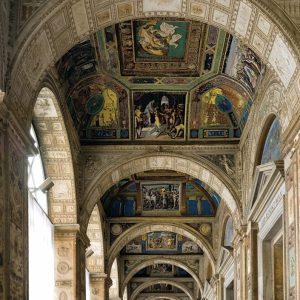
The Stanza della Segnatura was the first to be frescoed. What Raphael produced there between 1509 and 1511 would change the course of European art. The theme of this room was worldly and spiritual wisdom and the harmony which Renaissance humanists perceived between Christian teaching and Greek philosophy. Four immense frescoes address theology, philosophy, poetry and law — the four pillars of human knowledge as the Renaissance understood them.
The School of Athens
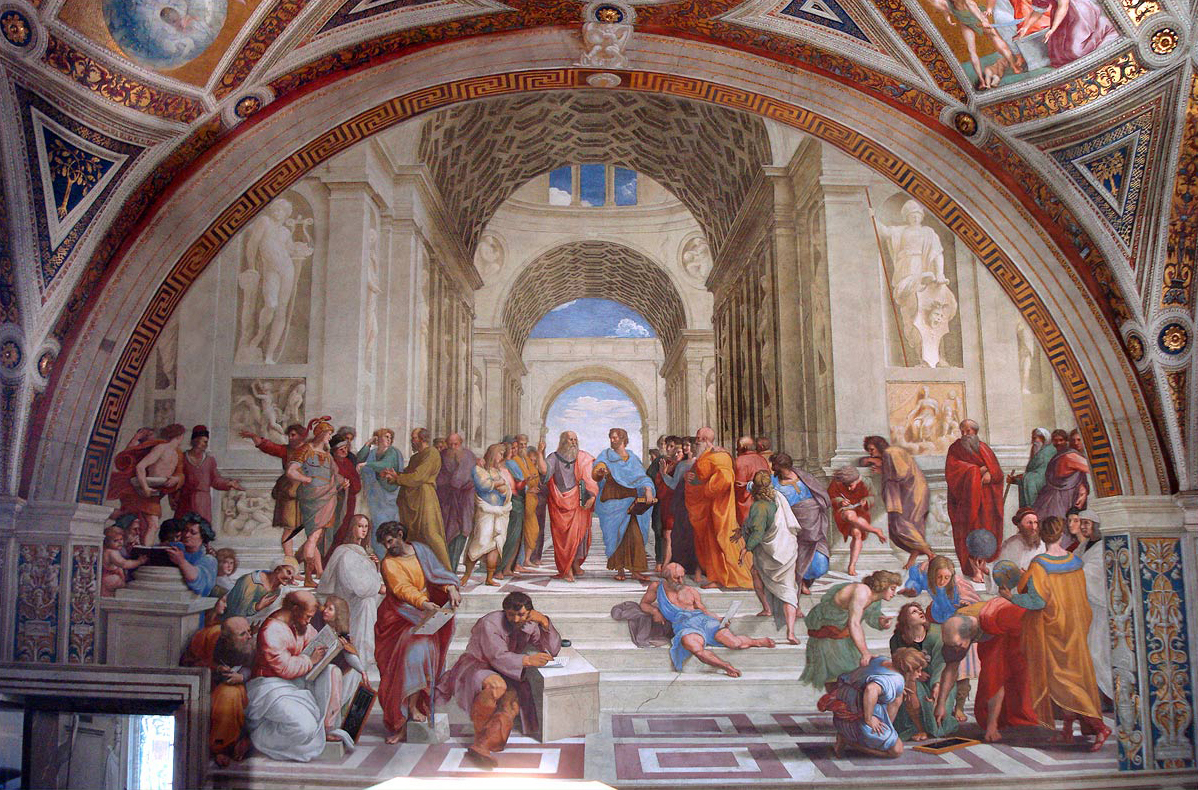
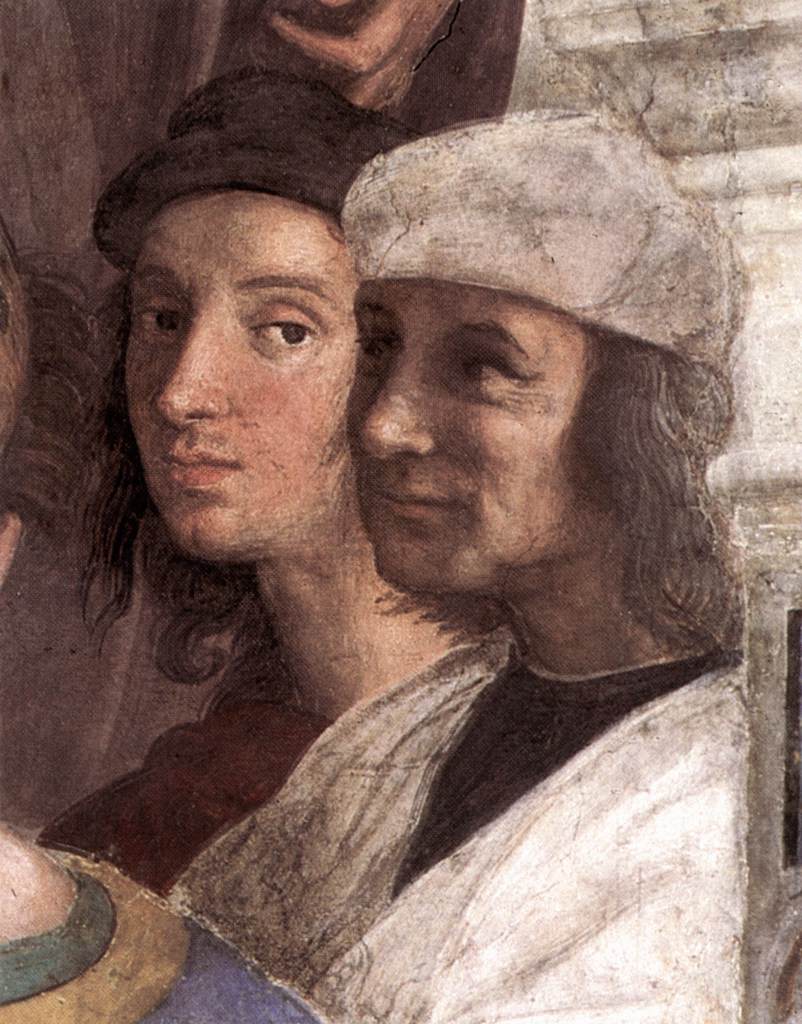
The most celebrated of these, and arguably the most famous fresco in the world after Michelangelo’s Sistine Chapel ceiling, is The School of Athens. It depicts a congregation of ancient mathematicians, philosophers and scientists, with Plato and Aristotle featured in the centre. Among those commonly identified are Socrates, Pythagoras, Archimedes, Heraclitus, Averroes, Euclid and Zarathustra. Additionally, Leonardo da Vinci and Michelangelo are believed to be portrayed through Plato and Heraclitus respectively. Raphael included a self-portrait beside Ptolemy.
It is a breathtaking act of intellectual synthesis. All of human philosophical thought gathered into a single, luminous space, presided over by the two great poles of ancient philosophy: Plato pointing upward, toward the ideal; Aristotle gesturing downward, toward the world as it is. And somewhere in the crowd, looking out at us, is Raphael himself.
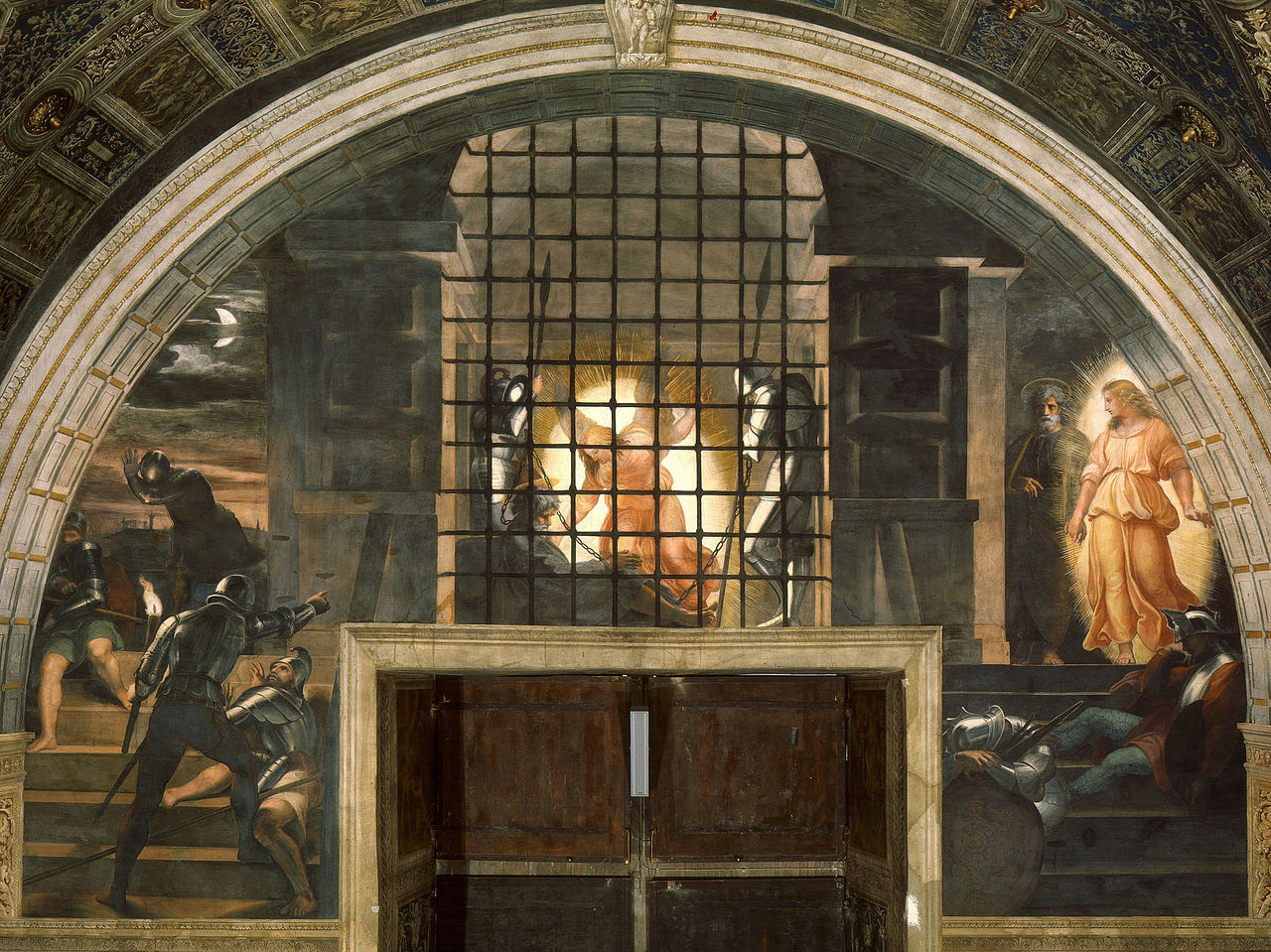
The Stanza d’Eliodoro came next, between 1511 and 1514. Instead of the static images of the Pope’s library, Raphael now had dramatic narratives to portray, and his approach was to maximise the frescoes’ expressive effects. He represented fewer, larger figures so that their actions and emotions have more direct impact on the viewers, and used theatrical lighting effects to spotlight certain figures and heighten tension.
The Liberation of Saint Peter, in which an angel frees the apostle from prison in a nocturnal scene of extraordinary luminosity, is one of the most technically astonishing night scenes in the whole of Renaissance painting.
Architect, Antiquarian, Celebrity
Julius II died in 1513, and his successor, Leo X — a Medici pope, cultivated and humanist — continued to lavish commissions on Raphael. In 1514, on the death of Bramante, he was appointed architect in charge of St Peter’s. He was also appointed Superintendent of Roman Antiquities and given responsibility for overseeing and documenting the ancient ruins of the city. This role effectively made Raphael the world’s first professional archaeological conservator. He began compiling a survey of ancient Rome which he never completed.
The pope made him a “Groom of the Chamber”, which gave him status at court and an additional income, and also a knight of the Papal Order of the Golden Spur. Vasari claims that he had toyed with the ambition of becoming a cardinal. He was simultaneously designing palaces, painting altarpieces, producing tapestry cartoons for the Sistine Chapel and running what was, by this point, one of the largest artistic workshops in Europe, with dozens of assistants executing works to his designs.
The sheer scale of this operation inevitably meant that not everything that bears Raphael’s name was entirely by his hand. In his later Roman years, Raphael designed many works but his assistants, in the main, painted them. The best scholars can usually distinguish the master’s touch from his pupils’, saying there is a quality of luminous calm in Raphael’s own passages of painting that his assistants could approximate but never quite replicate.
La Fornarina and the Question of the Heart
For all his professional triumphs, Raphael had a complicated personal life. He never married, but in 1514 became engaged to Maria Bibbiena, Cardinal Bibbiena’s niece. He seems to have been talked into this by his friend the cardinal. His lack of enthusiasm seems to be shown by the marriage not having taken place before she died in 1520.
The real attachment of his life in Rome was Margherita Luti whom he kept, according to various sources, in a house in Trastevere and whom he clearly loved with an intensity that his engagement to the more socially suitable Maria Bibbiena could not displace. Two of his most striking portraits — La Fornarina and La Donna Velata — are believed to depict her. The latter, a portrait of a veiled woman of extraordinary self-possession, shows a figure whose identity remains debated but whose psychological presence is among the most compelling in all of Renaissance portraiture.
![La Donna Velata By Raphael - https://web.archive.org/web/20060505064506/http://www.deutsche-liebeslyrik.de/manuskript/man4_seite10.htm. There are two hi-res images of this painting on the internet, and though the previously uploaded image is to some degree more pleasing to the eye, this image I've uploaded is more accurate. It was originally obtained from Visipix when it was a free serviceOriginally from en.wikipedia; description page is (was) here* 01:05, 31 March 2006 [[:en:User:R6|R6]] 2221×2859 (929,319 bytes) <span class="comment">(Raphael "Woman")</span>R6 on en.wikipedia, Public Domain, https://commons.wikimedia.org/w/index.php?curid=1957467](https://italynews.online/wp-content/uploads/2025/04/960px-La_donna_velata_v2.jpg)
Vasari, characteristically, turned the relationship into a cautionary tale. He mentions Raphael’s love of women and alleges that the fever that killed him was due to a night of excess passion. Most modern historians are sceptical of this colourful account. A sudden fever of unknown origin seems a more likely and less dramatically convenient explanation.
The death of Raphael
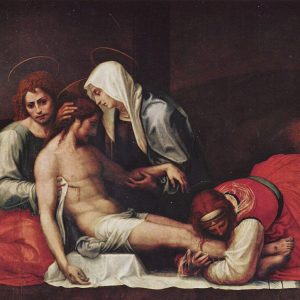
On 6 April 1520, his 37th birthday, Raphael died in Rome. He had been working on what would have been his largest canvas painting: the Transfiguration, commissioned in 1517, a monumental work depicting Christ’s transfiguration on the mountain with the healing of a possessed boy in the scene below, its two halves united by the upward gaze of the figures in the lower register. When his funeral mass was held at the Vatican, Raphael’s unfinished Transfiguration was placed on his coffin stand.
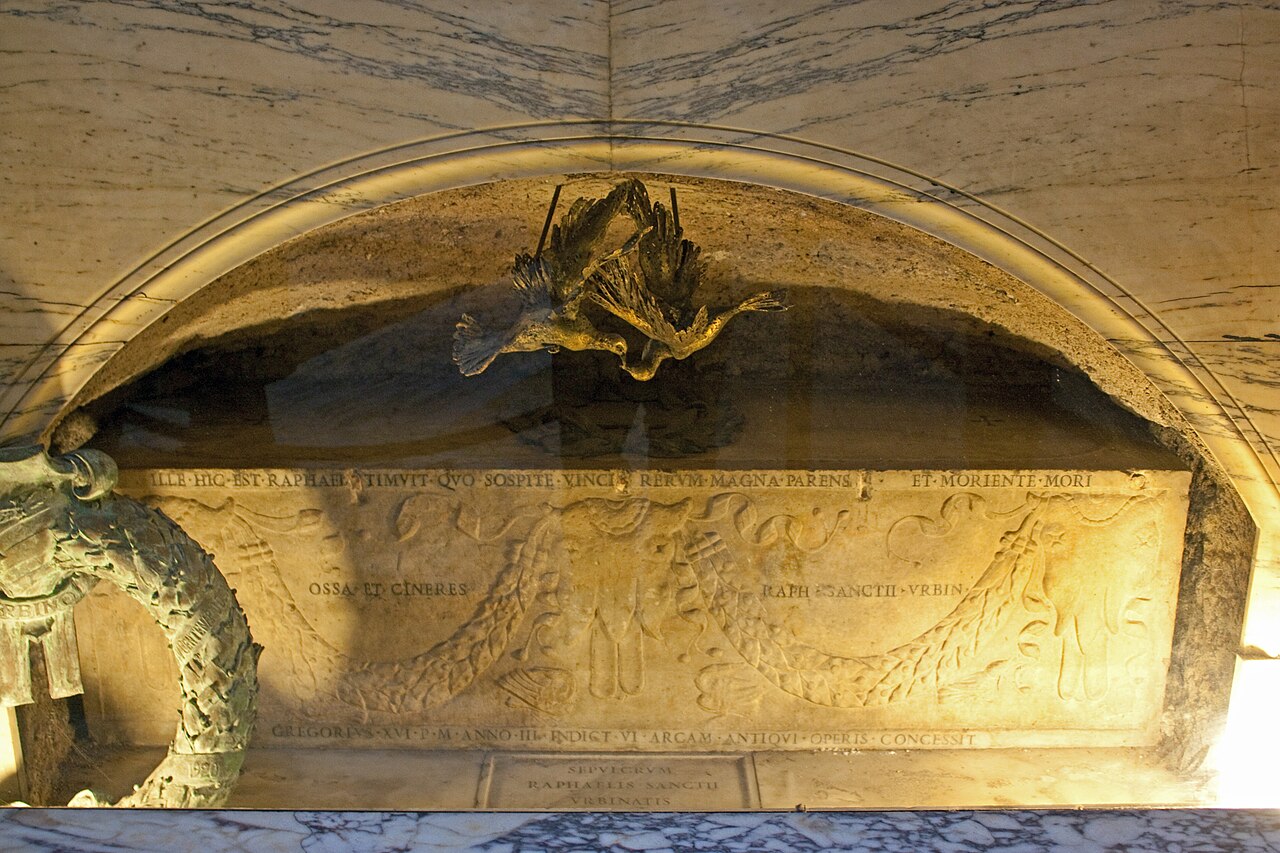
The city mourned extravagantly. Giorgio Vasari recorded the grief as universal. His death was mourned throughout Italy, and he was buried in the Pantheon, a fitting resting place for an artist who had so profoundly contributed to the Renaissance’s artistic legacy. The inscription on his tomb, composed by the humanist Pietro Bembo, remains one of the most famous epitaphs in history:
“Here lies Raphael, by whom Nature feared to be outdone while he lived, and when he died, feared she too would die.”
Where to See Raphael
Raphael’s work is spread across Italy and Europe, but Florence and Rome are the essential pilgrimage points.
In Florence, the Uffizi holds the Madonna of the Goldfinch and the double portrait of Agnolo Doni and Maddalena Strozzi. At the Palazzo Pitti, the Palatine Gallery houses the Madonna della Seggiola, La Fornarina and several other works of the Roman period. Seeing them alongside works by Leonardo and Michelangelo is to understand the phrase “High Renaissance” not as a period label but as a lived, competitive creative reality.
In Rome, the Vatican Museums hold the four Raphael Rooms which are an essential experience for any visitor. The School of Athens alone justifies the journey. And the Pantheon remains open to visitors; his tomb is modest, the inscription unforgettable.
Beyond Italy, the National Gallery in London holds several important works including The Ansidei Madonna and a portrait of Pope Julius II. The Louvre in Paris holds the portrait of Baldassare Castiglione, one of the greatest portraits of the Renaissance, depicting the author of The Book of the Courtier with an expression of such quiet intelligence and calm authority that it feels like a summary of an entire civilisation.
Michelangelo, ever a rival, once claimed: “Everything he knows of art, he learnt from me.” Yet Raphael’s style was his own – calm, graceful, deeply human.
For tours of the Uffizi, visit Floeasy.online