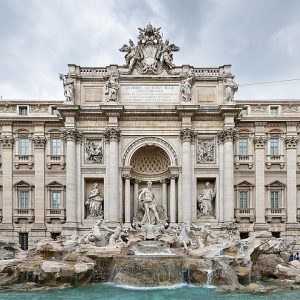
On 8th February 1751, Nicola Salvi, the architect forever associated with Rome’s Trevi Fountain, died while still at work on the project that would define his legacy.
Salvi had been engaged on the Trevi Fountain since 1732 and devoted nearly two decades to its design and construction. Although he did not live to see it completed, his vision shaped what would become one of the most recognisable monuments in the world. After his death, the work was continued by Giuseppe Pannini, while the monumental statue of Oceanus in the central niche was sculpted by Pietro Bracci. Despite these later contributions, Salvi is rightly remembered as the fountain’s principal architect.
Born in Rome in 1697 to a wealthy family believed to have origins in Abruzzo, Nicola Salvi showed early intellectual promise. He initially studied mathematics and philosophy before turning to architecture, training under Antonio Canevari. When Canevari left Rome in 1727 to work for the Portuguese court in Lisbon, Salvi took over his workshop and completed several outstanding commissions on his behalf. Much of his time, however, was spent teaching, and for many years his own architectural output remained modest.
Salvi’s rise to prominence
Salvi’s career changed dramatically in 1732, when Pope Clement XII launched two major architectural competitions. One was for a new façade for the Basilica of San Giovanni in Laterano. Although Salvi did not win, his design was praised and he was invited to collaborate on elements of the final project alongside Alessandro Galilei, the eventual winner, and Luigi Vanvitelli.
The second competition proved decisive. It concerned the revival of a long-abandoned project to create a monumental fountain at the end of the ancient Aqua Virgo aqueduct, in front of the Palazzo Poli. Gian Lorenzo Bernini had first proposed a design more than a century earlier, but it had never been realised. Accounts differ on the outcome of the competition, but Salvi’s proposal was not initially the preferred choice. Designs by Florentine architects, including Galilei or Ferdinando Fuga, were favoured. Public opinion, however, held that such an important Roman monument should be entrusted to a Roman architect. Pope Clement XII ultimately agreed and awarded the commission to Salvi.
Theatrical composition of stone and water
Salvi conceived the Trevi Fountain as a theatrical composition in stone and water. A vast basin is framed by a rugged, rock-like cliff, from which the Palazzo Poli appears almost to emerge. At its centre stands Oceanus, the Titan god of the sea, positioned within a grand arched niche directly above the point where the aqueduct’s waters flow into the basin. The monumental façade of the Palazzo Poli, designed by Vanvitelli, provides a dramatic architectural backdrop, integrating palace and fountain into a single visual statement.
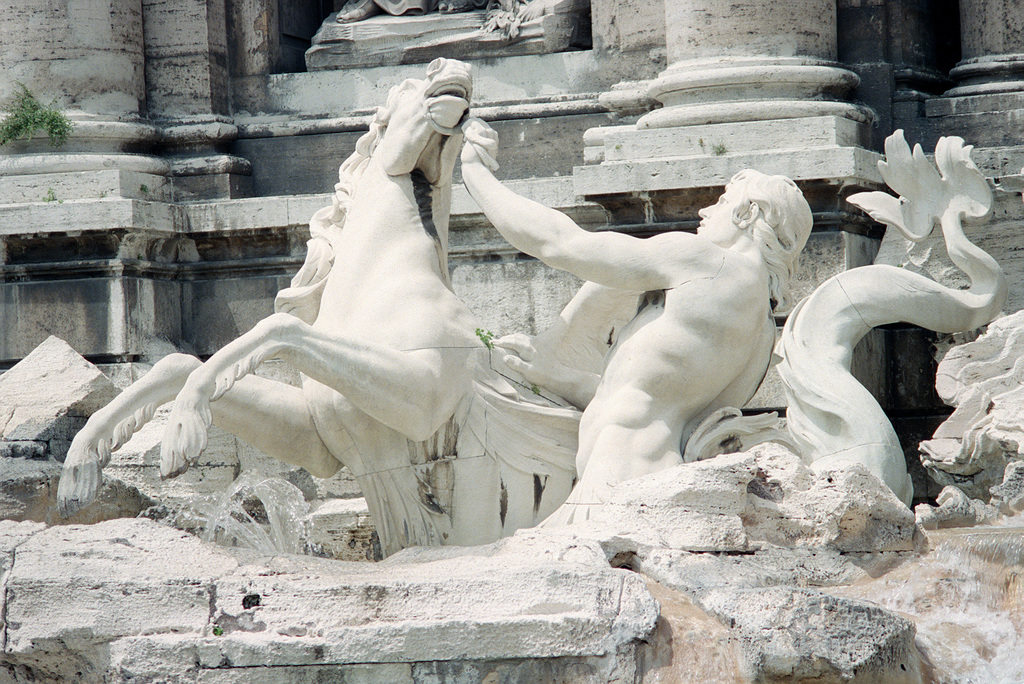
Completed in the decades after Salvi’s death, the Trevi Fountain became the largest Baroque fountain in Rome and one of the most significant architectural works of the 18th century. Its name derives from its location at the junction of three roads, or tre vie, and its enduring fame has made it one of the most visited sites in the city.
Also read: Inauguration of the Trevi Fountain
Outside the Trevi, much of Salvi’s work has been lost. A baptistery he designed at the Basilica of St Paul Outside the Walls was destroyed in the fire of 1823, while his reconstruction of Santa Maria a Gradi in Viterbo was flattened during the Second World War. As a result, his reputation rests almost entirely on the fountain that bears his vision.
Nicola Salvi died at his home in Via della Colonna at the age of 53. He had suffered from chronic bronchial problems, believed to have been caused by the many hours he spent working in the damp tunnels of the Aqua Virgo aqueduct. His name lives on not only through the Trevi Fountain itself, but also in Via Nicola Salvi, the street that runs alongside the Colosseum.