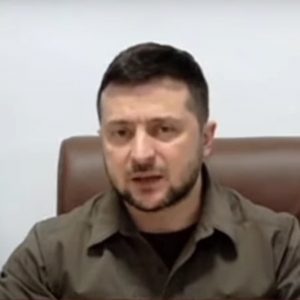
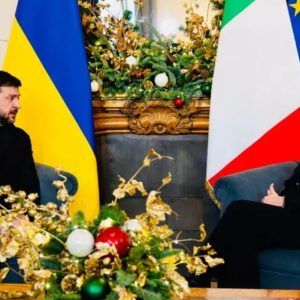
Italian Deputy Premier and Foreign Minister Antonio Tajani spoke optimistically about the ongoing efforts to end the war in Ukraine, following discussions in Berlin involving European leaders, American representatives, and Ukrainian President Volodymyr Zelensky. On Tuesday, Tajani reaffirmed Italy’s significant contribution to securing a peaceful resolution, particularly focusing on providing security guarantees for Ukraine.
Tajani’s comments were made on the sidelines of the 18th conference of ambassadors at Italy’s foreign ministry in Rome. He expressed confidence in the prospects for Ukraine’s security, noting that the United States would play a central role in the proposed guarantees.
Positive prospects for Ukraine security
“The prospects regarding security guarantees for Ukraine are very positive,” Tajani told reporters, highlighting the importance of international cooperation. “The Americans will be part of it, and they have made it clear that there will be a mechanism similar to NATO Article 5, which is the Italian proposal too.”
Article 5 of the NATO treaty, which stipulates collective defence in the event of an attack on a member state, is seen as a key principle in ensuring Ukraine’s long-term security. Tajani stressed the importance of U.S. involvement, particularly in the area of air defence and airspace protection, describing their participation as “indispensable.”
Italy’s role in European negotiations
Tajani was quick to emphasise Italy’s influence in European negotiations, acknowledging the country’s pivotal role in shaping discussions on Ukraine’s future. “Italy’s position was important in the European negotiations once again,” he stated, underscoring that Italy’s security proposals were widely accepted due to their logical and practical nature.
“Italy’s proposals, especially with regard to the security of Ukraine and Europe, were accepted because they were common-sense proposals,” Tajani added, reinforcing Italy’s diplomatic efforts in securing Ukraine’s future within the European framework.
Concerns over Russian asset freezing
Despite Italy’s strong stance on security guarantees, Tajani also addressed the ongoing debate surrounding the potential use of frozen Russian assets to support Ukraine. While Italy is “politically” in favour of the idea, the Deputy Premier expressed legal reservations regarding the move.
“The idea of using frozen Russian assets to aid Ukraine is politically sound, but there are concerns about its legal implications,” Tajani explained. Italy is treading carefully on this matter, aware of the complex legal frameworks that govern such actions on the international stage.
Salvini’s controversial remarks and Russian response
The remarks of Italian Deputy Prime Minister Matteo Salvini also made headlines earlier this week. Salvini, who is the leader of the far-right League party, has long been a vocal critic of Italy’s current foreign policy towards Russia. In an outspoken statement, Salvini compared the current European stance on Russia to the failed campaigns of Napoleon and Hitler against Moscow.
“If Hitler and Napoleon failed to bring Moscow to its knees with their campaigns in Russia, Kaya Kallas, Macron, Starmer and Merz are unlikely to succeed,” Salvini remarked, drawing a comparison between historical military failures and current Western efforts to challenge Russia.
The Russian Foreign Ministry spokeswoman, Maria Zakharova, praised Salvini’s comments, agreeing with his assessment. “The comparison is accurate, the conclusion is indisputable,” Zakharova wrote in a Telegram post, acknowledging Salvini’s critique of Western policy.
Salvini has been known for his previous admiration of Russian President Vladimir Putin, and his scepticism towards further military aid to Ukraine. He has warned that continuing to arm Kyiv could risk prolonging the conflict, a sentiment that resonates with a section of Italy’s far-right and Eurosceptic factions.