As Italy marks the 800th anniversary of the death of St Francis of Assisi, attention naturally turns to the man and his spiritual revolution. Yet to understand Francis properly, one must first understand the town that formed him.
The Assisi into which St. Francis was born in 1181 or 1182 was not a tranquil religious enclave. It was a politically unstable, socially divided, economically ambitious commune navigating the violent realities of central Italy in the High Middle Ages.
What was the political structure of Assisi in the 12th century?
In the late 1100s, Assisi was a self-governing commune, part of the broader movement of urban autonomy reshaping central and northern Italy. Like other communes, it had consuls and councils drawn from leading families. But governance was fragile.
Assisi sat in contested territory between Papal authority and imperial influence linked to the Holy Roman Empire. Allegiances shifted. Local elites manoeuvred constantly to preserve status and control. Political conflict was not theoretical; it involved street violence, property seizure, exile, and periodic armed clashes.
The communal structure was dominated by noble lineages and rising merchant families. Rival factions, including the powerful Monaldi and Frecce families, fought for municipal dominance. Civic instability was therefore a routine part of urban life.
Francis grew up in this atmosphere. Political power was visible, unstable and frequently exercised through coercion. Authority was contested, not sacred. This early exposure could explain why, later in life, he would reject conventional forms of prestige and refuse positions of hierarchical power even within his own movement.
How did the emerging merchant class change Assisi?
Francis’s father, Pietro di Bernardone, was part of Assisi’s expanding merchant elite. Textile trade connected the town to regional markets in Umbria and beyond. Commercial wealth was beginning to rival older noble privilege.
The rise of merchants created new tensions. Nobility derived status from lineage and land. Merchants derived influence from liquidity and trade networks. Competition for civic offices intensified. Political violence often reflected this deeper economic shift.
The Bernardone family’s prosperity placed Francis among the privileged urban class. He had access to education, exposure to trade networks and familiarity with civic leadership. But he also witnessed how wealth created rivalry, exclusion and resentment.
Francis’s later rejection of inheritance and material property was not an abstract spiritual gesture. It was a concrete break from the economic culture that shaped his upbringing.
What were living conditions like in medieval Assisi?

Assisi in the 12th century was densely built within defensive walls. Streets were narrow and uneven. Houses ranged from stone towers owned by elite families to modest dwellings clustered around workshops and markets.
Most residents lived precariously. Agricultural labourers worked the surrounding Umbrian hills. Artisans produced ceramics, leather goods and textiles. Seasonal instability, poor harvests and limited sanitation made hardship common.
Public space revealed inequality clearly. Markets were hubs of economic exchange, but also reminders of class hierarchy. Wealth was concentrated, whilst poverty was visible.
Francis’s later emphasis on identifying with the poor should be understood in this setting. Poverty in Assisi was not symbolic; it was structural. His embrace of voluntary poverty was radical precisely because it inverted the values of his class.
What role did the church play in Assisi’s civic life?
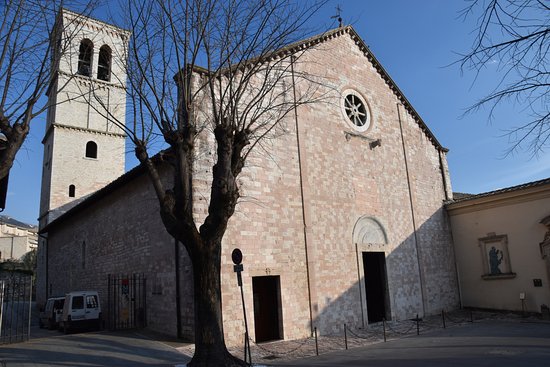
Religion in Assisi was inseparable from politics and economy. Major churches such as Cathedral of San Rufino and Santa Maria Maggiore were not only places of worship but institutional landholders and centres of influence.
Monastic communities, including the Benedictines at San Damiano, controlled property and resources. Clergy interacted regularly with civic authorities. At the same time, church festivals reinforced hierarchy just as much as devotion.
Francis grew up immersed in this environment. He saw both genuine piety and institutional power. His later insistence on evangelical simplicity did not reject the Church; it sought to strip it back to its apostolic foundations. That impulse only makes sense in the context of a Church deeply embedded in property and politics.
How violent was Assisi during Francis’s youth?
Assisi was not constantly at war, but violence was a regular instrument of political negotiation. Internal factional disputes sometimes escalated into armed confrontation. Exile of rival families was common practice across Italian communes, not limited to Assisi.
Beyond internal conflict, Assisi clashed with neighbouring Perugia in the late 12th century. Communal warfare between Umbrian towns was frequent. Although the major battle between Assisi and Perugia occurred in 1202, slightly after Francis’s youth, the climate of militarisation was already present during his formative years.
Young men of merchant families were expected to participate in civic defence. Francis himself would later take part in military action and experience captivity. His later rejection of violence should therefore be read against a culture that normalised it.
How did civic honour and reputation shape Assisi’s society?
Medieval Assisi operated within a culture of honour. Family prestige mattered, so public reputation influenced marriage alliances, commercial credibility and political advancement. Disputes over an alleged insult or status could escalate quickly.
Francis grew up within this honour culture. His early life reportedly included participation in youthful displays of wealth and status typical of prosperous urban sons. His later embrace of humility was a direct challenge to this system of public honour.
What cultural influences surrounded Francis?

Assisi was culturally active within the broader Umbrian context. Oral storytelling, religious drama, vernacular poetry and liturgical music were integral to civic life. Trade brought exposure to ideas and influences from beyond the region.
Francis’s later use of vernacular language, poetic expression and symbolic gestures did not emerge in isolation. They were tools shaped by an urban culture accustomed to public performance and communal ritual.
Francis’s famous canticles and public preaching reflect an understanding of audience and message formed in the marketplaces and piazzas of Assisi.
Why does Assisi’s political reality matter for understanding Francis?
It is tempting to portray Francis as emerging from a serene spiritual landscape. However, the historical record suggests the opposite.
He came of age in a town defined by factional rivalry, economic ambition, visible inequality and institutional religion intertwined with civic power. Authority was contested. Wealth generated conflict. Violence was a tool of politics.
Francis’s later programme – voluntary poverty, reconciliation, peacemaking, obedience without domination – reads less as mystical abstraction and more as a deliberate inversion of the structures that shaped him.
The Franciscan movement’s emphasis on fraternity rather than hierarchy, itinerancy rather than territorial control, and poverty rather than property ownership can be seen as responses to the specific communal tensions of late 12th-century Assisi.
Frequently Asked Questions
Parts of Assisi were economically successful, particularly merchant families involved in textile trade. However, wealth was unevenly distributed, and poverty was widespread among labourers and artisans.
Like many Italian communes, Assisi shifted allegiance depending on political advantage. The town’s location in central Italy meant it navigated between Papal influence and imperial power.
Francis was born into a prosperous merchant household. This gave him access to education and social status but also exposed him to economic rivalry and class tension, shaping his later rejection of wealth.
No. Factional disputes and regional conflicts were common. Communal politics involved periodic violence, exile and armed confrontation.
Francis’s radical embrace of poverty, humility and peacemaking becomes clearer when placed against the competitive, status-driven and politically unstable environment of medieval Assisi.