
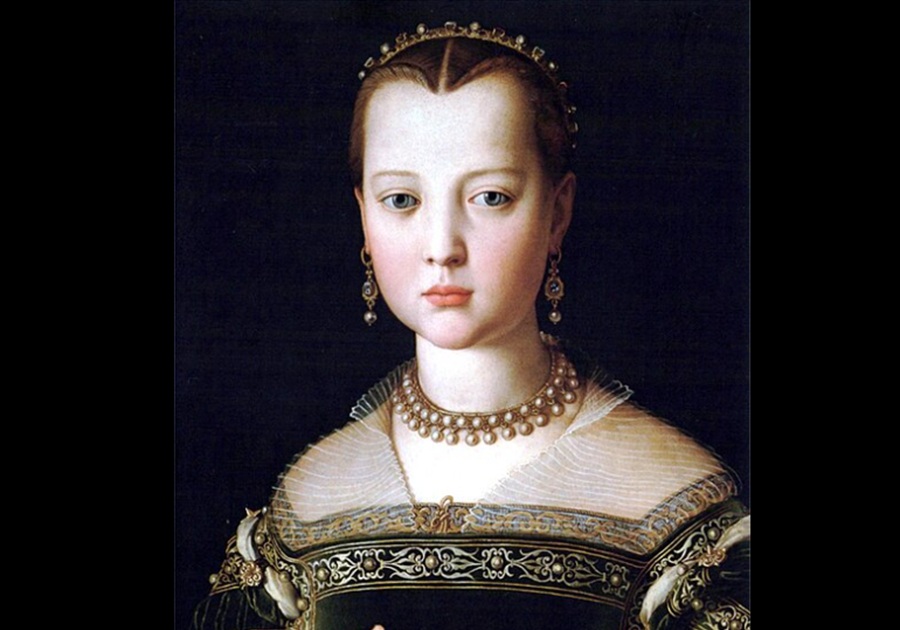
Born with every gift Florence could bestow, Cosimo I’s brilliant eldest daughter, Maria de’ Medici, was dead at seventeen. Her story casts a long shadow over one of history’s most powerful families.
On 3rd April 1540, a girl was born in Florence who, had fate been kinder, might have become one of the most powerful women in Renaissance Italy. Maria de’ Medici, named in honour of both her grandmothers, Maria Salviati on her father’s side and Maria Osorio y Pimentel on her mother’s, was the eldest legitimate child of Cosimo I de’ Medici and his wife Eleonora di Toledo. She was also the first of what would become a large and, in many respects, catastrophically ill-fated family. Cosimo and Eleonora would have eleven children together, yet the fates that awaited many of them would reduce their father, the most feared ruler in Tuscany, to a broken man in the last decade of his life.
Maria was not Cosimo’s first child. Before his marriage to Eleonora he had fathered a daughter, Bia, by an unknown mother, some accounts suggest a servant. Bia was raised at the Medici court alongside the legitimate children, painted by the great court painter Agnolo Bronzino, and died in 1542 at around the age of six. Cosimo grieved for her. But his feeling for Maria was something altogether different: a love that outlasted her by seventeen years and endured until the day he too died.
A private life in a public arena
Crédito editorial: Bobica10 / Shutterstock.com
Maria came into the world at a pivotal moment in Florentine history. Her father had taken power only three years earlier, at the age of seventeen, following the assassination of his predecessor Alessandro de’ Medici in 1537. The ruling class of Florence had expected to control the young Cosimo; they were swiftly and decisively proved wrong. By the time Maria was born he had already begun consolidating his grip on the city, and the household she grew up in was a court of power, learning and constant political calculation.
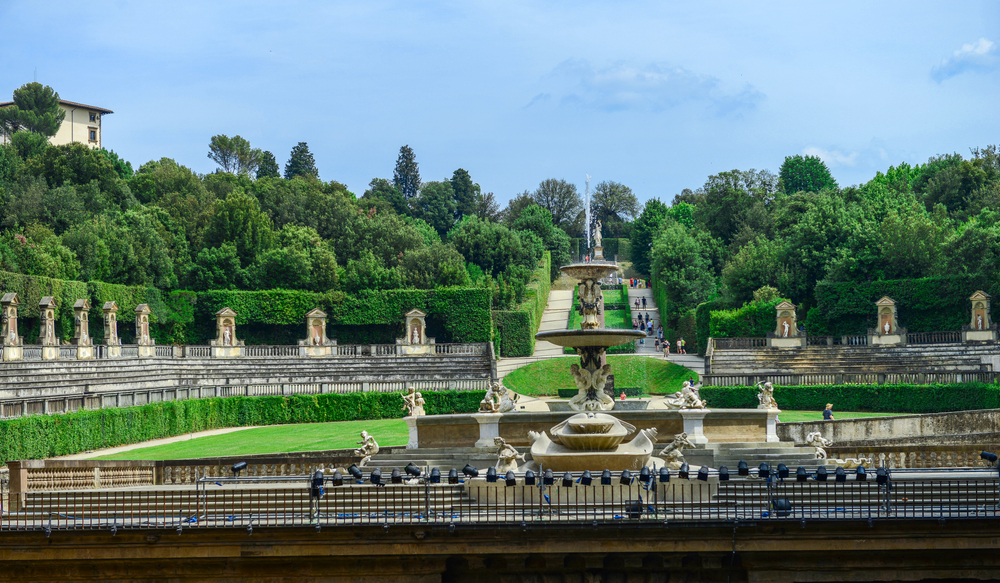
The family’s principal residence in Maria’s early childhood was the Palazzo Vecchio, Florence’s imposing medieval town hall which Cosimo adapted into a ducal palace and seat of government. When Eleonora di Toledo purchased the Pitti Palace across the Arno in 1550 using her own considerable fortune, the family began a gradual transition to what would become their grandest residence. The Boboli Gardens were simultaneously laid out on the hillside behind it, initially planned by Niccolò Tribolo and continued after his death by Bartolomeo Ammannati. They were conceived as an entirely private space, no entertainment or parties are recorded as ever having taken place there, and no one outside the immediate Medici family was permitted access.
Exceptional education
The education Maria and her siblings received was exceptional even by the standards of Renaissance court life. The Medici children of both sexes were taught languages, philosophy, music, and the classical texts of Greece and Rome. Eleonora’s own upbringing in the strict Spanish viceregal court of Naples had introduced a pedagogical influence shaped by the humanist educator Juan Luis Vives, emphasising piety, modesty and rigorous learning alongside refined etiquette.
Maria excelled. She was, by all contemporary accounts, among the most gifted of the Medici children, In fact, she was bright enough that, on at least one occasion, she was called upon to rescue her brother Francesco from his own inadequacy. When Francesco could not follow his Greek lesson, his tutors apparently turned to Maria, asking her to explain it to him. It is a small story, and perhaps embellished in the retelling, but it lodged in the historical memory: an image of a girl more capable than the boy who would one day rule Tuscany. Maria is also described as somewhat aloof from her younger siblings — self-contained and composed. She enjoyed outdoor pursuits, hunting and the active life of the court, alongside her academic work.
“She was of the same disposition as myself — and she was deprived of fresh air.”
— Cosimo I de’ Medici, on the death of Maria
Bronzino, portraiture, and a continuing mystery
Maria’s face is known to us, we believe. The Florentine court painter Agnolo Bronzino, one of the supreme portraitists of the sixteenth century, painted the Medici family repeatedly over three decades. His portraits of Cosimo and Eleonora set the template for how ducal power presented itself to the world: poised, magnificent, utterly unyielding. The children too were painted, some in formal dynastic studies, others in works that seem to catch something more genuinely personal.
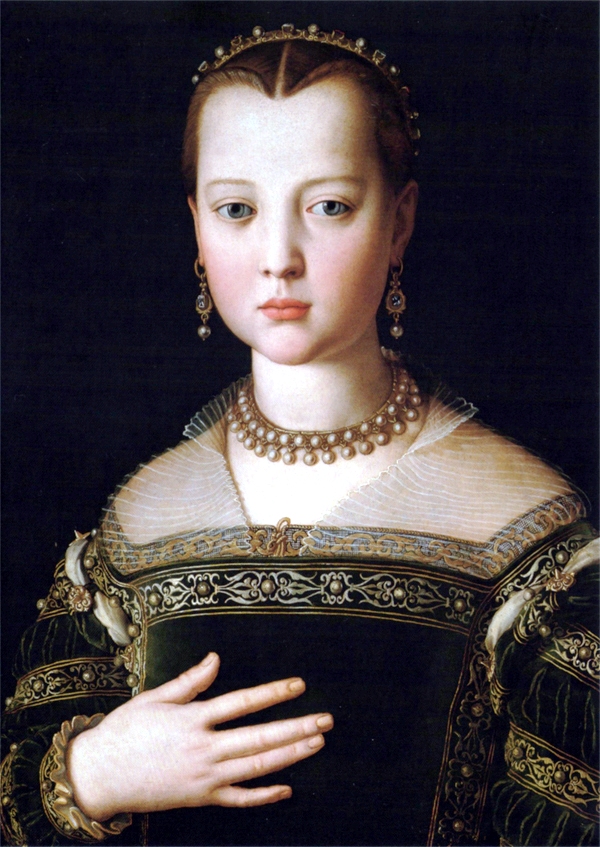
A portrait in the Uffizi Gallery, long believed to depict Maria at around the age of ten or eleven, shows a girl in a richly embroidered gown with pearl earrings and a necklace of large white pearls, which were a symbol the Medici family adopted in the 1540s to signal wealth and purity. The painting was confirmed by a 1551 letter from Bronzino to Cosimo I, and its frozen, jewelled elegance is characteristic of the Mannerist style Bronzino mastered — pale skin, elongated proportions, a psychologically distant gaze. Maria was rendered as a symbol of dynastic legitimacy as much as a living girl.
Yet even this portrait is disputed. The scholar Maike Vogt-Lüerssen has argued, in the academic journal Medicea, that portraits attributed to Maria have been systematically misidentified over five centuries and that this particular Bronzino may in fact depict Maria’s younger half-sister Virginia de’ Medici.
Second portrait of Maria de’ Medici
A second portrait, attributed to Alessandro Allori and dated around 1555 to 1558, now in the Kunsthistorisches Museum in Vienna, is also associated with Maria. Originally painted of her alone, it was later altered posthumously to include her younger brother Antonio, as if Cosimo wished to keep both lost children together on the same wooden panel. Therefore, we cannot be entirely certain what Maria looked like. She died young enough that the record she left is fragmentary, contested, and coloured by grief.

in a posthumous portrait by Agnolo Bronzino.
The betrothal to Ferrara
In 1554, when Maria was fourteen, her father formalised her betrothal to Alfonso II d’Este, heir to Duke Ercole II d’Este of Ferrara. He was the future holder of one of the most prestigious titles in Italy. Alfonso was twenty-one, a handsome young man who was also, notably, a grandson of Lucrezia Borgia. The match was politically significant: it was designed to cement an alliance between the Medici and Este houses at a moment when Italian dynastic politics were being delicately reconstructed, partly as a consequence of Spain’s recently dominant position following the Italian Wars. The union would have made Maria the future Duchess of Ferrara, Modena and Reggio, one of the great prizes of Italian aristocratic marriage.
The negotiations were conducted by Cosimo himself directly with Ercole d’Este. Maria had three years ahead of her, three years in which to complete her education, to prepare for her new life in Ferrara. It was not to be.
Death at Livorno

In the autumn of 1557, Maria was staying at the Castello Mediceo in Livorno, the port city on the Tuscan coast that Cosimo had been developing as a major commercial hub for his state. On 19 November, the seventeen-year-old became ill with fever, and she died. The most widely accepted explanation, supported by contemporary records, is that she contracted malaria. The disease was endemic in the low-lying, marshy coastal areas around Livorno and would prove catastrophic for the Medici family in the years to follow.
Malaria, transmitted by mosquitoes breeding in stagnant water near the coast, was one of the great killers of Renaissance Italy. Cosimo’s own words, reported after Maria’s death: “She was of the same disposition as myself, and she was deprived of fresh air,” suggest both the closeness of their bond and an awareness that the environment had been lethal. “Bad air”, the literal origin of the word malaria, was widely understood as dangerous in the sixteenth century, though the precise mechanism was unknown. Maria, staying at a coastal castle in autumn, when mosquito populations remained active, was fatally exposed.
The legend — and why historians reject it
A rival account of Maria’s death circulated as anti-Medici propaganda in the sixteenth century and was later popularised in Edgcumbe Staley’s 1911 book The Tragedies of the Medici. According to this story, Maria had managed to meet a young nobleman named Malatesta de’ Malatesti in secret, and the two became lovers. Her father discovered the liaison and, in a fit of rage, stabbed Maria in the heart. Cosimo then allegedly covered up her death by claiming she had died of spotted fever and threw her supposed lover into prison.
The tale has the dramatic architecture of Renaissance tragedy. It also has essentially no credibility. Modern historians have widely rejected it as unreliable fiction, originating in the anti-Medici political climate of the period. Contemporary documentation confirms a death by fever. The story of the stabbing is inconsistent with what we know of Cosimo’s grief, and with the complete absence of any contemporary evidence for the affair or the imprisonment. That Cosimo mourned his daughter openly, keeping her portrait in his bedroom for the rest of his life and reportedly gazing at it for hours at a time, is poorly compatible with the portrait of a man who had murdered her.
What happened next — a family stalked by malaria
Maria’s betrothal to Alfonso d’Este could not simply be allowed to lapse. Within months of her death, Cosimo began negotiations to transfer the arrangement to his next surviving daughter Lucrezia. At this point, she was barely twelve years old, roughly half the age of her intended bridegroom. A marriage contract was signed in April 1558, and Alfonso d’Este arrived in Florence on 18 June.
On July 3, 1558, the twenty-four-year-old Alfonso and the thirteen-year-old Lucrezia were married in the chapel of the Palazzo Vecchio. Alfonso then left almost immediately to fight in France, leaving his child bride in Florence with her family for a further two years. Lucrezia finally joined him in Ferrara in February 1560. She died there on April 21, 1561, of tuberculosis just one year after arriving as Duchess. Rumours that Alfonso had poisoned her were never entirely dispelled. She was the second of Cosimo’s daughters to die before reaching adulthood.
Three deaths in a month
The catastrophe that befell the Medici family in 1562 dwarfed even these losses. In the autumn of that year, Cosimo and Eleonora were travelling with their sons Giovanni and Garzia when, on November 15, the nineteen-year-old Giovanni, Bishop of Pisa and a cardinal, fell ill with fever after a hunting trip along the wooded Livorno coastline. The family gathered in the same port city where Maria had died five years earlier. Giovanni died on November 20. Fifteen-year-old Garzia died on December 12. Five days later, Eleonora di Toledo herself — weakened by tuberculosis and devastated by the loss of two sons — died of malarial fever at three in the morning of December 17. She was forty years old. In the space of a single month, Cosimo had lost two sons and his wife.

For centuries, a sensational alternative version of these events also circulated: that Garzia had murdered his brother Giovanni in a quarrel, that Cosimo had then killed Garzia with his own sword, and that the distraught Eleonora had died of grief. Modern forensic science, applied to the exhumed remains of the family, confirmed what the Medici had always maintained: all three died of malaria. The Livorno coast had taken from Cosimo, over five years, his eldest daughter, his wife, and two sons.
The children of Cosimo I and Eleanora di Toledo
Maria (1540–1557) Died of malaria at seventeen, on the eve of her marriage to Alfonso II d’Este
Francesco (1541–1587) Succeeded Cosimo as Grand Duke; died with his second wife, possibly of poison
Isabella (1542–1576) Murdered by her husband Paolo Giordano Orsini
Giovanni (1543–1562) Cardinal; died of malaria at Livorno, aged nineteen, in his father’s arms
Lucrezia (1545–1561) Married Alfonso II d’Este in Maria’s place, aged thirteen; died of tuberculosis at sixteen
Garzia (1547–1562) Died of malaria at fifteen, weeks after his brother Giovanni
Ferdinando (1549–1609) Eventually became Grand Duke of Tuscany as Ferdinando I
Pietro (1554–1604) Murdered his wife Eleonora di Garzia di Toledo; never punished
Read together, the fates of Cosimo’s children constitute one of the most concentrated sequences of tragedy in the history of the Italian Renaissance. Of his eight surviving legitimate children with Eleonora, two daughters died of malaria before marriage, a third died within a year of her wedding from tuberculosis, a fourth was murdered by her husband, a son died of malaria at nineteen, another at fifteen, and a further son committed murder himself.
Maria was simply the first, the one who set the pattern, though no one could have known it at the time. She died at seventeen, before marriage, before any of the violence that came after. In some respects she was the luckiest of them.


