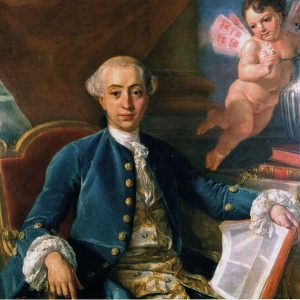
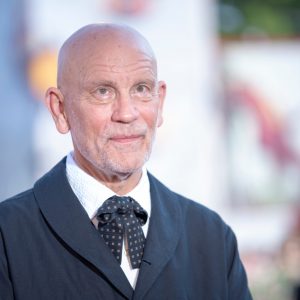
Gaetano Casanova, the Italian actor and ballet dancer best remembered as the father of Europe’s most celebrated seducer, was born on 2 April 1697 in Parma.
Born into a family of modest means, Casanova pursued a career in the performing arts, beginning as a dancer before transitioning into acting roles that would take him across Europe. He performed at prestigious venues such as Venice’s Teatro San Samuele, gaining recognition for his skills in both ballet and dramatic performance.
An unrequited infatuation
The path that brought Gaetano to Venice began with heartbreak. At the age of 16, following the example of his older brother Giambattista, he left the family home and fell helplessly in love with Giovanna Benozzi — a commedia dell’arte actress known by the stage name La Fragoletta, the Little Strawberry. The infatuation was not returned. Benozzi instead married Francesco Balletti, a star of the troupe from a celebrated acting dynasty who specialised in the role of Arlecchino (Harlequin). Crestfallen, Gaetano left the troupe and went to Venice, where he found a position at the Teatro San Samuele, owned by the influential Grimani family.
A secret marriage
It was in Venice that Gaetano found a more receptive romantic interest. Near the place where he was staying, there was a shoemaker’s shop owned by a certain Girolamo Farussi, who had an attractive daughter known as Zanetta. The following year, against her parents’ wishes, she married Gaetano. Her father died shortly after, from grief according to later accounts, and her mother Marcia was reconciled to the union only when Gaetano promised that he would not allow Zanetta to become an actress.

It proved a promise he would not keep. The owner of the Teatro San Samuele, Michele Grimani, was captivated by Zanetta’s talents and looks, and gave her a role on stage. The attention Michele paid to Zanetta Farussi was so marked that when their first child, Giacomo, was born in 1725, Gaetano suspected Michele Grimani of being the actual father. Giacomo himself would later, with characteristic cool, refer to Gaetano only as “my mother’s husband.” Before he died, however, Gaetano had secured for his children an oath of protection from the theatre-owning Grimani brothers.
A life on the road
Despite domestic uncertainties, the couple remained together. In the early 1720s, Gaetano joined a touring acting company that brought him to London, exposing him to international audiences and broadening his theatrical experience. Their second child, Francesco, was born in London in 1727. Giacomo was the first of six children, followed by Francesco Giuseppe (1727–1803), Giovanni Battista (1730–1795), Faustina Maddalena (1731–1736), Maria Maddalena Antonia Stella (1732–1800), and Gaetano Alvise (1734–1783). The youngest was born two months after his father’s death and went on to become a priest.
An early death
In 1733, Gaetano developed an abscess on his ear that became infected and he died on December 18 of that year in Venice, aged just 36. Zanetta, now 26, was left a widow and the family’s sole breadwinner. She went on to carve out a very successful stage career, ultimately becoming far more celebrated as a performer than her husband had ever been.
The painter sons
Two of Gaetano’s sons achieved considerable distinction in the arts. Francesco, born during the London tour, trained initially in the workshop of the Venetian painter Giovanni Antonio Guardi and made his name painting dramatic battle scenes. At the height of his fame he sold works to King Louis XV of France and received commissions from Catherine the Great of Russia. His painting The Cavalry Battle is currently held at the Louvre in Paris.
Giovanni, the younger painter, worked in the neoclassicist tradition, travelled widely across Italy and France, and was commissioned to paint a portrait of Pope Clement XIII for the Sorbonne. He later settled in Dresden, where he taught at the Academy of Fine Arts. Giovanni collaborated with the art historian Johann Joachim Winckelmann, one of the founders of modern art history.
Eclipsed by Giacomo
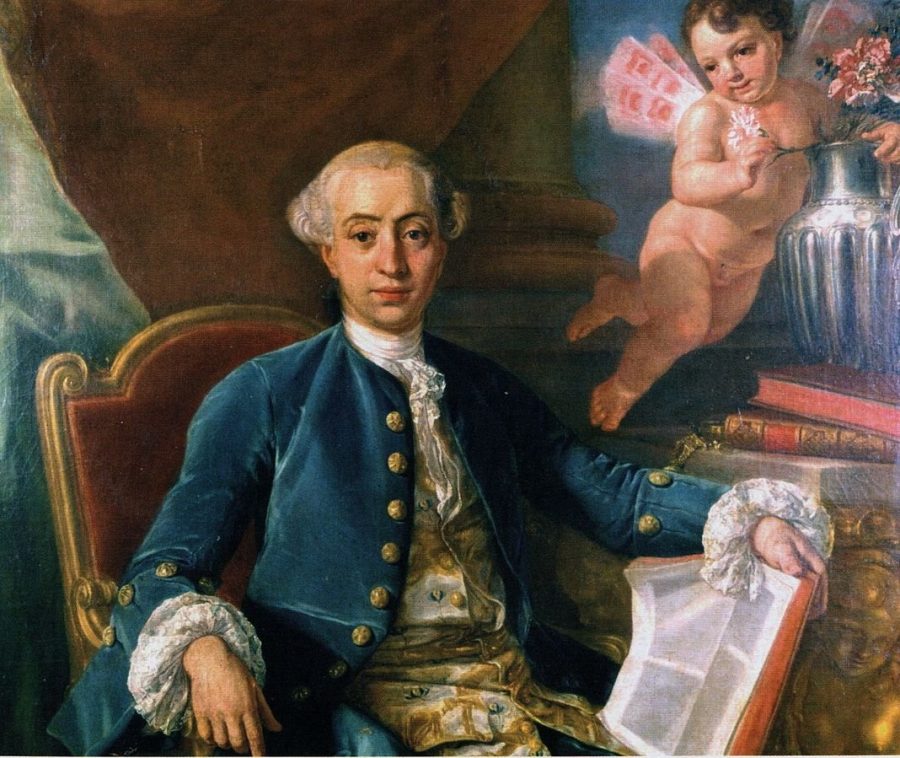
Yet both brothers have been almost entirely overshadowed in history by their eldest sibling. Giacomo Casanova graduated from the University of Padua with a degree in law and had a short career as an ecclesiastical lawyer before setting out on his adventures. His numerous occupations included gambler, attorney, clergyman, musician, dancer, writer, mathematician, con man and spy.
He pursued passionate and frequently risky affairs with women across Europe, regularly ran out of money, and was on several occasions imprisoned for debt. His autobiography, The Story of My Life, has come to be regarded as one of the most vivid and authentic accounts of European social life in the 18th century and his name has since passed into everyday language as a synonym for a serial seducer.
The man who started it all, however, was a modestly talented actor from Parma who died young, never suspecting the extraordinary legacy his brief life would leave behind.
Parma, where Gaetano Casanova was born, is a historic city in the Emilia-Romagna region, famous for Prosciutto di Parma, Parmigiano Reggiano cheese and a rich musical tradition. Its opera house, the Teatro Regio, is among Italy’s most celebrated, and its music conservatory bears the name of Arrigo Boito, who wrote the libretti for many of the great operas of Giuseppe Verdi, born nearby at Busseto.