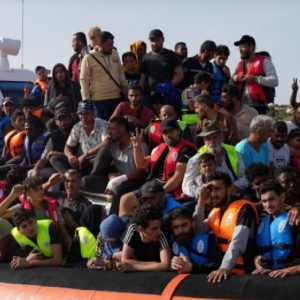
Italy officially opened two refugee centres in Albania on Friday to hold men intercepted in international waters while trying to reach Europe.
The Italian ambassador to Albania, Fabrizio Bucci, stated the refugee centres were ready to accommodate people while their asylum applications were processed. He added, “As of today, the two centres are ready and operational.” However, he could not confirm when the first arrivals would take place.
Under a controversial deal, criticised by human rights groups but supported by the EU, up to 3,000 men a month will be sent to the centres for processing in Italy. However, women, children, and vulnerable individuals will still be transferred to Italy.
The agreement, signed last November by Italian Prime Minister Giorgia Meloni and Albanian Prime Minister Edi Rama, is part of a broader effort to reduce migrant arrivals by sea. Meloni, who once suggested repatriating migrants and “sinking the boats that rescued them,” said the plan serves as a deterrent for illegal migration to Europe.
“The most useful element of this project is that it can represent an extraordinary tool of deterrence for illegal migrants destined to reach Europe,” Meloni said in June. She added, “The agreement could be replicated in many countries and become part of the EU’s structural solution.”
Albanian centres only hold men from ‘safe’ countries
The centres, located in Shëngjin and Gjadër, have cost Italy €670m (£564m) and are under Italian jurisdiction. Albania will provide external security. Italy aims to process asylum requests within 28 days, significantly faster than the current timeline in Italy.
Only individuals from countries designated as safe by Italy will be processed. These nations now include Bangladesh, Egypt, and Tunisia, among others. Last year, 56,588 people from these countries arrived in Italy.
Most applications are expected to be rejected, as the applicants come from countries deemed safe, limiting asylum prospects. Those whose requests are denied will be detained and later repatriated. Successful applicants will be transferred to Italy.
Aid organisations criticise the deal
Aid organisations, such as Médecins Sans Frontières, have criticised the agreement. They argue it goes “one step beyond” previous EU deals with countries like Turkey and Libya, actively preventing people from reaching European territory.
Riccardo Magi, president of the leftwing More Europe party, strongly condemned the arrangement, calling it “a sort of Italian Guantánamo,” where international standards are disregarded.
In August, the UN refugee agency (UNHCR) agreed to monitor the first three months of the agreement, despite having serious concerns. While not a party to the deal, the UNHCR said its involvement was intended to safeguard the rights of those affected.
Some Albanians see the agreement as a way of repaying Italy for sheltering thousands of people after the fall of communism in 1991.
The Council of Europe’s commissioner for human rights warned this deal could set a dangerous precedent. “The shifting of responsibility across borders by some states also incentivises others to do the same, which risks creating a domino effect that could undermine the European and global system of international protection.”
Reuters and Associated Press contributed to this report