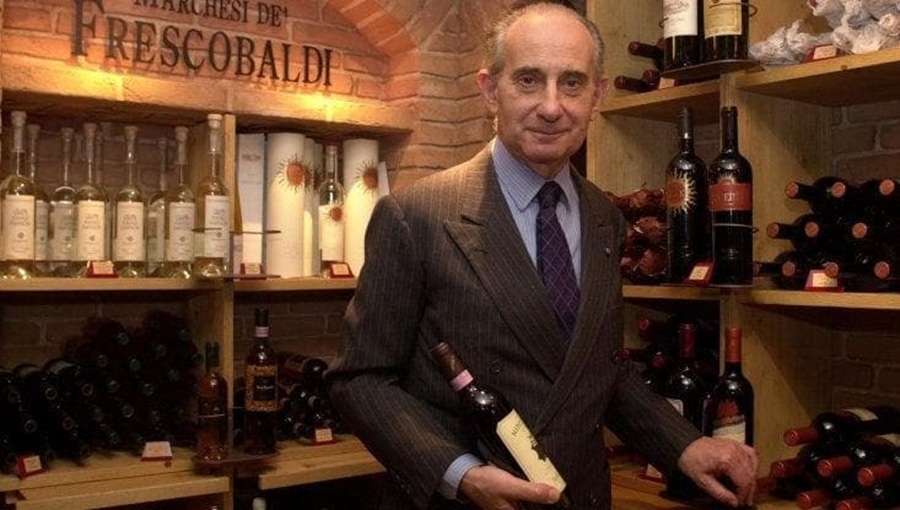
Marquess who modernised the 700-year-old Frescobaldi wine empire has died in Florence. Vittorio Frescobaldi leaves behind a portfolio of storied estates from Chianti Rufina to Montalcino.
Vittorio Frescobaldi, the great patriarch of the famed Florentine winemaking family, has died at 97, his family confirmed on Wednesday.
Born in Florence on 30 November 1928, the marquess belonged to the thirty-first generation of the noble Frescobaldi family, whose ties to winemaking stretch back to the Middle Ages. He was named Cavaliere del Lavoro (Knight of Labour) in 1977 in recognition of his work as “a passionate farmer.”
A dynasty stretching back 700 years
The Frescobaldi family’s association with wine is one of the oldest in Italy, with documented winemaking history dating to the 1300s and family roots traced back a thousand years. Over the centuries, Frescobaldi wines supplied the English royal court, the papacy and Florence’s great noble houses, beginning with the Medici.
Vittorio, a graduate in agricultural studies, took over the running of the family businesses following the death of his father, Lamberto, and went on to drive a significant modernisation of the company. Alongside his brothers Ferdinando and Leonardo, he helped to establish Tuscany as a region of global excellence in viticulture, steering the business through the second half of the twentieth century and into the 2000s as Tuscan wine consolidated its place among the world’s great winemaking regions.
Opening Tuscany to the world
Under his stewardship, the Florentine firm accelerated its expansion, investing in the diverse character of Tuscany’s winegrowing areas and pushing the business outward into export markets — part of a broader shift that took Italian wine from a largely domestic product to an internationally sought-after one.
One of the defining moments of his career came in the early 1990s, when he struck up a relationship with the American vintner Robert Mondavi. Their collaboration, launched in 1995 at the Frescobaldi’s Montalcino property, gave rise to Tenuta Luce, a joint venture blending Sangiovese and Merlot that became one of the standard-bearers of Tuscany’s modern wine renaissance. Frescobaldi acquired full ownership of the project a decade later.
An estate portfolio spanning Tuscany
Today the Marchesi Frescobaldi group owns around a dozen estates across Tuscany and beyond, encompassing roughly 1,500 hectares of vineyard. Among the most celebrated is Castello di Nipozzano in Chianti Rufina, the historic seat of the family and source of Montesodi, a single-vineyard Sangiovese, along with the Cabernet-based Mormoreto. The company’s Brunello di Montalcino comes from Tenuta CastelGiocondo, while Castello di Pomino, set at 750 metres above sea level, focuses on white wine.
Other Tuscan holdings include Tenuta Perano in Gaiole in Chianti, Tenuta Castiglioni near Montespertoli, Tenuta Ammiraglia in the Maremma, Remole, Tenuta Calimaia near Montepulciano, and the island estate of Gorgona. The group’s reach extends further still, taking in Ornellaia and Masseto in Bolgheri, Attems in Friuli’s Collio, and, more recently, Domaine Roy & Fils in Oregon and a minority stake in Sicily’s Tenuta delle Terre Nere on Mount Etna.
A generational handover
In recent years, Vittorio had gradually passed the reins to the next generation. Leadership of the family’s flagship company, Marchesi de’ Frescobaldi, moved in 2013 to his son Lamberto.
Vittorio Frescobaldi is survived by his wife, Bona, and his children Fiammetta, Angelica, Lamberto and Diana. His death, the family said, closes a long chapter in Italian viticulture — one that saw Tuscany rise to become one of the world’s great wine regions.