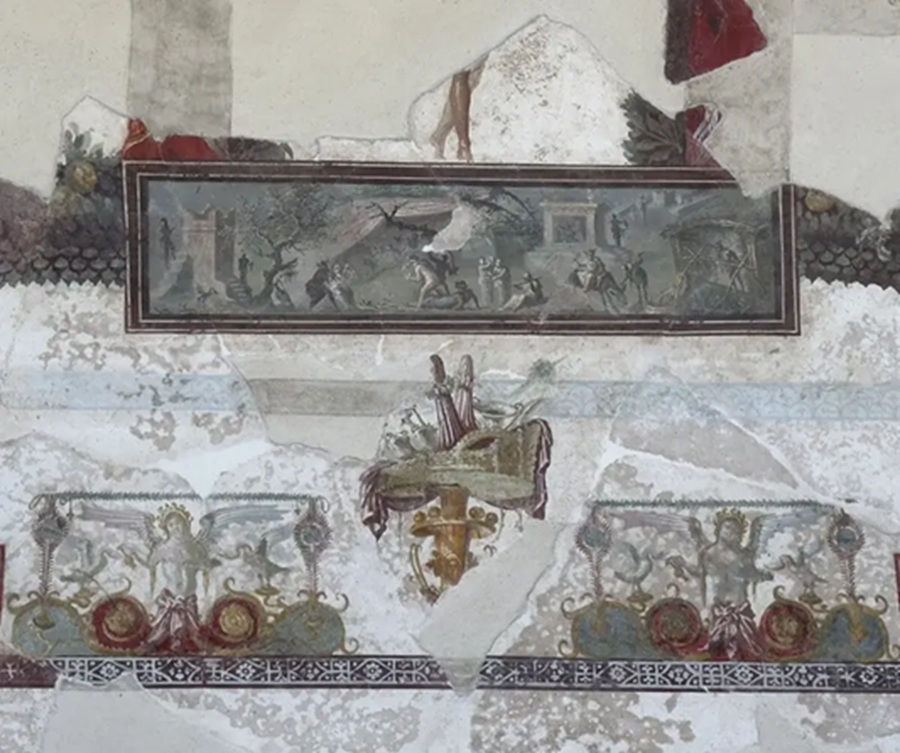
More than a quarter of a vaulted dining room ceiling from the House with Bakery has been rebuilt from fragments found where it collapsed nearly 2,000 years ago. It reveals a richly decorated scene of Dionysus and Ariadne.
A restored ceiling from Pompeii’s House with Bakery has brought one of the ancient city’s finest painted rooms back into view. Archaeologists and restorers pieced together fragments that had lain untouched since the ceiling collapsed almost two millennia ago.
The fresco once decorated the vaulted ceiling of an upper-floor dining room in Regio IX, a space where guests would have gathered for banquets. More than a quarter of the original ceiling has now been rebuilt, with room deliberately left for further pieces to be added as excavation work continues.
The project was unveiled at the Palestra Grande of the Pompeii Archaeological Park, following the International Workshop on Ongoing Excavations and Research. The event brought together researchers from Italy and abroad to share findings from current digs and discuss new discoveries across the ancient city.
Piecing together a two-thousand-year-old puzzle
The painted fragments were recovered from the exact spot where the ceiling had fallen. During excavation, the team matched broken sections together, building the first outline of the room’s design before moving on to cleaning, conservation and reconstruction.
One of the trickiest problems the team faced was the ceiling’s curved shape. A flat support simply wouldn’t have matched the original structure, so restorers designed a new modular frame that could be adjusted as more fragments found their place, gradually shaping it to match the vault’s curve. Crucially, the design also allows for future additions without disturbing the work already completed.
The reconstruction is far from finished. Many painted fragments remain in storage, and further pieces could still emerge as excavation continues inside the House with Bakery. The flexible support structure means each newly identified fragment can be incorporated into the ceiling as it’s found, turning the restoration into an ongoing project rather than a single finished display.
Even with large sections still missing, what has been recovered gives a real sense of the richness of Roman interior decoration. A large central panel sits within painted architectural frames, bordered by colourful decoration, flower garlands, winged figures, seasonal symbols and a wealth of smaller decorative details. They are rendered in bright colours and careful patterning that point to the skill of the artists who originally decorated the room.
Dionysus and Ariadne take centre stage
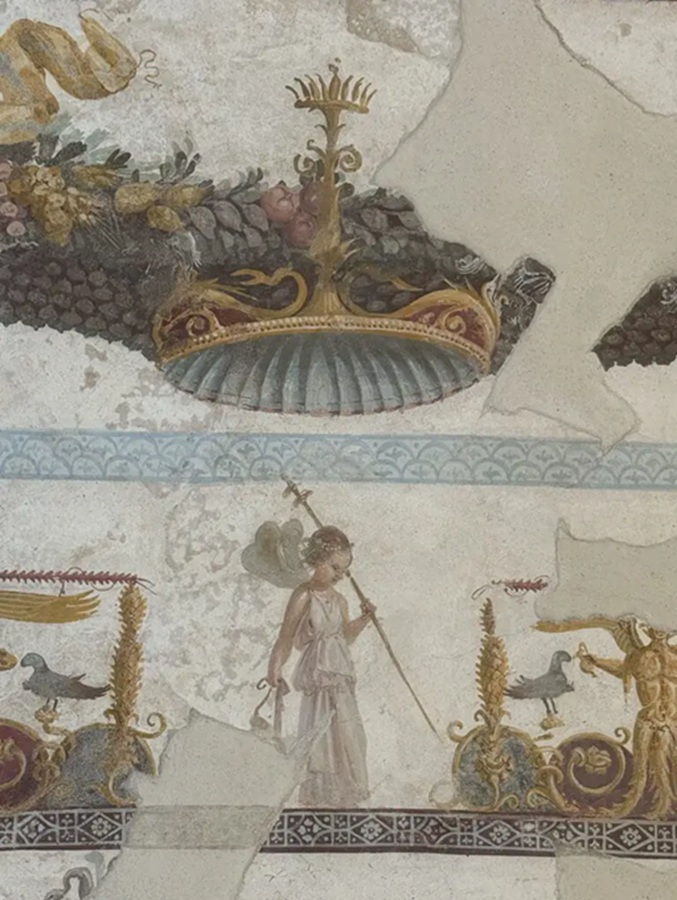
The ceiling’s central image tells the story of Dionysus and Ariadne, a theme popular throughout Roman art. Only part of the original scene survives, but researchers were able to reconstruct the missing composition by comparing it with similar paintings found elsewhere. Dionysus appears reclining on a chariot opposite Ariadne, who plays a harp as the winged Eros performs beside her, while two centaurs provide music as they pull the chariot forward. Around the central scene, painted masks, ritual vessels, fruit and flowers connect the decoration to the wider cult of Dionysus.
The restored ceiling adds to a broader programme of research at Pompeii focused on Dionysian art and religion, an area of study that has gained fresh momentum following excavations at the nearby House of the Thiasos. There, archaeologists uncovered one of the largest known ancient frescoes depicting a procession dedicated to the god.