
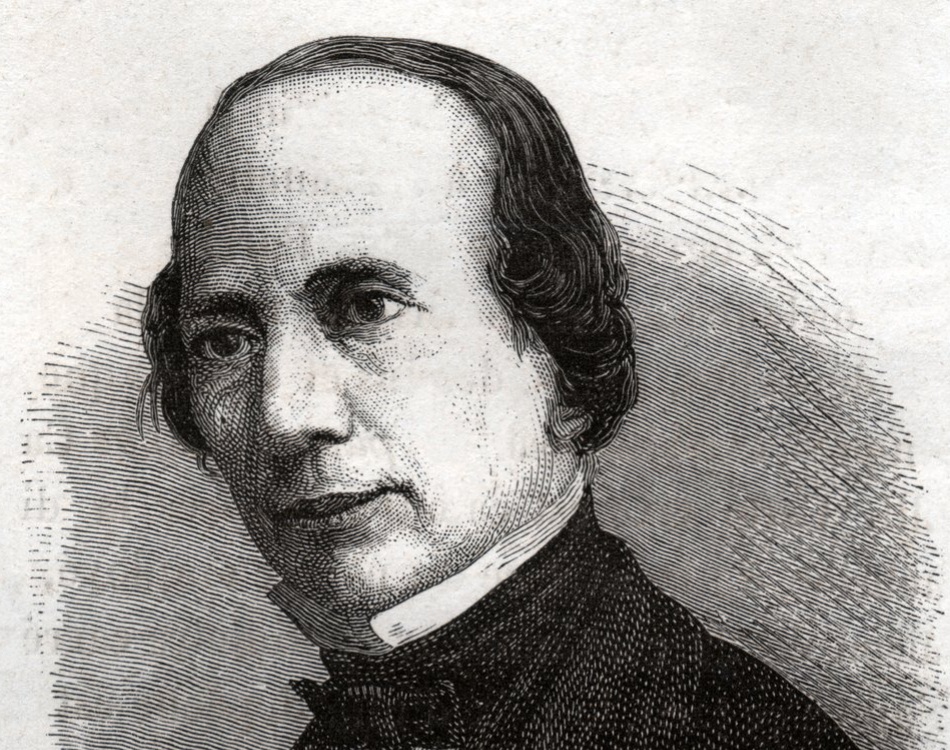
Giovanni Caselli, the Sienese inventor whose pantelegraph transmitted handwritten images along telegraph wires more than a century before the fax machine, was born on 25 April 1815. He died on the same date he was born in 1891.
Giovanni Caselli was born in Siena on 25 April 1815, the same date on which he would die 76 years later in Florence. It was a poetic symmetry for a man whose life traced an equally remarkable arc, from Catholic priest to pioneering inventor, from the lecture halls of Tuscany to the courts of Napoleon III.
Caselli was an Italian priest, inventor and physicist whose childhood studies in electricity and magnetism led him to invent the pantelegraph. Known as the universal telegraph, it was the forerunner of the fax machine. It was the world’s first practical, operational facsimile system, and it worked: in its first year of service, it transmitted nearly 5,000 messages.
A turbulent path to science
As a child, Caselli was tutored in Florence by the Italian physicist Leopoldo Nobili, whose instruction encompassed electrochemistry, electromagnetism, electricity and magnetism. He was ordained as a Catholic priest in 1836, and for a time combined his religious vocation with a teaching role in Parma, where he instructed the sons of a Bolognese nobleman.
His political sympathies proved costly. Caselli participated in the insurrection of 1848 that sought to annex the Duchy of Parma to Piedmont. He was expelled from the area as a consequence. Caselli returned to Florence, where he became professor of physics at the University of Florence in 1849. In 1851 he founded the popular science journal La Ricreazione, which aimed to explain the principles of physics to a general audience.
The invention of the pantelegraph
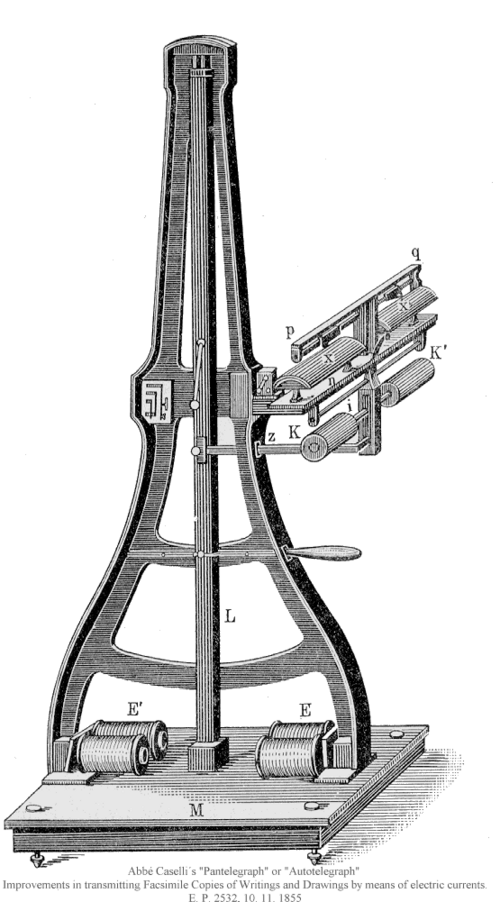
The central preoccupation of Caselli’s scientific life was a problem that had defeated other brilliant minds of his era: how to transmit not just words, but images and handwriting, along telegraph wires. British inventor Alexander Bain and physicist Frederick Bakewell had both attempted similar systems. However, neither had solved the crucial challenge of synchronisation, i.e. getting the sending and receiving mechanisms to work together with sufficient precision.
Caselli’s solution was a regulating clock that made the sending and receiving ends work in concert. In his device, an image was made using non-conductive ink on tin foil, over which a stylus passed, lightly touching the surface and conducting electricity only where there was no ink, causing circuit breaks that precisely matched the original image.
He made a working prototype by 1856 and demonstrated it to Leopold II, Grand Duke of Tuscany, who was sufficiently impressed to finance further experiments. When the Duke’s interest waned, Caselli took his invention to Paris, where it found a far more enthusiastic patron.
Napoleon III and the Paris years
Napoleon III was immediately captivated by the technology. Caselli perfected his pantelegraph between 1857 and 1861 in Paris, working under French inventor and engineer Paul-Gustave Froment, and in 1858 an improved version was demonstrated to the French Academy of Sciences by physicist Alexandre-Edmond Becquerel.
The tests were spectacular. In November 1860, Caselli demonstrated the pantelegraph on a dedicated line between Paris and Amiens, successfully transmitting the signature of the opera composer Gioachino Rossini over a distance of 140 kilometres. The delighted Rossini commemorated the occasion by composing a short piano piece, the Allegretto del Pantelegrafo.
By French law enacted in 1864, the pantelegraph was officially integrated into the national telegraph network. A public service operated between Paris and Lyon from 1865, extended to Marseille in 1867, nine years before Alexander Graham Bell received his telephone patent.
For this achievement, Caselli was awarded the Légion d’honneur by Napoleon III, and Parisian scientists and engineers founded the Pantelegraph Society to develop the technology further.
Caselli ahead of his time
The pantelegraph’s commercial life proved short. The complexity of the technology, its costs, and an incomplete understanding of its potential meant the pantelegraphic network remained limited and was eventually dismantled. The one industry that adopted it enthusiastically was banking, which used it to verify signatures on financial documents.
Caselli’s inventive ambition extended beyond the pantelegraph. He also invented a cinemograph for measuring the speed of trains, a nautical electric torpedo, and a hydromagnetic rudder.
The technology was not entirely forgotten. In the 1920s AT&T developed a method of transmitting images by radio signal, and it was not until 1964 that the Xerox Corporation introduced the first commercial fax machine of the kind that became recognisable in offices around the world. The scanning principles Caselli pioneered also fed, through various routes, into the development of analogue television.
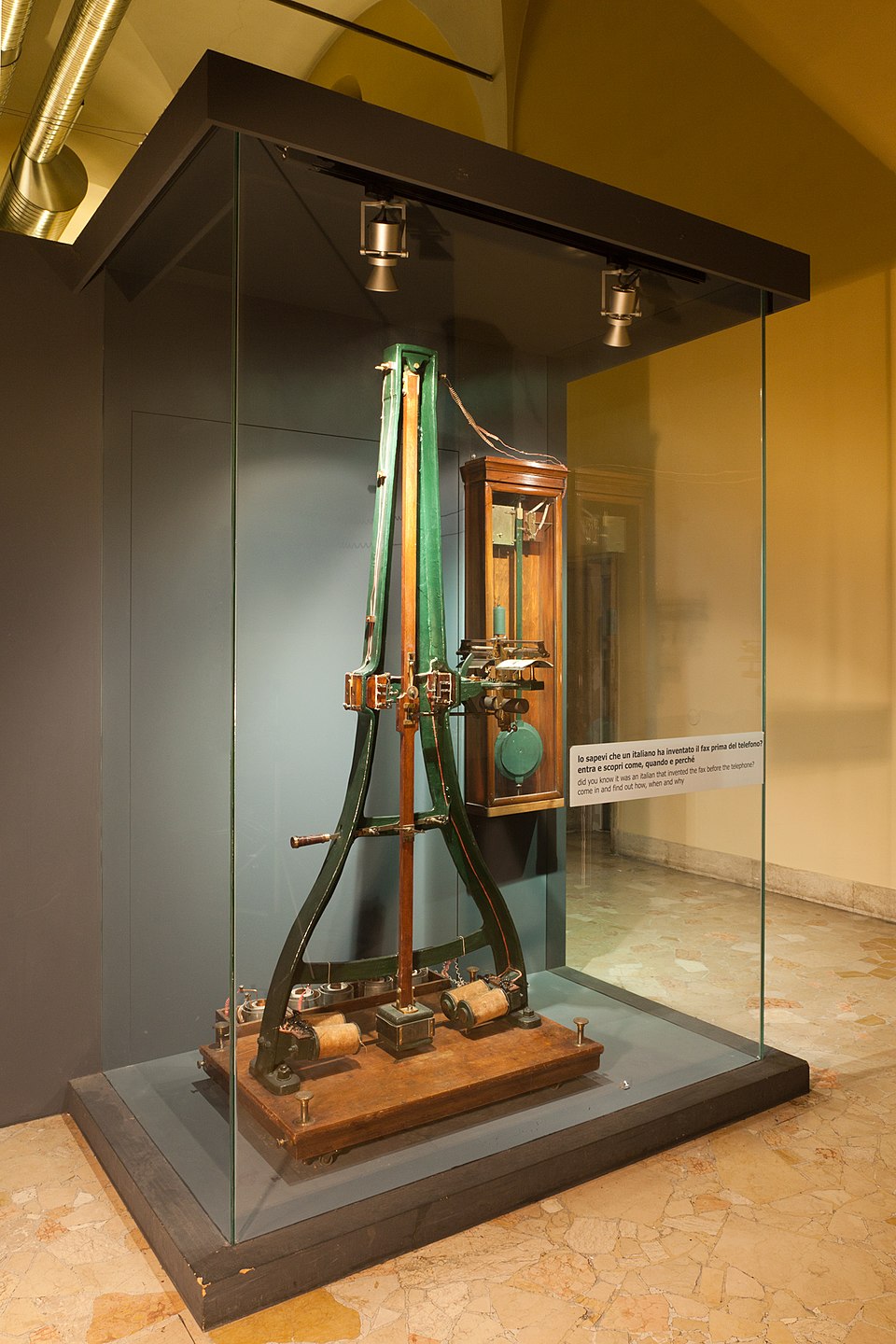
Caselli returned to Florence in his later years and died there on 25 April 1891. Many of his patents, letters and proofs of teleautographic transmission are preserved in the municipal library of Siena. Others are held in the archives of the Museo Galileo in Florence. A replica of his pantelegraph can be seen at the Museo Nazionale della Scienza e della Tecnologia Leonardo da Vinci in Milan.
Giovanni Caselli was, in the truest sense, a man out of time; a nineteenth-century priest who saw, with extraordinary clarity, the future of human communication.


