Italy is divided into 20 regions, which form the highest level of administrative government below the national state. These regions of Italy play a crucial role in managing local services, economic development, infrastructure and healthcare, while also reflecting the country’s deep historical and cultural diversity.
Understanding Italy’s regional system helps explain many political, economic and social stories reported across the country. From regional elections to healthcare management and economic policy, the regions are central to how modern Italy functions.
How Italy’s Regional System works
Italy is a decentralised republic, meaning many powers are shared between the national government and regional administrations.
This structure is defined by the Italian Constitution and developed after the Second World War to give local areas greater autonomy. The regions operate with their own governments and legislative powers in specific policy areas.
Each region has:
- a regional council (legislative body)
- a regional government
- a regional president, often referred to as the governor
The national constitution allows regions to legislate on matters such as health services, transport, urban planning and economic development, although national laws set the overall framework.
The system was introduced after the creation of the Italian Republic following the Italian institutional referendum, 1946, which abolished the monarchy and established a republican state.
The 20 Regions of Italy
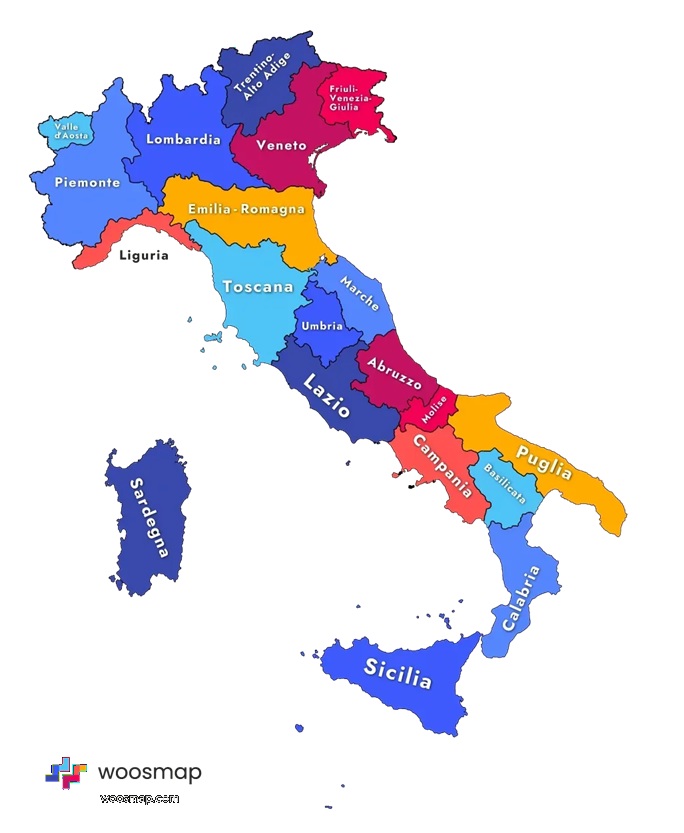
Italy’s regions vary widely in size, population and economic strength. They are grouped broadly into northern, central and southern areas of the country.
Northern Italy
- Piedmont
- Aosta Valley
- Lombardy
- Trentino-Alto Adige
- Veneto
- Friuli Venezia Giulia
- Liguria
- Emilia-Romagna
Northern Italy contains some of the country’s most industrialised areas and major cities such as Milan and Turin.
Central Italy
- Tuscany
- Umbria
- Marche
- Lazio
Central Italy includes the national capital, Rome, located in Lazio.
Southern Italy and the Islands
- Abruzzo
- Molise
- Campania
- Apulia
- Basilicata
- Calabria
- Sicily
- Sardinia
Southern regions generally have lower economic output compared with the north, though they are major destinations for tourism and agriculture.
Italy’s five autonomous regions
Five regions have special autonomous status, giving them greater legislative and financial powers.
These are:
- Sicily
- Sardinia
- Trentino-Alto Adige
- Aosta Valley
- Friuli Venezia Giulia
These regions gained autonomy mainly for historical, linguistic or geographic reasons. For example, Aosta Valley has strong French cultural influences, while Trentino-Alto Adige includes a significant German-speaking population.
Autonomous regions retain a larger share of local tax revenue and have broader legislative powers than ordinary regions.
What regional governments do
Regional governments oversee many of the public services that affect daily life in Italy. Their responsibilities include:
- managing regional healthcare systems
- planning infrastructure and transport networks
- environmental protection
- regional economic development
- tourism promotion
- agriculture and fisheries policies
One of the most significant areas of responsibility is healthcare, which means regional governments manage hospitals and local health authorities across the country.
Provinces and Municipalities
Below the regions are additional levels of local government. Regions are divided into provinces and metropolitan cities, which in turn contain municipalities (comuni).
Major metropolitan cities include:
- Rome
- Milan
- Naples
Municipalities are responsible for local services such as public transport, schools, policing and urban planning.
Italy has more than 7,900 municipalities, reflecting the country’s long history of independent city-states and local communities.
Why regions matter in Italian politics
Regional governments play a major role in Italy’s political system. Regional elections can influence national politics and often serve as an indicator of public support for the central government.
Policies implemented at the regional level can also differ significantly across the country, particularly in areas such as healthcare management and economic planning.
Regional leadership has become increasingly important in national debates about fiscal autonomy, infrastructure investment and economic inequality between northern and southern Italy.
A country defined by regional identity

While Italy is a unified nation, strong regional identities remain a defining feature of its society. Local dialects, cuisine, traditions and economic structures vary widely from region to region.
These differences reflect the country’s history before unification in the 19th century, when the peninsula consisted of multiple kingdoms, republics and states.
Today, the regional system helps preserve those distinct identities while allowing Italy to function as a single national state.
Key Facts about Italy’s Regions
- Italy has 20 regions
- Five regions have autonomous status
- Regions manage major services including healthcare and infrastructure
- The regional system is defined by the Italian Constitution
- Italy has more than 7,900 municipalities