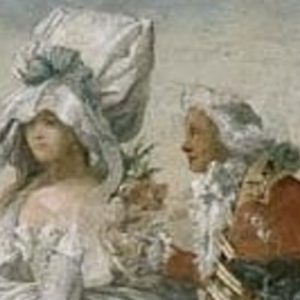
Giovanni Domenico Tiepolo, one of Venice’s most original painters and printmakers, was born on 30th August, 1727. The eldest of Giambattista Tiepolo’s painter-sons carved out his own artistic identity, moving from grand Baroque fresco cycles to intimate, wry portraits of everyday Venetian life. He also had an enduring obsession with the comic figure of Pulcinella.
Giovanni Domenico Tiepolo — known to history as Giandomenico — was born in Venice on 30 August 1727, the son of the city’s most celebrated painter, Giovanni Battista Tiepolo, and Cecilia Guardi, sister of the noted view-painters Francesco and Antonio Guardi. Of the family’s children, Giandomenico was the one who would follow most closely in his father’s footsteps, becoming, alongside his younger brother Lorenzo, part of the workshop dynasty that carried the Tiepolo name across Europe.
A prodigy in his father’s workshop
Giandomenico entered his father’s studio while still a boy and was already his principal assistant by the age of 13. He began contributing to major decorative projects early, working on the frescoes of Palazzo Labia in Venice in 1746–47, and by 1747–49 had already produced independent work of his own: the Via Crucis (Stations of the Cross) cycle for the Oratory of the Crucifix at San Polo in Venice, a series that showed he could balance devotional gravity with real artistic energy even as a very young painter.
Over the following decades, father and son worked as a team on some of the most ambitious commissions of the age, travelling together to fresco the Würzburg Residenz in Germany and, later, the Royal Palace in Madrid, where Giambattista spent his final years from 1762 to 1770.
A pivotal moment came in 1757, when the pair worked together on the frescoes of the Villa Valmarana ai Nani near Vicenza — a commission still regarded as one of the high points of Giandomenico’s career. While his father took the villa’s main rooms, Giandomenico had responsibility for the foresteria, or guest quarters, where he broke away from his father’s more classical grand manner and developed a lighter, more modern style influenced by Enlightenment sensibilities — an early sign of the independent artistic voice he would fully embrace in later life.
Return to Venice and a new artistic direction
Following his father’s death in Madrid in 1770, Giandomenico returned to the Veneto. Although he continued to accept public commissions — including, in 1789, frescoes for Venice’s Palazzo Contarini, executed in a style still indebted to his father’s — he increasingly turned away from grand Baroque ceiling decoration in favour of smaller, more intimate scenes.
His later work captured Venetian festivals, aristocratic gatherings, and above all the everyday lives of ordinary people, rendered with a distinctive lightness of touch, lively colour and theatrical sense of movement.
Series of works on Pulcinella

It was at the family’s villa in Zianigo, in the countryside near Venice, that Giandomenico produced the works for which he is now best remembered. Between 1759 and 1797 he decorated the villa with frescoes made not for any patron but purely for his own pleasure and that of his family — a private, unpressured context that freed him from convention and let him indulge his taste for sharp, sarcastic observation of the world around him.
Chief among these was his obsessive engagement with Pulcinella, the hunchbacked comic mask of the commedia dell’arte later anglicised as Mr Punch. In his final years, Giandomenico appears to have been almost consumed by the character, populating the walls of his home with swarms of Pulcinellas acting out the follies and pretensions of Venetian nobility, mocking the society around him even as he delighted in pure invention and comic spectacle. He also created dozens of drawings, later gathered into a 104-sheet album titled Divertimento per li Ragazzi (“Entertainment for Children”). In total he produced more than a hundred drawings and frescoes centred on the character. The Punchinello Room, a bedchamber within the villa, was the last of the cycle to be painted and remains the most celebrated.
The Zianigo frescoes were stripped from the villa’s walls in 1906 to be sold abroad, but were bought back by the city of Venice and transferred, in the mid-1930s, to Ca’ Rezzonico on the Grand Canal. They are on display today in rooms designed to echo their original setting.
Printmaker and custodian of a family legacy
Beyond painting, Giandomenico was also an accomplished printmaker, producing etchings that reworked both his own compositions and those of his father, helping carry Venetian pictorial art to audiences well beyond Italy. His paintings, drawings and prints are today held in major collections around the world, including New York’s Metropolitan Museum of Art and the British Museum in London.
Giandomenico Tiepolo died in Venice on 3 March 1804, at the age of 76.