Padua (Padova) is one of northern Italy’s most historic cities and one of its most liveable. Located in the Veneto region, it sits just west of Venice and has been shaped by centuries of learning, religion and civic life. It is compact, walkable and ideal for a short cultural break or an overnight stop on a wider Italian itinerary. Our quick guide to Padua with itinerary, will help you make the most of this wonderful city.
When I lived in Veneto, I was always heading into Venice – and why not, it’s packed full of gorgeous art and architecture. Then one day, I decided to get on the train to Padua – a very good decision. This compact city is rammed full of historical goodies. Whether it’s art, religious or political history, or a good dose of intellectualism you’re looking for, Padua has it. And this quick guide to Padua gives you all the hot spots to enjoy.
Must-see sights
Scrovegni Chapel

The Scrovegni Chapel is Padua’s most famous attraction and one of the most important art sites in Europe. Built in the early 14th century, the small chapel is entirely covered by Giotto’s fresco cycle, which marked a turning point in Western art. The scenes show biblical narratives with emotional depth and realism that were revolutionary for their time. Visitor numbers are strictly limited to protect the paintings, and timed entry must be booked in advance. Even for those with limited time, it is worth planning the visit around this site.
Official website for Scrovegni Chapel – note same ticket reservations are not possible.
Basilica of Saint Anthony

Known locally as Il Santo, the Basilica of Saint Anthony is both a major pilgrimage site and an architectural landmark. Its exterior blends Romanesque, Gothic and Byzantine elements, while the interior contains chapels filled with sculpture, frescoes and votive offerings. The tomb of Saint Anthony attracts visitors from around the world. The basilica sits at the edge of the historic centre and opens onto a large square that often hosts markets and local events.
Also read: Churches and Cathedrals of Padua
Prato della Valle

Por Hannelore – Trabajo propio, CC BY-SA 3.0,
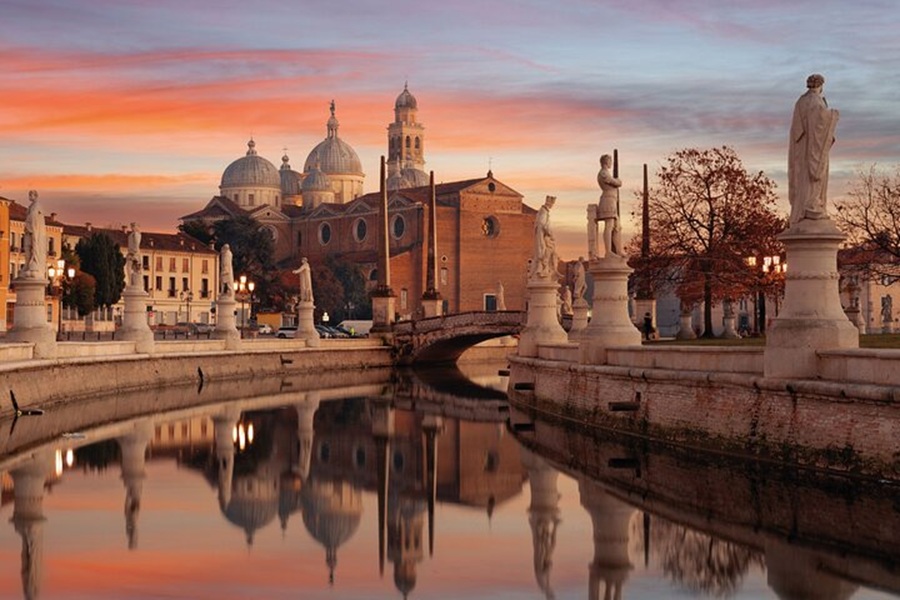
Prato della Valle is one of Europe’s largest public squares and a focal point of daily life in Padua. Its elliptical design features a central green island surrounded by a canal lined with statues of historical figures. Used for markets, festivals and informal gatherings, and it is particularly lively at weekends. It also provides a visual contrast to Padua’s narrower medieval streets and offers a sense of the city’s scale.
Palazzo della Ragione
Once the seat of Padua’s civic courts, the Palazzo della Ragione dominates the area between Piazza delle Erbe and Piazza della Frutta. Its vast upper hall is one of the largest unsupported rooms in Europe and is decorated with a complex cycle of medieval frescoes linked to astrology and civic order. Below the hall, market stalls selling food and local products have operated for centuries, making this area a good place to experience everyday Padua.
University of Padua and the Anatomical Theatre

Founded in 1222, the University of Padua is one of the oldest universities in Europe and has played a key role in the history of science and medicine. Galileo taught here in the early 17th century. The historic Palazzo del Bo includes the Anatomical Theatre, built in 1595, which is considered the world’s first permanent structure designed for human dissection. Guided visits offer insight into early medical teaching and the university’s international influence.
Orto Botanico di Padova
Established in 1545, Padua’s botanical garden is the oldest academic botanical garden still in its original location. Created to help medical students identify medicinal plants, it remains a centre for botanical research. Today it combines historic layouts with modern greenhouses and exhibitions. The garden is a UNESCO World Heritage site and provides a quiet contrast to the surrounding city.
Caffè Pedrocchi

The Caffè Pedrocchi is one of Padua’s most iconic meeting places and a symbol of the city’s intellectual life. Opened in 1831, it was famously known as the “café without doors” because it never closed, day or night. The neoclassical building sits near the university and has long been associated with students, writers and political debate. Inside, richly decorated rooms reflect different artistic styles.
Visitors can stop for coffee, aperitivo or a light meal, or visit the upper-floor museum to learn about the café’s role in Padua’s social and political history.
Also read: On this day in history: Padua uprising
Getting around
Padua is well connected by train, with frequent services to Venice, Verona, Bologna and Milan. The historic centre is compact and largely flat, making walking the easiest way to explore. Cycling is also popular, and local buses and trams connect outlying districts.
A 24-hour itinerary – Quick Guide to Padua
Morning
Start the day with a coffee and pastry near Piazza delle Erbe, then explore the historic market area around Palazzo della Ragione. Continue on foot to the University of Padua for a guided visit of the Anatomical Theatre. Late morning is the ideal time to visit the Scrovegni Chapel, allowing time to reach the site and pass through the required climate-control chamber.
Lunch
Have lunch in the historic centre or near Prato della Valle, choosing a simple Veneto dish such as risotto or pasta. After lunch, walk through Prato della Valle and around the Basilica of Saint Anthony, taking time to explore the interior.
Afternoon
Spend the early afternoon at the Orto Botanico, then wander back through the old streets towards the centre, stopping in small shops or galleries. This is a good time for a slower pace and informal sightseeing.
Evening
Head to Caffè Pedrocchi for an aperitivo or early dinner, followed by a walk through Piazza dei Signori and the surrounding streets. In warmer months, the city stays lively well into the evening, with outdoor seating and events.