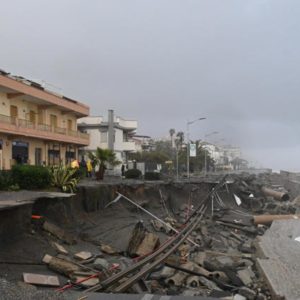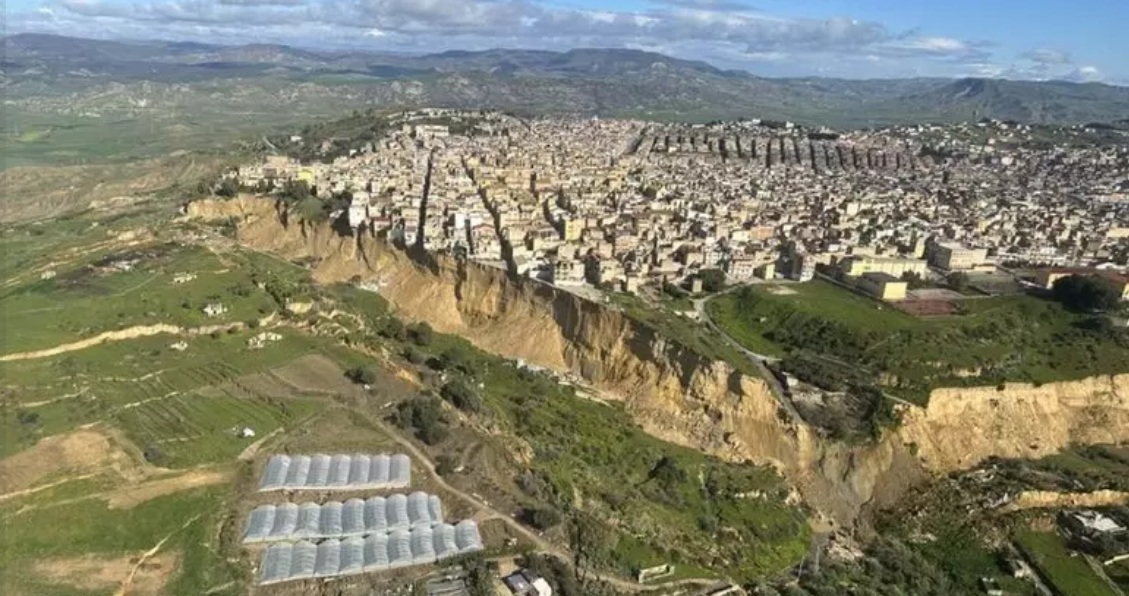
The Sicilian town of Niscemi is facing an escalating geological emergency after a massive landslide triggered by Cyclone Harry left a hillside sliding towards the Gela plain. Italian authorities have warned that the situation remains highly unstable and that parts of the town may never be safe to re-inhabit.
Italy’s Civil Protection Department chief, Fabio Ciciliano, said on Tuesday that the entire hill beneath Niscemi is still moving and continuing to slide towards lower ground.
“The whole hill is falling onto the Gela plain,” said Ciciliano. “The landslide is (still) fully active and the situation is critical. There are homes that can no longer be saved. It will be necessary to define a plan for the definitive relocation of the people who lived there.”
The landslide, which began on Sunday, has eaten away a long stretch of terrain and swallowed a section of highway. Many homes now sit perilously close to the collapsing edge
Evacuations
Officials ordered the evacuation of around 1,500 residents from their homes as a precautionary measure. Authorities have drawn a “red zone” around the most dangerous areas. This is defined by the advancing 4-kilometre front of the landslide, and the number of people displaced could rise if the slide worsens.
Some residents have been relocated to temporary accommodation at local facilities, while others are staying with family. Schools and major road links in and out of the town have been closed to ensure public safety.
Civil protection officials have made clear that some homes can no longer be saved and that a plan for permanent relocation of affected families will be necessary. There are significant concerns about infrastructure damage and long-term resettlement needs.
Broader Issues
The landslide follows several days of intense rainfall associated with Storm Harry, which struck southern Italy late last week. The storm has wrought widespread damage in Sicily, Calabria and Sardinia, prompting the Italian government to declare a state of emergency across the three regions. Initial emergency funding of €100 million has been allocated to support immediate response efforts.
In Sicily alone, regional officials estimate the cumulative cost of damage from the storm and associated landslides could reach well over €1.5 billion.
Geological Context for Niscemi
Niscemi, with a population of around 27,000, sits about 28 km inland from the coastal city of Gela. The area is geologically unstable, with clay-rich soils prone to saturation and slippage. These conditions were exacerbated by the heavy rains. Previous landslides have occurred in the region, including a major event nearly 30 years ago.
Experts warn that the landslide may continue for days or weeks, depending on weather conditions and ground stability. Once the soil dries and movement slows, engineers and geologists will begin detailed assessments of structural viability and long-term safety. In the meantime, many evacuees face uncertainty about when or if they can return to their homes.
The events in Niscemi highlight the growing challenges of managing hydro-geological risk in Italy.