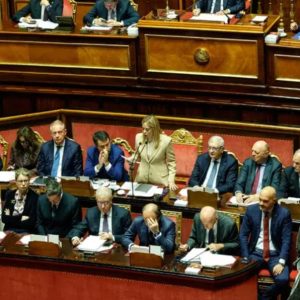
Prime Minister Giorgia Meloni marks 1,413 days in power with a rally in Bari. Her government is now the longest-serving since the Republic was founded post World War II. She told supporters that stability — not longevity — is the real achievement.
Giorgia Meloni’s government on Friday overtook Silvio Berlusconi’s second administration to become the longest-serving in the history of the Italian Republic, reaching 1,413 days in office. Berlusconi managed one day less between June 2001 and April 2005.
Meloni marked the milestone with a message on social media before addressing a rally organised by her Brothers of Italy (FdI) party in the southern port city of Bari, in Puglia.
A record she says she “welcomes with gratitude”
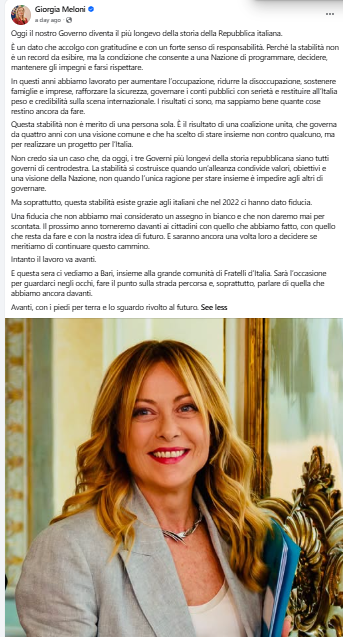
Writing online, the prime minister described the achievement as a fact she accepted with gratitude and a strong sense of responsibility. She argued that stability is not something to boast about but a condition that allows a country to plan, decide, honour its commitments and be taken seriously abroad.
Speaking to supporters in Bari, she went further, telling the crowd that the most stable government is not automatically the most competent one — simply the one that has been given the longest time to be judged. That judgement, she said, belonged to the people in front of her and to the millions of Italians still backing her coalition.
She said the government should take pride not in the number of days served, but in the fact that public support remains higher now than on its very first day in office.
“Building ideas”, not just outlasting rivals
Meloni rejected the suggestion that her coalition’s main goal was simply to see off its opponents, contrasting her government with rivals she said had no plan for what to do after winning power. After more than 1,413 days, she said, her side still has a to-do list.
The prime minister, who leads the 68th government in Italy’s 80-year republican history, described stability itself as her administration’s first major reform. She recalled a time when Italy was seen as Europe’s political hot potato, with foreign counterparts openly doubting how long any Italian government would last. That reputation, she said, left the country unable to negotiate from a position of strength or defend its own interests.
With stability, she said, Italy has moved from having to submit to decisions made elsewhere to being able to help set the agenda itself.
“Swimming in glue”, but never giving up
Reflecting on the personal toll of the job, Italy’s first woman prime minister admitted there had been difficult days — comparing the sensation, on some of them, to swimming through glue. However, she insisted she had never considered stepping back and did not intend to now.
She acknowledged the government had faced a demanding run of external shocks over the past four years, listing turmoil in the Middle East and around the Strait of Hormuz, a surge in fuel prices, the landslide on the island of Ischia, flooding in Emilia Romagna, terrorism and youth gang violence among the challenges it had confronted. Nothing was missing in terms of difficulty, she said, adding that the point was to remind Italians what a country without stable leadership would have cost its citizens.
Stability, she argued, had functioned not as a slogan but as a shield protecting the nation. She also called on her own governing class to keep improving, whilst warning political opponents seeking to obstruct her that they had misjudged who they were up against.
Meloni also defended her government’s record on the public accounts, saying it had kept the finances in order out of genuine patriotism, in contrast — she claimed — with predecessors who had damaged state finances through measures such as the Superbonus building-renovation scheme.
Watch our podcast about pioneering women in Italy
The record in numbers
Beyond the political rhetoric, the government points to several concrete figures to support its stability narrative. Employment is up by more than a million people since it took office, income tax cuts worth around €21 billion concentrated on lower and middle earners, and a cautious approach to public finances is credited with helping push down Italy’s bond yields. Meloni said the priorities of the past four years had been raising employment, cutting unemployment, supporting families and businesses, reinforcing security, managing the public finances responsibly and rebuilding Italy’s credibility and influence internationally. Results had been achieved, she added, while acknowledging that much work remains.
The government also cites gains on the international stage, including changes secured to the European Union’s migration rules, as evidence that a more stable Italy has been able to punch above its weight in Brussels and beyond.
The opposition’s rebuttal
Opposition parties dispute the government’s account of the last four years, arguing that economic growth has remained weak, that the overall tax burden has actually risen even as income tax has fallen for some earners, that health spending has declined as a share of GDP, and that major structural reforms have failed to materialise.
Meloni’s most significant setback since taking office came earlier this year, when voters rejected her government’s proposed constitutional reform to overhaul the judiciary in a referendum.