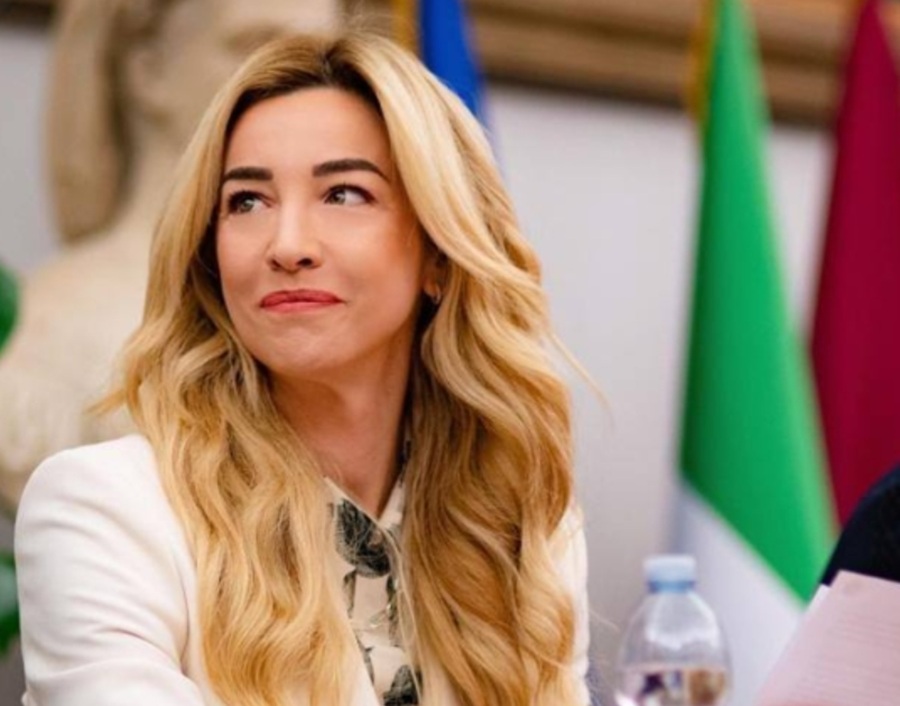
Silvia Salis, the former Olympic athlete turned mayor of Genoa, has said she would at least consider a challenge to Giorgia Meloni if the centre-left asked her to stand. However, she was careful to add that her mandate, and her loyalty to Genoa’s voters, come first.
It takes a certain kind of political figure to generate a lengthy Bloomberg profile while serving as mayor of a mid-sized Italian city. Silvia Salis, 40-year-old former hammer-throw champion, current Mayor of Genoa, and increasingly talked-about face of the Italian centre-left, has managed it. The profile described her as “the new face of Italy and a possible anti-Giorgia Meloni candidate.”
Asked directly whether she would consider running against the prime minister at next year’s general election, Salis did not deflect. “It would be a lie to say I wouldn’t consider it. This national attention flatters me,” she told Bloomberg. It was a more candid answer than she has previously given to similar questions, and it set off an immediate round of speculation about whether the centre-left might have found its candidate.
Salis clarifies her remarks
By the end of the day, Salis contextualised her remarks. She was elected to lead Genoa for five years, she said, and she has no intention of abandoning that mandate. “I have no intention of failing in my mandate,” she said. “In the Bloomberg interview, among many other things, I was asked what I would do if, even though I wasn’t running in the primaries, someone asked me to run. And I answered, as I always have, even in the recent past, to very similar questions. That is, that faced with a unified request, it would be false to say I wouldn’t even consider it.”
She also noted that she had added a further point that did not make it into the interview. “The fact remains that I was elected to serve as mayor of Genoa for five years. And, compared to other names being floated, I already have another position.”
A fractured opposition
The context for all of this is an opposition that is energised by Meloni’s recent referendum defeat on justice reform. However, it is far from united on how to capitalise on it. Bloomberg noted at the outset of its profile that the referendum result is “galvanizing the Italian opposition,” and the search for a credible challenger to Meloni has acquired new urgency as a result.
The two most prominent figures currently expected to compete for the opposition’s premier candidacy are Democratic Party leader Elly Schlein and former two-time prime minister Giuseppe Conte, leader of the leftist-populist Five Star Movement. The expectation is that the two would contest primaries once a shared programme is agreed. At the moment, Conte is currently polling ahead of Schlein in hypothetical primary scenarios, a fact that complicates the centre-left’s internal dynamics considerably.
Salis has been openly sceptical of the primary route, saying she believes it risks being dangerously divisive for an opposition that already struggles with coherence. Her preference, implicitly, appears to be for a more consensual process that could produce a unity candidate. This, of course, is precisely the kind of scenario in which someone like Salis herself might emerge as a compromise figure.