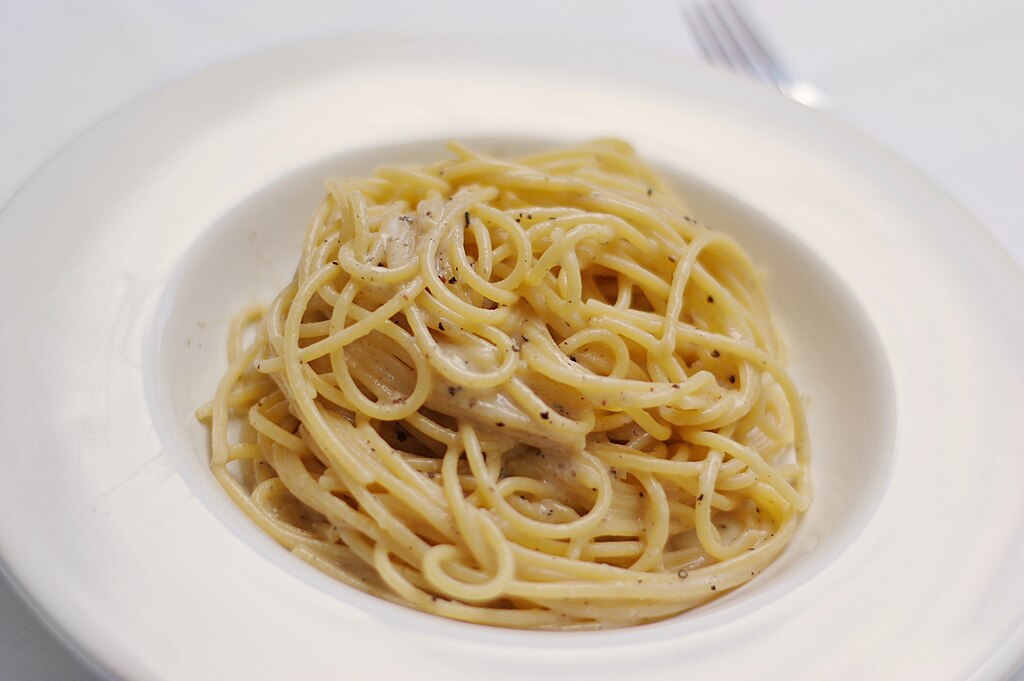
A group of Italian physicists have been awarded the 2025 Ig Nobel Prize in Physics for a study that tackles one of the country’s most cherished yet challenging dishes: cacio e pepe. Their work, carried out with colleagues from Austria, Germany and Spain, explores why the sauce sometimes turns creamy and delicious while other times it becomes clumpy and unpleasant.
The winning team included Giacomo Bartolucci, Daniel Maria Busiello, Matteo Ciarchi, Alberto Corticelli, Ivan Di Terlizzi and Fabrizio Olmeda. They received the prize, which honours research that first makes people laugh and then makes them think, for uncovering the physics behind the dish’s temperamental sauce.
The researchers found that the secret lies in the behaviour of starch and protein during cooking. At high temperatures, above around 65 °C, the proteins in Pecorino Romano begin to denature and aggregate, leading to clumps. The starch content of pasta water plays a critical role in preventing this. If it is too low, the sauce is unstable; if properly balanced, it helps the cheese emulsify into a smooth coating for the pasta.
To overcome this problem, the team proposed a simple fix: introduce extra starch and control the temperature more carefully. Their results showed that adding about 2–3% starch relative to the weight of the cheese, and mixing at lower heat, produces a consistently creamy result.
While cacio e pepe appears deceptively simple – pasta, Pecorino cheese, pepper and water – it has a reputation among cooks for being difficult to master. The research provides a scientific explanation for why this is the case, while also demonstrating how physics can illuminate everyday problems.
Try the Ig Nobel recipe for yourself!
For those wanting to apply the science in their own kitchen, the researchers suggest the following method:
- Mix a small amount of potato or corn starch (about 2–3% of the cheese’s weight) in water to form a gel.
- Keep the temperature moderate when adding cheese to avoid overheating beyond ~65 °C.
- Use starchy pasta water and reserve some for adjusting consistency.
- Mix gently, season with pepper and salt, then toss the pasta with the sauce in the pan.
The scientists described the project as light-hearted but also revealing. Fabrizio Olmeda, from ISTA in Austria, explained that even though their main work focuses on complex systems, this study proved that everyday phenomena can conceal deep and fascinating science.
The Ig Nobel Prizes are awarded annually to celebrate unusual achievements in science, medicine and technology. This year’s award for pasta sauce underlines not only the cultural importance of food in Italy, but also the power of curiosity-driven research to connect science with daily life.