Every year on 2 June, Italy celebrates Republic Day (Festa della Repubblica), marking one of the most significant moments in the nation’s modern history. On that day in 1946, Italians voted to abolish the monarchy and establish a republic, ending a turbulent period that had seen the rise of Fascism, the devastation of the Second World War and the collapse of Benito Mussolini’s regime.
The national holiday commemorates far more than a constitutional change. The referendum represented Italy’s rebirth as a democratic state and gave millions of citizens, including women voting nationally for the first time, a direct role in shaping the country’s future.
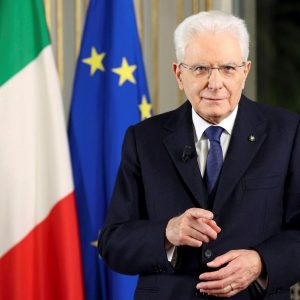
As Italy marked the 80th anniversary of the Republic in 2026, President Sergio Mattarella described the vote as “a turning point in the country’s history”, one that laid the foundations for a new democratic order based on freedom, equality and solidarity.
Italy before the Republic
To understand the significance of Republic Day, it is necessary to look at the decades that preceded it.
Italy had been a constitutional monarchy since national unification in 1861, ruled by the House of Savoy. Although the country possessed elected institutions, the monarchy remained at the centre of political life.
In 1922, Fascist leader Benito Mussolini came to power following the March on Rome. Over the following years, democratic institutions were dismantled, opposition parties were outlawed and Italy became a dictatorship. King Victor Emmanuel III remained head of state throughout the Fascist era and was widely criticised after the war for failing to prevent Mussolini’s rise and for allowing the regime to consolidate power.
The collapse of Fascism began in 1943. Mussolini was removed from office, Italy signed an armistice with the Allies and the country became a battlefield between Nazi forces, Fascist loyalists and the Italian Resistance. By 1945, the war had ended, but Italy faced enormous challenges. Its political system required rebuilding, its economy was devastated and many Italians questioned whether the monarchy could survive after its association with the Fascist period.
The historic vote of June 1946
On 2 and 3 June 1946, Italians were asked a simple but momentous question: should the country remain a monarchy or become a republic?
At the same time, voters elected the Constituent Assembly, the body tasked with drafting a new constitution for the post-war state. Nearly 25 million Italians participated in the vote, making it the first truly democratic national election after years of dictatorship.
When the results were announced, the republic won with more than 12.7 million votes against approximately 10.7 million for the monarchy. The result brought an end to almost 85 years of rule by the House of Savoy. King Umberto II, who had succeeded his father only weeks earlier, left Italy and began his long exile in Portugal.
For many Italians, the result symbolised a decisive break with the past. The country had rejected not only the monarchy but also the political failures that had allowed Fascism to flourish.
The first national vote for women
One of the most important aspects of the 1946 referendum was that it marked the first time Italian women participated in a national vote.
Women’s suffrage had been granted in 1945 following the fall of Fascism, reflecting both decades of campaigning and the important role women had played during the Resistance movement. On 2 June 1946, millions of women entered polling stations alongside men to help determine Italy’s future.
The election also produced another historic milestone. Twenty-one women were elected to the Constituent Assembly, where they became known as the “Madri Costituenti” – the Mothers of the Constitution. Their contributions helped shape constitutional protections relating to equality, family rights, employment and political participation.
Their influence can still be seen in Article 3 of the Constitution, which established the principle that all citizens possess equal social dignity and are equal before the law regardless of sex, race, language, religion or political opinion.
Writing a new Constitution
The referendum was only the beginning of Italy’s democratic transformation.
The Constituent Assembly, elected alongside the referendum, consisted of 556 representatives drawn from the major anti-Fascist political forces that had emerged after the war. Their task was to create a constitutional framework capable of preventing the return of dictatorship and safeguarding democratic freedoms.
Debates within the Assembly reflected the diversity of post-war Italy. Christian Democrats, Socialists, Communists, Liberals and other political groups often disagreed sharply, but they shared a determination to build democratic institutions strong enough to withstand future crises.
After eighteen months of discussion and drafting, the Constitution was approved on 22 December 1947. It was promulgated five days later and entered into force on 1 January 1948.
The Constitution established Italy as a parliamentary republic, guaranteed fundamental rights and freedoms, and introduced a system of checks and balances designed to prevent the concentration of power. It also included Article 11, in which Italy repudiates war as an instrument of aggression, reflecting the lessons learned from two decades of dictatorship and global conflict.
Why Republic Day still matters
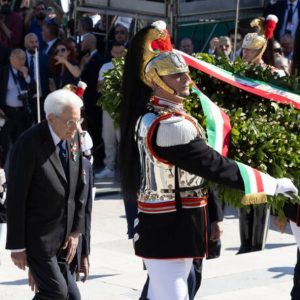
Today, Republic Day is celebrated across Italy with ceremonies, military parades and official events. The largest takes place in Rome, where the President of the Republic lays a wreath at the Tomb of the Unknown Soldier before attending the traditional parade along Via dei Fori Imperiali.