
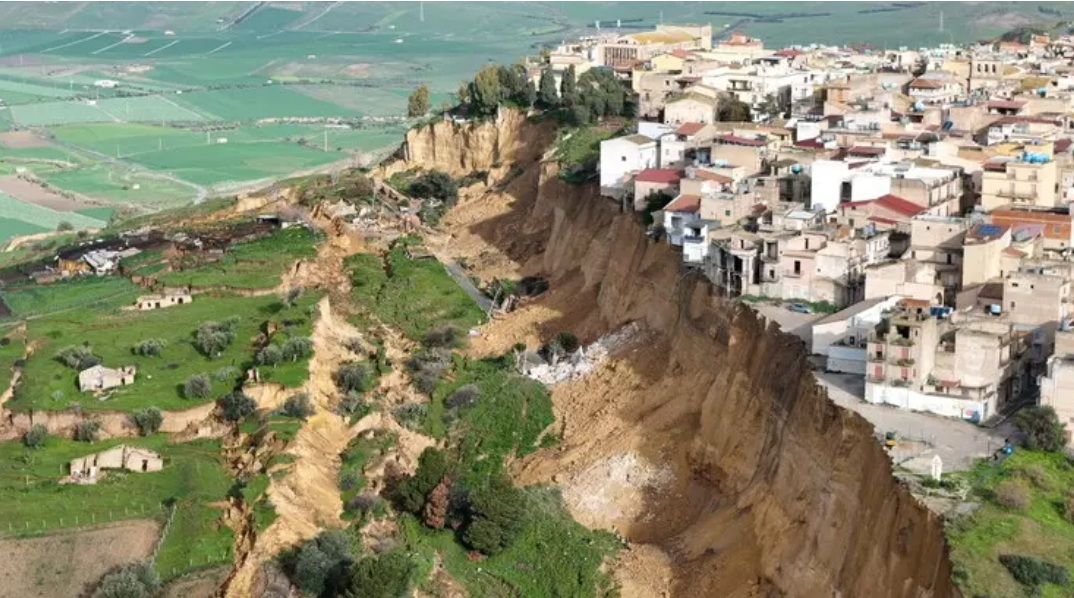
The premier returns to the landslide-hit Sicilian town of Niscemi four months on, as investigators examine authorisations granted over decades on an unstable hillside.
Premier Giorgia Meloni visited Niscemi on Thursday for the latest in a series of visits to the Sicilian town devastated by landslides in January. She told residents and the local council assembly that the government was ready to move swiftly with the resources already allocated. On Friday, the cabinet was due to formally approve two separate programmes worth €75 million each — one for land stabilisation and one for compensation to homeowners who lost their properties.
“We’re here today to tell you that we are, within a fairly rapid timeframe, ready to deploy the resources allocated by decree in February,” Meloni said during her address. “Tomorrow we’ll have another cabinet meeting, and we would like to approve two programmes worth €75 million each, the first for land safety, the second for compensation to homeowners.”
The premier drew an explicit contrast with the government response to Niscemi’s previous major landslide, in 1997. “We are doing things differently with respect to 1997, when the interventions were not planned and we are still paying the compensation today,” she told reporters.
A hillside in slow collapse
On 16 January 2026, a significant landslide struck Niscemi, in the province of Caltanissetta, causing initial critical issues in the western part of the town. On 25 January, a second, larger landslide reactivated an old fault line near the southern part of the town, impacting much of the local road network, compromising the stability of numerous buildings, and disrupting essential services. The mayor declared a red zone and ordered evacuations; approximately 1,500 residents were displaced, most housed by family members, with around 20 transferred to an emergency reception centre.
The situation has not stabilised since. Civil Protection Department chief Fabio Ciciliano has confirmed that the hill on which Niscemi sits is continuing to move slowly towards the plain where the city of Gela stands. For the most severely affected areas, there is no prospect of residents returning: the homes there will not be inhabitable again. The town of Niscemi sits on historically geologically unstable terrain — the ground is rich in clay soil with many slopes vulnerable to erosion.
The landslide’s total affected front stretches over five kilometres. In a further blow to community morale, a cross that had been erected along the landslide front as a symbol of hope collapsed in early February.
Investigations into past failures
The disaster has prompted a criminal investigation examining how decades of administrative decisions may have contributed to the crisis. Among the 13 people placed under investigation are the last four governors of Sicily, including the current incumbent, Renato Schifani, and his predecessor Nello Musumeci — now serving as civil protection minister in the Meloni government. The inquiry is focusing in part on authorisations granted for construction and other projects that, prosecutors allege, should never have been permitted on terrain of this fragility.


