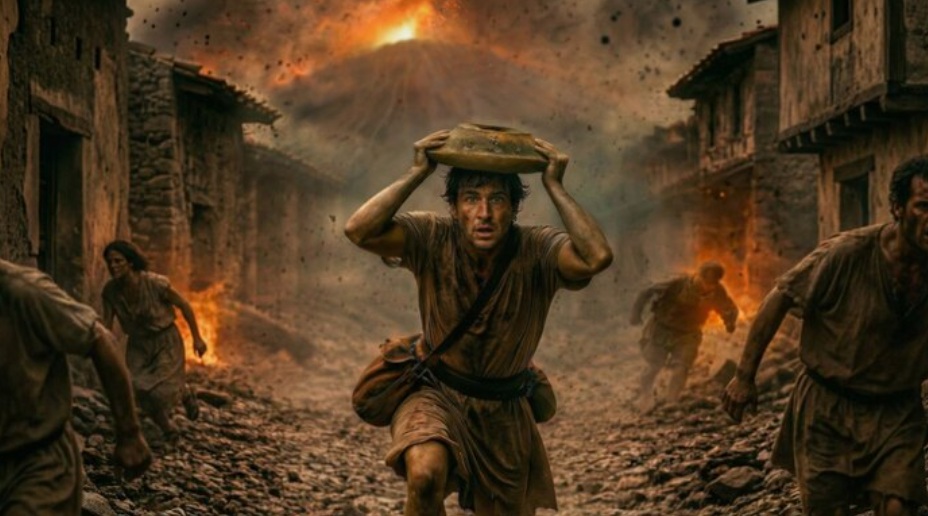
For the first time, the Pompeii Archaeological Park has used artificial intelligence (AI) to give a human face to one of history’s most documented catastrophes. It brings a fleeing man’s last hours to life through a collaboration between cutting-edge technology and rigorous archaeological science.
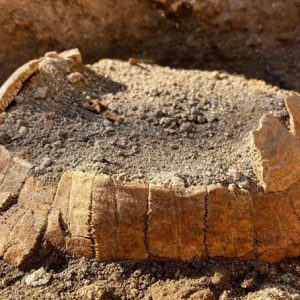
The man was was older. He was running toward the coast. He carried a lamp to see through the ash-darkened sky. A small iron ring on his left little finger, ten bronze coins, and, held above his head, a terracotta mortar, pressed into service as a makeshift shield against the rain of lapilli.
He didn’t make it.
Now, nearly two thousand years after the eruption of Vesuvius in 79 AD buried and preserved the ancient Roman city of Pompeii, this man — one of two whose remains were recently unearthed in excavations at the Porta Stabia necropolis, just outside the ancient city walls — has been given a face. It is the first time artificial intelligence has been used to digitally reconstruct the final moments of a Pompeii victim. The result is a collaboration between the Pompeii Archaeological Park and the University of Padua that its creators describe as both scientifically rigorous and genuinely accessible.
A Double Discovery
The two men were found together, fleeing in the same direction. The younger of the two was likely engulfed by a pyroclastic surge, the superheated, fast-moving cloud of ash and toxic gases that swept down the slopes of Vesuvius in the eruption’s later stages, killing with devastating speed. He would have had little warning and no chance.
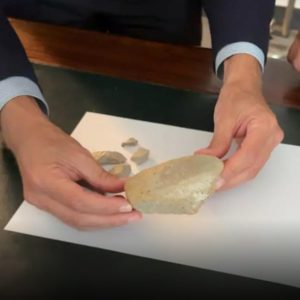
The older man’s fate arrived differently, and perhaps more slowly. He died in the earlier, heavier phase of the eruption, beneath a sustained shower of lapilli and volcanic fragments, the weight and force of which proved lethal. The terracotta mortar found beside his body had been held above his head, a practical if ultimately inadequate effort at protection. Alongside it lay the ceramic lamp, evidence of a man navigating by firelight through a world turned dark at midday, his iron ring, and the coins.
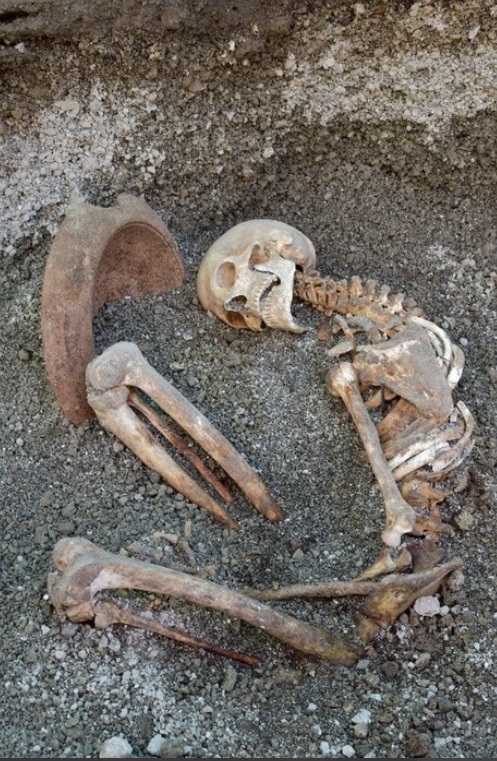
It is the older man who is the subject of the AI reconstruction.
Works of Pliny the Younger reimagined
The reconstruction draws on one of antiquity’s most famous eyewitness accounts. Pliny the Younger observed the eruption from across the Bay of Naples and later recorded it in two celebrated letters to the historian Tacitus. He described in vivid detail how those fleeing Vesuvius tied cushions or other objects to their heads to protect themselves from the falling debris. The terracotta mortar found beside the older victim is a precise material echo of Pliny’s account.
The digital model was generated through a combination of artificial intelligence and photo editing techniques. The explicit goal was to produce an image that is both scientifically defensible and accessible to a non-specialist audience. The Pompeii Archaeological Park is clear that this is not dramatisation for its own sake. Archaeologists from the Ministry of Culture conducted the underlying work. Furthermore, the AI tools were applied under rigorous scholarly supervision. The resulting image serves as a bridge between specialist research and the broader public.
‘Archaeologists must take charge of it themselves’
The project has prompted reflection not only on what AI can do for archaeology, but on who should be doing it. Pompeii Archaeological Park Director Gabriel Zuchtriegel was direct on the point. “The vastness of archaeological data at Pompeii is now such that only with the help of artificial intelligence will we be able to protect and enhance it. And it’s important that we archaeologists take charge of it ourselves, because otherwise others will do it in our place, lacking the necessary humanistic and scientific background.”
Professor Jacopo Bonetto of the University of Padua, who led the collaborative element of the project, described it as opening “a broader discussion on the use of AI in archaeology — a technology that can contribute to improving communication tools.” The emphasis on communication is significant. Pompeii already attracts millions of visitors a year and generates vast quantities of new data with every season of excavation. The challenge is no longer simply one of discovery, but of interpretation, presentation, and preservation at scale.
Professor Luciano Floridi, founding director of the Digital Ethics Center at Yale University, offered a wider perspective. “Two thousand years later, AI is helping us reconstruct the final moments of Pompeii. Artificial intelligence does not replace archaeologists. Under their control, it expands their potential and makes accessible to many what was previously only accessible to a few.”
Pompeii a prestigious site

Culture Minister Alessandro Giuli, who has been among the more vocal champions of technological innovation in Italy’s cultural heritage sector, offered his assessment of the find and its wider implications. “Pompeii is perhaps the most prestigious site in the world for archaeological research, where each new discovery excitingly illuminates the fabric of ancient life. The investigations conducted with these excavations demonstrate that innovative methodologies, used rigorously, can give us new historical perspectives.”
The Porta Stabia necropolis, where the two men were found, lies just outside the ancient city walls. It is an area that has yielded significant finds in recent years as excavation works associated with the wider Great Pompeii Project have pushed further into previously unexplored terrain. The site continues to produce new evidence about life and death in one of the ancient world’s most intensively studied urban centres.