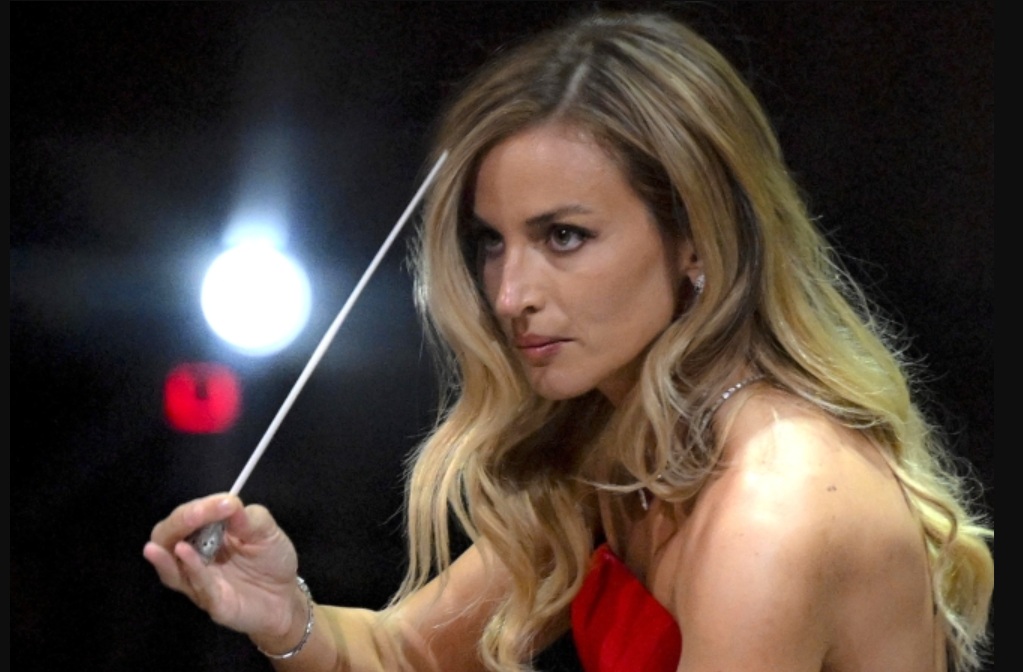
Venice’s storied opera house has terminated all ties with its controversial music director-designate Beatrice Venezi after comments she made to an Argentine newspaper. Venezi’s interview brought months of bitter conflict to an abrupt head and sparked scenes of jubilation inside the theatre itself.
Beatrice Venezi’s tenure as music director of Teatro La Fenice is over before it began. On Sunday 26 April, the foundation that runs Venice’s legendary opera house announced it had cancelled all future collaborations with the 36-year-old conductor.
The immediate trigger was an interview Venezi gave on 23 April to the Argentine daily La Nación, a newspaper with which she has ties through her role as guest conductor at Buenos Aires’s Teatro Colón. In the interview, Venezi accused La Fenice of nepotism, saying: “I have no patrons. I do not come from a family of musicians. And this is an orchestra in which positions are passed down practically from father to son.”
The words landed like a grenade inside the institution. The theatre’s workers’ union swiftly condemned the statements as “grave, false and offensive” and incompatible with the conditions necessary to build a relationship of trust and productive artistic collaboration.
The Firing
Superintendent Nicola Colabianchi announced the termination, stating, “The decision was reached in part as a result of repeated and grave public statements made by the Maestro; statements deemed offensive and detrimental to the artistic and professional standing of the Teatro La Fenice Foundation and its Orchestra. These assertions, with whose substance and expressed judgments the Foundation does not concur, are incompatible with the Foundation’s principles and with the protection and respect due to the members of the Orchestra.”
The decision carried a particular irony. Colabianchi had been among Venezi’s most steadfast defenders since her controversial appointment in September 2025. He was the superintendent who had designated her, championing the choice as “an investment in the future” and citing what he called the “symbolic value” of appointing a young woman to one of Italy’s most prestigious podiums.
Culture Minister Alessandro Giuli, who had also previously backed the appointment, moved swiftly to distance the government from the fallout. He expressed “full confidence” in Colabianchi and said he hoped the decision would “clear the field of misunderstandings, tensions and instrumentalisation of every order and degree in the interest of the theatre and the city of Venice.”
Scenes of jubilation at the Fenice
The news broke on Sunday evening just as La Fenice‘s closing night performance of Wagner’s Lohengrin, conducted by Markus Stenz, was getting under way. Word spread quickly through the house during the first interval, with audiences pulling out their phones and passing the news from person to person. A unanimous ovation followed, with some audience members going to congratulate the orchestral musicians in person. Among the players themselves, the enthusiasm was obvious, with violinists raising their instruments aloft in celebration.
The orchestra joined the public in sustained applause and cries of joy at the news.
A controversy seven months in the making
The roots of the crisis stretch back to 22 September 2025, when Venezi was appointed as La Fenice’s permanent music director with a four-year mandate set to begin in October 2026. The decision immediately ignited fierce opposition from the theatre’s musicians and staff, who raised concerns not only about the political nature of the appointment but about the conductor’s artistic credentials.
Critics noted that Venezi had never before led a major opera house orchestra. The orchestra and chorus took repeated industrial action. A strike in October 2025 led to the cancellation of the premiere of Wozzeck, and a workers’ procession in November drew in staff from other Italian theatres. Protest spilled into the auditorium too, with musicians wearing lapel pins bearing a treble clef symbol and audience members showering the stalls with leaflets.
The appointment also produced a string of high-profile resignations. Domenico Muti, son of the celebrated conductor Riccardo Muti, stepped down as a theatre consultant, as did board member Alessandro Tortato, who had been appointed by the government.
So raw did feeling run that, for the first time in La Fenice’s history, the public had explicitly called for the superintendent’s resignation before the start of a concert — at an Easter Friday performance earlier this month.
Politics, gender and the Meloni connection
The appointment was contentious from the outset, not least because of Venezi’s well-documented proximity to Prime Minister Giorgia Meloni. Shortly after Meloni came to power in 2022 as Italy’s first female prime minister, she named Venezi as her government’s musical advisor. The conductor had since received both public praise from Meloni and an award from her Brothers of Italy (FdI) party.
Venezi’s father is a former far-right militant, a biographical detail that contributed to the politicisation of the dispute and made it difficult to separate questions of artistic merit from political allegiance. Critics on the left argued her curriculum was too thin for a post of La Fenice’s stature. Britain’s Daily Telegraph, by contrast, argued that she was the victim of sexism, misogyny and reverse ageism.
Venezi herself had made the gender dimension central to her public case, insisting on being addressed as “direttore” rather than “direttrice” — a longstanding personal position. She also presented her appointment as a blow struck for female representation in classical music.