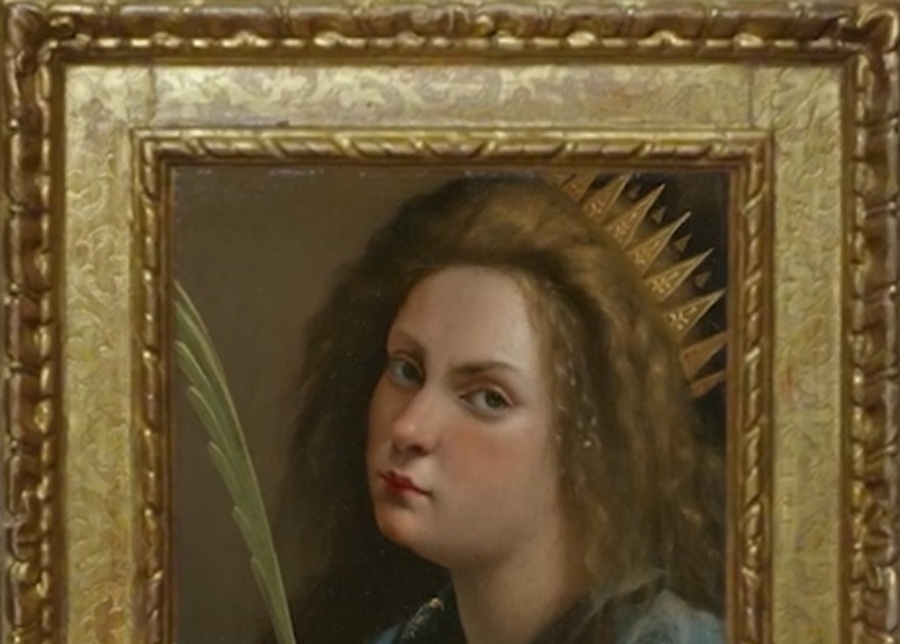
A rare Artemisia Gentileschi self-portrait will go under the hammer at Christie’s New York on 4 February 2026, as part of its Old Masters sale during Classic Week. The painting, Self-Portrait as Saint Catherine of Alexandria, will be on public view at Christie’s Rockefeller Center galleries from 29 January. The sale estimate is between $2.5 million and $3.5 million.
Artemisia Gentileschi remains one of the most compelling figures in European art history, not only for the quality of her work, but for the life she forged in a world almost entirely dominated by men. While she was not the first professional woman painter in Italy, her career stands apart for its ambition, independence and sustained success across several major cultural centres.
Who was Artemisia Gentileschi?
Born in Rome in 1593, Artemisia was the daughter of the painter Orazio Gentileschi, who trained her in his studio. Like most unmarried women of her social class, she lived a largely secluded life and had little access to formal artistic networks. Her early development took place almost entirely within the domestic sphere, yet her talent emerged rapidly.
Art historian Elizabeth Cropper has argued that Artemisia’s unusual position worked in her favour. With no formal artistic education to unlearn, she absorbed technical skills quickly and developed a distinctive visual language at a young age.
Her life changed decisively after the highly publicised rape trial of 1612, in which fellow painter Agostino Tassi was found guilty of assaulting her. Shortly afterwards, Artemisia left Rome and moved to Florence. There she established her own studio and began to build an independent career.
Florence proved crucial. Between 1613 and 1620, Artemisia secured commissions from prominent collectors, including members of the Medici family. She moved in elite intellectual circles that included Galileo Galilei and Michelangelo Buonarroti the Younger. In 1616, she became the first woman admitted to the Accademia delle Arti del Disegno, one of Europe’s most prestigious artistic institutions.
It was also in Florence that Artemisia began to use her own image in her work. Several of her paintings from this period feature disguised self-portraits, in which she appears as musicians, saints or allegorical figures. This was partly a practical choice, as hiring models was expensive, but it was also a calculated form of self-promotion.
By inserting herself into her compositions, Artemisia shaped her public identity as both subject and author. This strategy anticipated later artists such as Rembrandt, who repeatedly painted himself in different guises, and even modern figures like Cindy Sherman, whose work centres on constructed identity and role-playing.
Gentileschi self-portrait as Saint Catherine of Siena
The painting offered at Christie’s depicts Artemisia as Saint Catherine of Alexandria, a fourth-century Christian martyr. Catherine is traditionally portrayed holding a palm frond, symbolising martyrdom, and a broken wheel, the instrument of her attempted execution. Artemisia adopts both attributes, while giving the saint her own facial features.
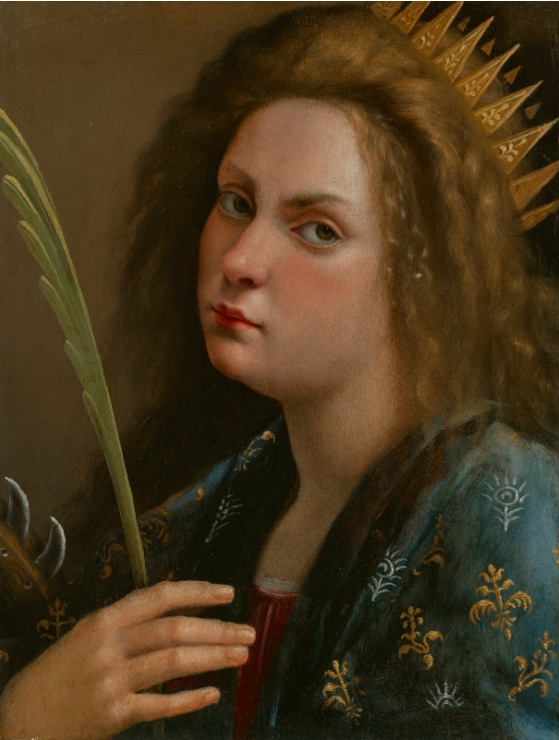
The choice of subject was significant. According to Christian legend, Catherine defeated fifty philosophers in public debate before being condemned by the Roman emperor. She became a symbol of intellectual authority and moral resistance. By merging her own likeness with Catherine’s, Artemisia aligned herself with a figure defined by learning, resilience and defiance of power.
Many of Artemisia’s most famous works centre on women from biblical or classical narratives, including Judith, Susanna and Cleopatra. While these subjects were common in Baroque art, her treatment of them was not. She portrayed her female protagonists with psychological depth and physical agency, often confronting violence, injustice or authority head-on.
Proto-feminist icon
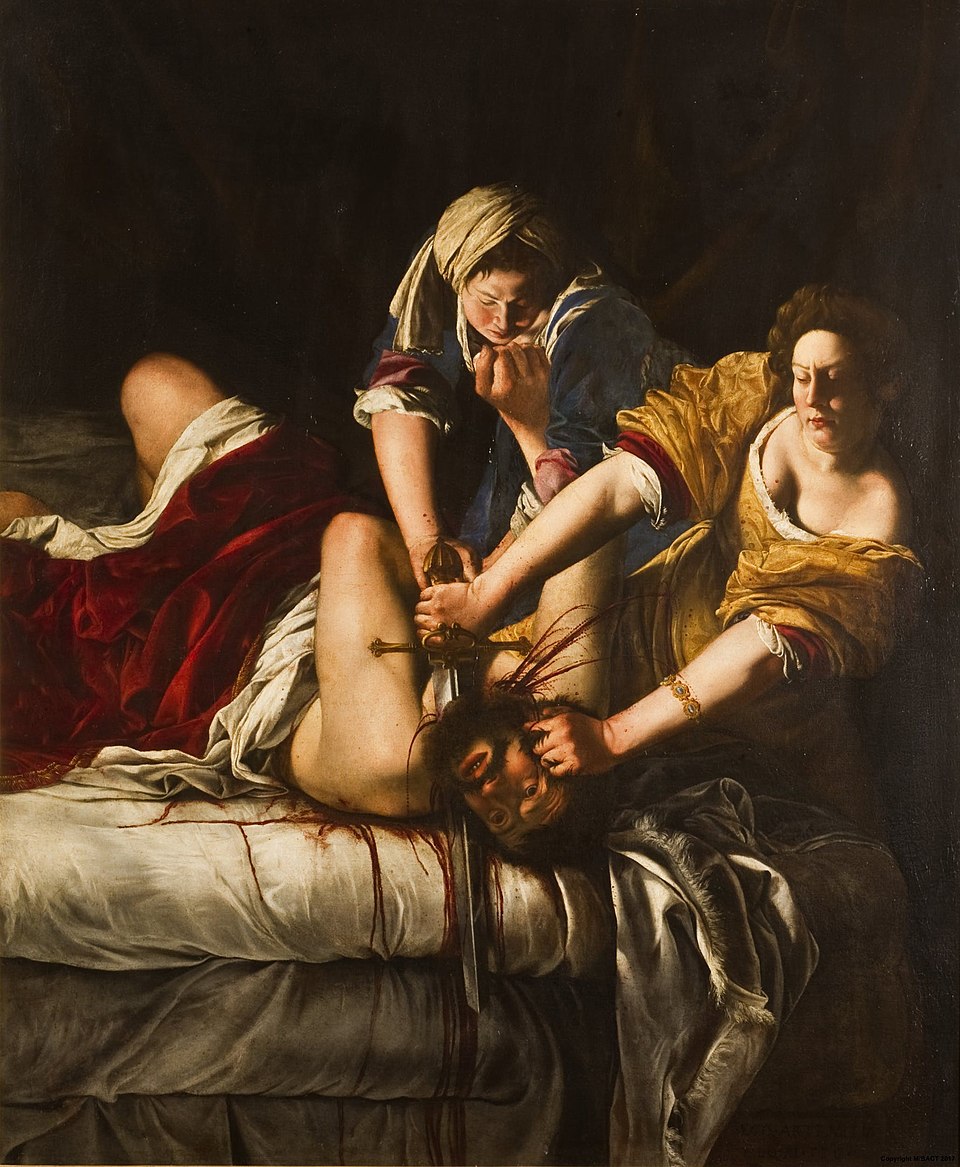
This perspective has contributed to her modern reputation as a proto-feminist icon. Her Judith beheading Holofernes, now one of the most recognised images of the Baroque period, depicts the act with brutal realism and emotional intensity. It has been widely interpreted as a radical inversion of traditional power structures in art.
Interest in Artemisia surged in the 1970s, driven by feminist art historians seeking to recover overlooked women artists. She featured in the landmark exhibition Women Artists, 1550–1950 in 1976 and in Judy Chicago’s installation The Dinner Party. The latter symbolically restored women to the historical canon.
Her wider public recognition accelerated after the National Gallery in London acquired its own version of Self-Portrait as Saint Catherine of Alexandria in 2018, followed by a major retrospective in 2020. That same year, Artemisia became the second most Googled female artist in the world, surpassing male figures such as Picasso and Velázquez in overall rankings.
Today, her influence extends beyond museums. An opera based on her life is due to premiere in Germany in 2028, with performances planned across Europe, including London. Her work continues to inspire new generations of artists, scholars and audiences.
The self-portrait coming to auction in New York offers a powerful example of how Artemisia shaped her own legacy. It is both devotional image and personal statement, blending religious symbolism with artistic self-assertion.