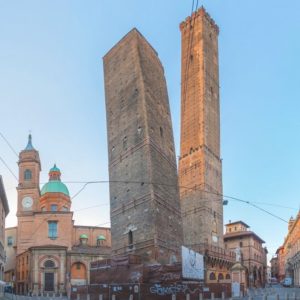
In the medieval city of Pisa, known for its iconic Leaning Tower, the story of St. Bona of Pisa unfolds as one of devotion, travel, and remarkable spiritual journeys. Recognised as the patron saint of tour guides and the city of Pisa, she continues to inspire those who wander and those who guide.
St. Bona was born around 1156 in Pisa, Italy, into a pious and noble family. From an early age, Bona exhibited profound religious fervour and a deep desire to serve God. By the age of ten, she had dedicated herself as an Augustinian tertiary, committing to follow the Rule of Saint Augustine and lead a life of penance and fasting.
Her spiritual journey began with a series of mystical experiences, including visions of St. James the Apostle. This saint would later play a significant role in her life’s mission.
Mystical Experiences
It is said that when Bona was about seven years of age, the figure on a crucifix in a church held its hand out to her, an event that profoundly impacted her faith. A few years later, at another church, she saw a vision of Jesus, the Virgin Mary, and three saints. Frightened by the light surrounding these figures, she ran away, but St. James the Great followed her and led her back to the image of Jesus. This experience solidified her lifelong devotion to St. James the Great.
Pilgrimages
When Bona was 14, she made the first of her many overseas trips, visiting Jerusalem. On her journey home, she faced a harrowing ordeal when she was captured by Muslim pirates in the Mediterranean. Wounded and imprisoned, Bona’s steadfast faith saw her through this difficult period until she was rescued by other travellers.
Bona’s calling led her to undertake numerous pilgrimages, often under perilous conditions. Her most notable journeys were to Santiago de Compostela in Spain, a major pilgrimage site dedicated to St. James.
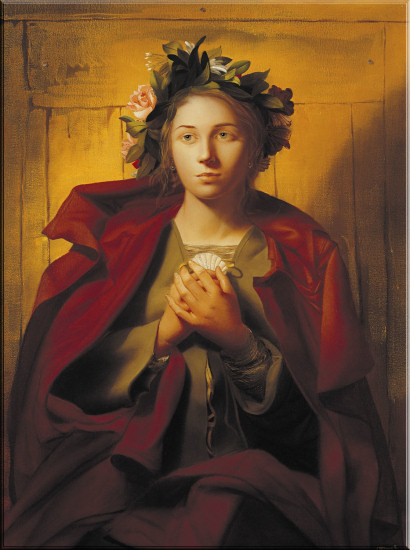
She is said to have completed the arduous trek nine times, a feat that underscores her extraordinary dedication and resilience. In the image below, you can see she is holding a shell, symbol of the Camino de Santiago.
She also made significant pilgrimages to Rome and the shrine of Monte Sant’Angelo sul Gargano.
On these pilgrimages, Bona served as a guide and protector to fellow travellers. Her leadership was marked by compassion and an unyielding spirit, qualities that earned her the respect and admiration of those she led. In an era when travel was fraught with danger, Bona’s role as a guide was invaluable. She not only provided practical assistance but also spiritual support.
Later Life and Legacy
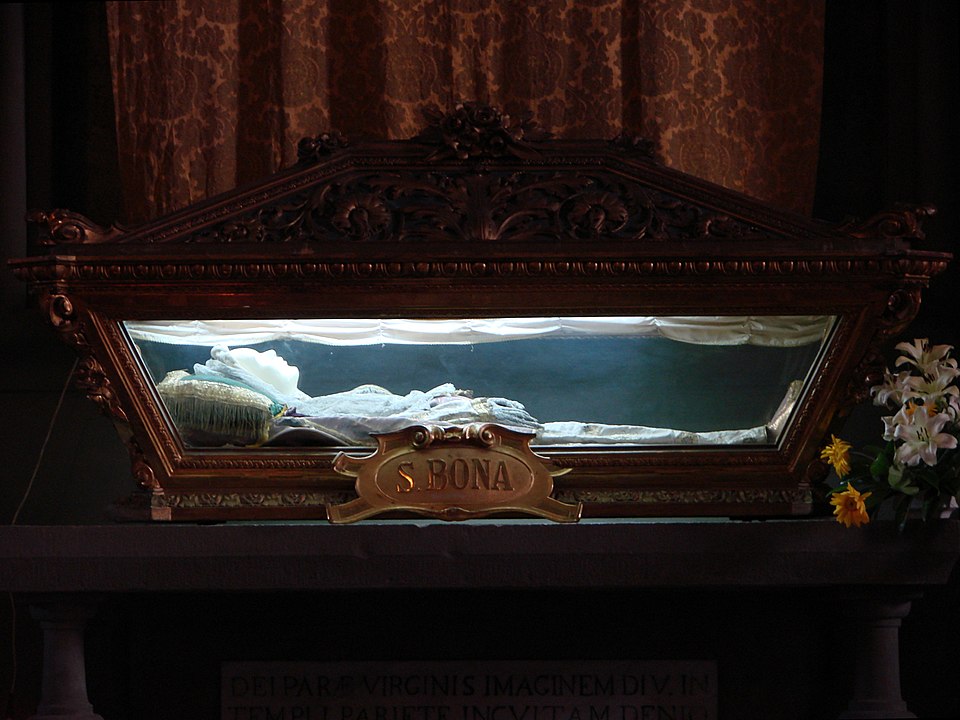
In her later years, Bona continued her service to the Church and her community in Pisa. She joined the Augustinian nuns and spent her remaining days in prayer and contemplation. Bona passed away around 1207; her remains preserved in a glass case in the church of San Martino in Pisa.
In 1962, Pope John XXIII canonised St. Bona, formally recognising her contributions to the faith and her exemplary life of service. Today, she is venerated as the patron saint of tour guides, for her role as a spiritual and literal guide for pilgrims.
Her feast day is celebrated on May 29th, a time for reflection on the virtues of perseverance, faith, and guidance.